



Reliable temperature measurement is essential wherever electrical equipment, industrial machinery, and high-energy assets must operate safely and continuously. A small increase in temperature can indicate excessive electrical resistance, loose connections, overloaded conductors, deteriorating insulation, poor ventilation, mechanical friction, or an approaching equipment failure. In high-voltage environments, however, direct inspection is often difficult, disruptive, or unsafe. A wireless sensor that can be mounted directly on a monitored surface provides an efficient way to collect temperature information without requiring frequent manual inspection or complex signal cabling.
The magnetic-attachment wireless temperature measurement sensor, model KL-DS31YS, is designed for this type of application. It combines a PT1000 temperature-sensing element, low-power electronics, wireless communication, a lithium battery, and magnetic fixation in a compact industrial device. Its measurement range extends from -40 to +200 degrees Celsius, while its stated accuracy is plus or minus 1 degree Celsius. The sensor samples temperature at a default interval of 10 seconds and transmits collected information to a wireless temperature measurement host through a LoRa communication network.
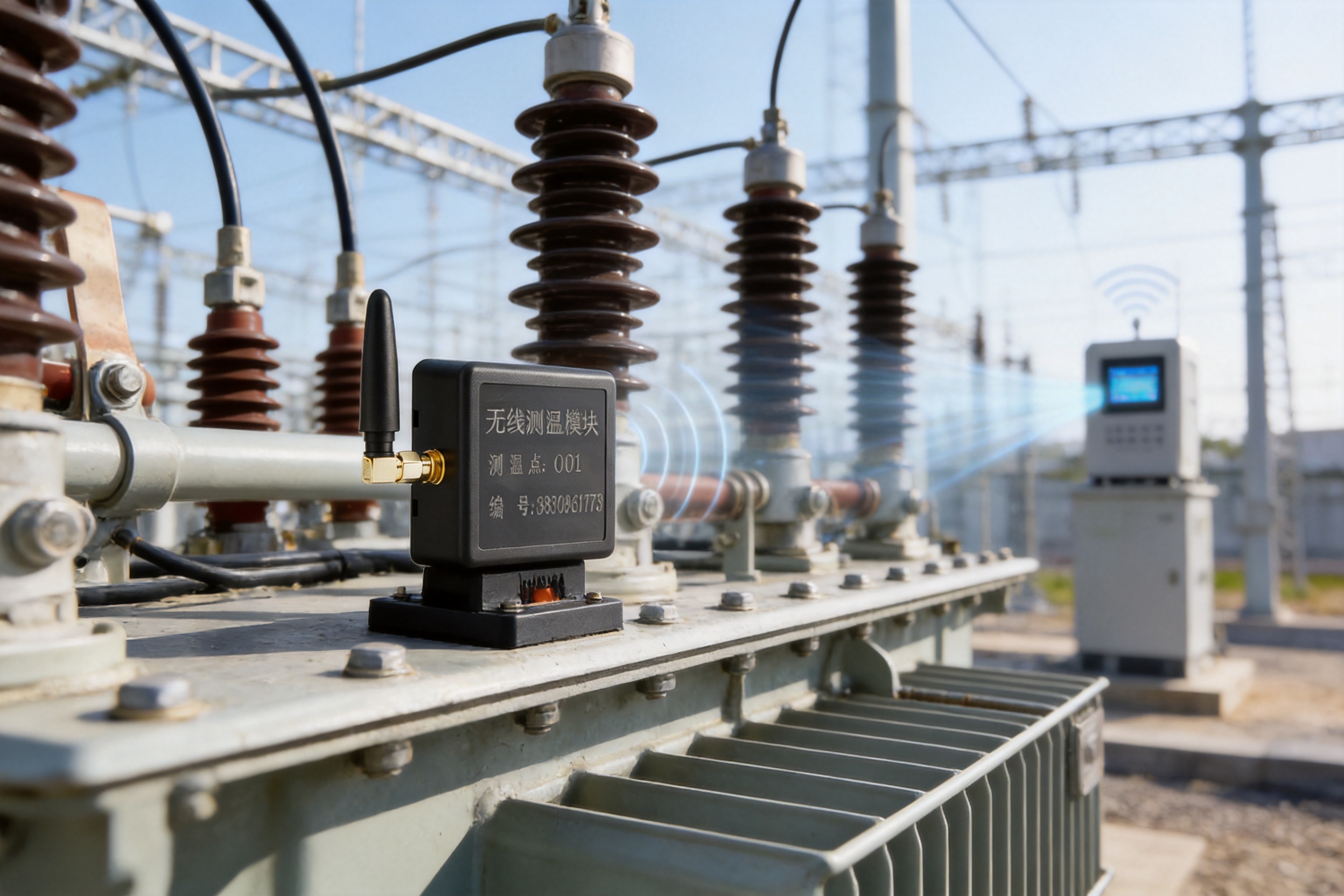
This combination of broad temperature coverage, wireless installation, low power consumption, and magnetic mounting makes the sensor suitable for outdoor isolating switches, wall-penetrating cable clamps, transformer terminals, flexible copper busbar connections, motors, industrial production equipment, and other locations where wired measurement is inconvenient or hazardous.
Why Surface Temperature Monitoring Matters
Electrical and mechanical systems rarely fail without warning. In many cases, abnormal heat develops before smoke, insulation damage, a visible change in equipment condition, or a complete shutdown occurs. Monitoring temperature at important points allows operators to identify abnormal trends while there is still time to inspect, repair, or redistribute the load.
High-voltage switchgear and outdoor disconnect switches are examples of equipment that can benefit from continuous temperature monitoring. Their conductive joints, terminals, and contact points may gradually develop increased resistance because of oxidation, vibration, aging, thermal cycling, or insufficient mechanical pressure. Under normal operating conditions, the resulting heat may be difficult to detect from outside the enclosure or at ground level. A sensor installed directly at the relevant point can provide more useful information than occasional visual inspections.
Transformers and busbar systems also have multiple connection points where heat can build up. A temperature sensor can be installed on the surface of an inlet or outlet terminal, a flexible copper connection, or another accessible component. The collected data can then be reviewed by a local monitoring host or integrated into a wider industrial monitoring system.
In production environments, temperature monitoring is equally important for motors, processing equipment, control cabinets, and other assets. Unexpected temperature increases may reveal overload, inadequate cooling, bearing problems, blocked ventilation, or a change in operating conditions. Continuous wireless monitoring supports condition-based maintenance by allowing maintenance teams to focus attention on equipment that shows meaningful changes rather than inspecting every asset at the same frequency.
Product Overview
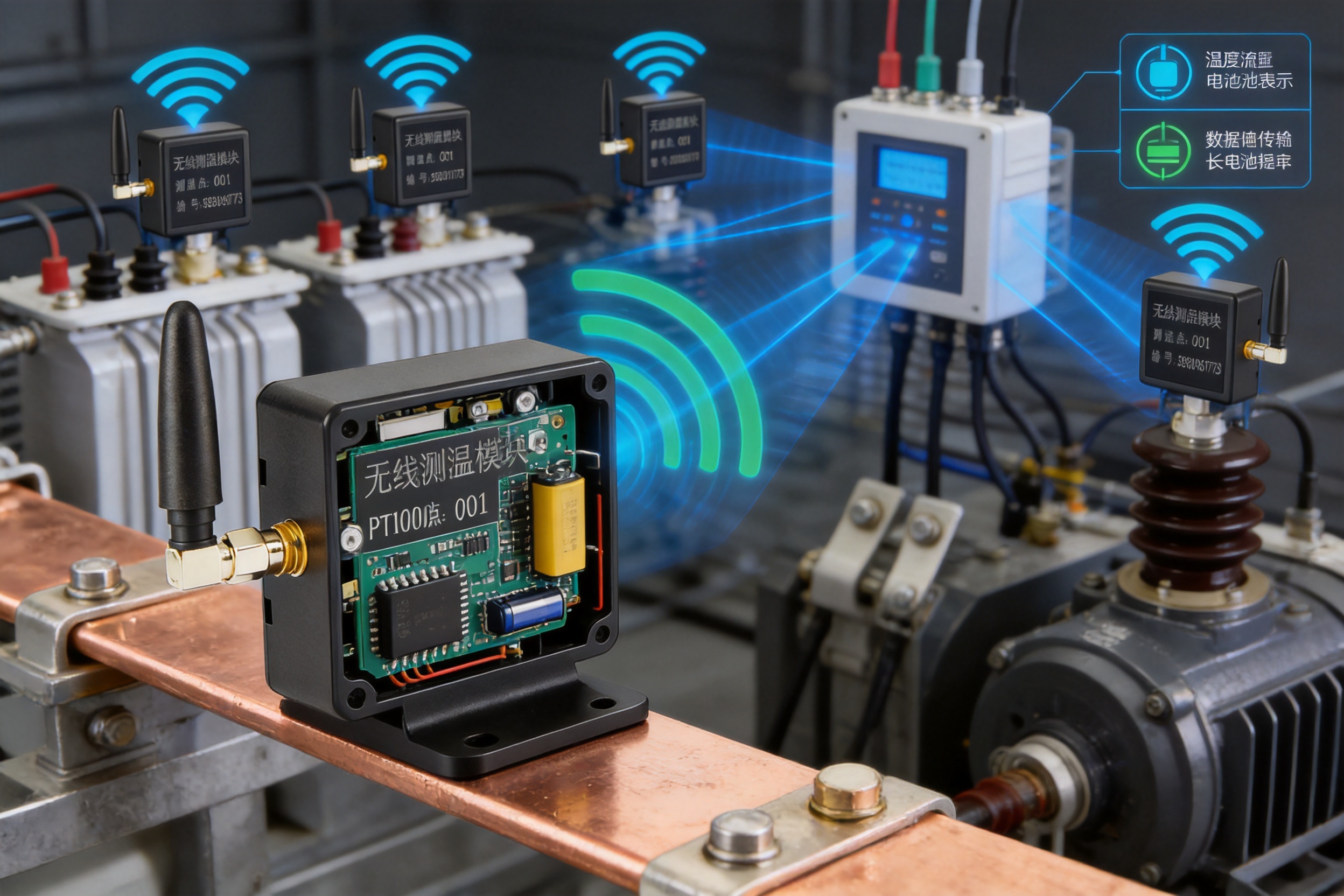
The KL-DS31YS is a single-channel wireless temperature sensor intended for measuring the temperature of a monitored surface or contact. Its internal architecture includes a temperature sensor, signal modulation and amplification circuitry, a logic control circuit, a wireless communication circuit, a lithium battery, and an antenna. These elements work together to acquire temperature data, process the signal, manage power use, and transmit readings over a wireless network.
The sensor uses a PT1000 thermistor-based sensing element. The PT1000 designation identifies a platinum resistance temperature detector with a nominal resistance of 1,000 ohms at zero degrees Celsius. Platinum sensing elements are widely valued for predictable resistance behavior, stable measurement performance, and suitability for industrial temperature applications. In this product, the sensing element is combined with signal conditioning and digital control electronics to support practical wireless operation.
The sensor is designed for ultra-low-power operation. This is important because the device is powered by an internal lithium battery rather than a continuously connected external power supply. The stated battery lifespan is five to eight years, depending on operating conditions, communication activity, environmental factors, and other application variables. A long service interval reduces the need for frequent access to high-voltage equipment and helps lower maintenance effort.
One of the product’s notable functions is battery voltage self-testing. In addition to measuring the temperature of the monitored object, the sensor detects its internal battery voltage and reports that information to the wireless temperature measurement host. This provides an additional maintenance indicator. Operators can identify a declining power source before it causes communication loss or an interruption in temperature data.
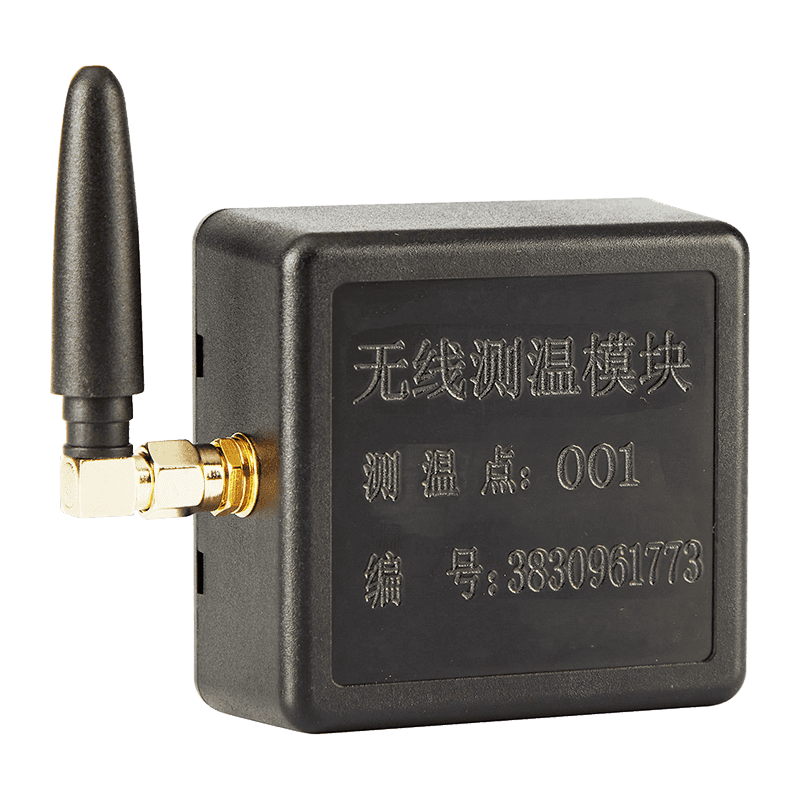
Magnetic-Attachment Wireless Temperature Measurement Sensor
Core Technical Specifications
| Parameter | Specification | Operational Significance |
|---|---|---|
| Product model | KL-DS31YS | Single-channel wireless temperature sensor |
| Temperature measurement range | -40 to +200 degrees Celsius | Supports cold outdoor conditions and high-temperature industrial applications |
| Measurement accuracy | Plus or minus 1 degree Celsius | Suitable for monitoring temperature changes and abnormal heat development |
| Temperature-sensing element | PT1000 | Provides stable and repeatable resistance-based temperature measurement |
| Default sampling frequency | Every 10 seconds | Provides frequent updates for condition monitoring |
| Communication method | LoRa | Supports low-power wireless transmission over industrial monitoring areas |
| Wireless frequency | 470 to 510 megahertz | Designed for the specified wireless communication band |
| Wireless transmission distance | Up to 800 meters | Helps cover dispersed equipment where radio conditions permit |
| Battery lifespan | Five to eight years | Reduces maintenance frequency compared with short-life battery devices |
| Installation method | Magnetic fixation | Enables fast attachment without extensive mechanical modification |
| External dimensions | 85 millimeters by 85 millimeters by 34 millimeters | Compact form factor for installation on equipment surfaces |
The specification profile is balanced for industrial monitoring. The temperature range is wide enough for outdoor equipment, electrical connection points, and many industrial machines. The 10-second default sampling interval provides a current view of temperature behavior without requiring the sensor to operate continuously at a high power level. The wireless range of up to 800 meters can be useful in substations, factories, equipment yards, and other facilities where sensors are distributed across a broad area.
The stated transmission distance should be interpreted as an application-dependent maximum. Actual performance can be affected by equipment density, metal structures, walls, enclosures, antenna orientation, electromagnetic conditions, terrain, and local radio requirements. A site survey and communication test are recommended before large-scale deployment.
Magnetic Fixation for Faster Installation
Traditional wired temperature sensors may require cable routing, drilling, brackets, terminals, conduit, and protective insulation. These requirements can increase installation time and create additional work around energized or difficult-to-access equipment. Magnetic fixation offers a simpler alternative when the monitored surface is compatible with magnetic attachment.
The magnetic mounting method allows the sensor to be positioned directly on suitable metal surfaces or components. This is especially useful for outdoor switches, transformer terminals, exposed conductive connections, and other locations where a sensor must be placed close to the heat source. Installation can often be completed without extensive structural modification, reducing the amount of mechanical work required at the site.
Magnetic attachment also supports more flexible maintenance. If a sensor must be replaced, repositioned, inspected, or temporarily removed, technicians can access the device without dismantling a complex cable assembly. This can shorten service operations and reduce the time personnel spend near operating equipment.
However, correct installation remains important. The mounting surface should be clean and suitable for stable contact. The sensor should be positioned so that it measures the intended thermal point rather than a nearby surface with a different temperature. The magnetic connection must be strong enough for the local vibration, weather exposure, and installation orientation. Where equipment surfaces are nonmagnetic, an appropriate mechanical adapter or alternative mounting arrangement may be required.
Wireless Communication for Difficult Industrial Locations
Wireless communication is a practical choice for equipment that is widely distributed, electrically isolated, mobile, or difficult to cable. The KL-DS31YS uses LoRa communication, a low-power wireless technology commonly selected for sensor networks that require extended range and modest data volumes.
Temperature monitoring does not usually require large data packets. A typical transmission includes the sensor identity, temperature value, battery voltage, and status information. This makes a low-data-rate communication method appropriate. The sensor can spend most of its operating time in a low-power state, wake at the configured sampling or transmission interval, measure the monitored point, process the result, and send the data to the host.
A wireless network also reduces the physical complexity of a monitoring installation. Instead of routing individual signal cables from every measurement point to a central cabinet, multiple sensors can communicate with a host through the designated radio network. This can reduce cable material, cable protection requirements, installation labor, and the number of penetrations into electrical or environmental enclosures.
The 470 to 510 megahertz frequency range and the stated transmission distance of up to 800 meters support broad-area monitoring where local radio conditions are suitable. The actual network design should account for the position of the host, the number of sensors, the construction of nearby buildings, metal obstructions, and the required data refresh rate.
For industrial users, the primary benefit is not simply the absence of wires. It is the ability to place sensors at locations that would otherwise be expensive, disruptive, or unsafe to connect. Wireless measurement makes it more practical to monitor a larger number of points and to expand a system as equipment priorities change.
Temperature Measurement Performance
The KL-DS31YS measures temperatures from -40 to +200 degrees Celsius. This range covers cold outdoor environments, normal operating temperatures of many electrical components, and elevated conditions associated with overloaded or deteriorating connections. The range also provides useful margin for applications where temperature may change significantly over the operating cycle.
With an accuracy specification of plus or minus 1 degree Celsius, the sensor is intended for practical industrial monitoring rather than laboratory calibration. The accuracy is appropriate for recognizing temperature increases, comparing similar connection points, identifying abnormal differences between phases, and observing the development of thermal conditions over time.
The default sampling frequency is 10 seconds. A reading at this interval can provide a reasonably detailed view of normal operating changes, load transitions, and temperature trends. It can also support alarm strategies based on sustained high temperature or rapid temperature increase when the wireless host and supervisory system are configured for those functions.
Temperature data should always be interpreted in context. Ambient temperature, load current, wind, enclosure conditions, solar radiation, equipment design, and the location of the sensor can all influence the reading. For this reason, the sensor is most valuable when used as part of a structured monitoring plan. Baseline temperatures should be established during normal operation, and alarm thresholds should be selected according to the equipment manufacturer’s guidance and the actual application.
Where several sensors are installed on comparable points, relative comparison can provide additional insight. If one phase connection or one terminal consistently operates at a higher temperature than similar points under the same load, maintenance personnel may have a reason to inspect that location. Trend analysis can also be more informative than a single isolated reading.
Advantages Compared with Conventional Wired Sensors
The first major advantage is simplified installation. Conventional wired systems require signal cables from the sensing point to a data acquisition device. In a high-voltage environment, those cables may need insulation, shielding, physical protection, separation from power conductors, and carefully designed routing. The magnetic wireless design avoids many of these requirements.
The second advantage is reduced intervention on existing equipment. Retrofitting a wired sensor can involve drilling, attaching brackets, opening cabinets, or modifying cable routes. A magnetic sensor can often be installed with limited mechanical change, which is valuable when equipment downtime must be minimized.
The third advantage is improved scalability. Adding a new measurement point to a wireless network generally requires installing the sensor and registering it with the host rather than extending a complete cable path. This makes it easier to begin with critical equipment and later expand monitoring to additional assets.
The fourth advantage is lower exposure to installation hazards. Any work around energized equipment must follow appropriate safety procedures, and wireless installation does not remove the need for qualified personnel or required isolation measures. Nevertheless, reducing cable work and mechanical modification can reduce the duration and complexity of field activity.
The fifth advantage is the inclusion of battery voltage self-testing. Some simple wireless sensors only report the measured process variable. A device that also reports its battery condition provides more complete information for maintenance planning. This is particularly helpful when sensors are installed at outdoor or high-level locations that are inconvenient to access.
Compared with short-range wireless sensors, the LoRa communication method and stated range of up to 800 meters may offer better suitability for distributed industrial sites. Compared with basic temperature transmitters that require continuous power, the low-power battery design can make installation possible in locations without a convenient local power source.
Advantages Compared with Basic Magnetic Temperature Devices
Magnetic mounting alone does not guarantee a useful industrial monitoring solution. A basic magnetic thermometer may display a local reading but lack network communication, battery diagnostics, historical data support, or integration with a central host. The KL-DS31YS is designed as a networked sensing component rather than an isolated indicator.
Its internal logic control circuit manages measurement and communication tasks, while the wireless circuit transmits data to a designated host. This makes the sensor suitable for multi-point monitoring, where operators need information from numerous devices rather than a reading from one location at a time.
The product also combines a broad temperature range with a PT1000 sensing element and a defined measurement accuracy. This is more appropriate for industrial condition monitoring than a low-cost consumer temperature device designed primarily for room or household use.
Another distinction is its intended installation environment. The product is specifically positioned for high-voltage contacts, busbar connections, transformers, outdoor switches, cable clamps, motors, and industrial equipment. Its application concept is therefore based on equipment condition monitoring, not simply ambient temperature display.
Low-Power Design and Long-Term Operation
Battery-powered industrial sensors must carefully balance measurement frequency, transmission frequency, radio performance, and service life. The KL-DS31YS is designed around ultra-low-power wireless operation. Its electronics can perform measurement and communication tasks while limiting unnecessary energy consumption between operating cycles.
The five-to-eight-year battery lifespan stated for the product can reduce the total maintenance burden in a large installation. If dozens or hundreds of sensors are deployed, frequent battery replacement can become a significant cost and logistical challenge. A longer expected service interval supports more predictable maintenance planning.
Battery lifespan is influenced by several factors. More frequent sampling or transmission, weak radio conditions, low temperatures, repeated communication retries, and environmental stress may reduce actual service life. The product’s default 10-second sampling setting should therefore be considered within the intended operating profile. Users should establish a replacement policy based on the application environment and battery-voltage data received from the sensor.
Battery self-testing adds an important layer of operational confidence. Maintenance personnel can review battery voltage alongside temperature data and identify devices that may require attention. This approach is more efficient than waiting for a sensor to stop communicating or scheduling unnecessary replacement visits at overly short intervals.
Industrial Applications
Outdoor Isolating Switches
Outdoor isolating switches may be exposed to rain, wind, dust, sunlight, temperature cycling, and mechanical vibration. Their contacts and connection points can develop abnormal heating as they age. A magnetic wireless temperature sensor can be installed on an appropriate conductive surface to support remote monitoring of operating temperature.
Transformer Inlet and Outlet Terminals
Transformer terminals carry substantial electrical current and may experience heat from load conditions, connection resistance, or environmental effects. Monitoring inlet and outlet terminal temperatures can provide useful information for comparing operating points and identifying unusual thermal behavior.
Flexible Copper Busbar Connections
Flexible copper busbars connect equipment while accommodating movement or mechanical arrangement. Their connection points should remain secure and thermally stable. Wireless temperature monitoring can help operators detect differences between similar connections and observe changes associated with load or contact condition.
Wall-Penetrating Cable Clamps
Cable clamps at wall penetrations may be difficult to inspect because they are located at boundaries between rooms, cabinets, or outdoor and indoor areas. A compact wireless sensor can collect temperature information without requiring a dedicated cable to be routed through the wall.
High-Power Motors
Motors and motor terminals may become hot because of excessive load, poor ventilation, connection problems, or changes in mechanical condition. The sensor can be used to monitor suitable external surfaces or electrical contacts, helping maintenance teams identify abnormal trends before a serious interruption occurs.
Industrial Production Equipment
Many production machines contain heated components, electrical terminals, drive assemblies, and process areas where temperature affects reliability. Wireless sensors can be deployed at selected points to support preventive maintenance and improve knowledge of real operating conditions.
Manufacturing and Engineering Strengths
The product is supplied by ASY Electronics, a high-technology enterprise focused on smart-factory development, industrial data sensing, and intelligent connectivity. Its stated product portfolio includes broadband power line carriers, wireless temperature monitoring systems, industrial transmitters, thermal gas mass flow meters, and automatic door controllers. This broad product scope is relevant because a wireless temperature sensor is most valuable when it can participate in a wider industrial data architecture.
The company’s engineering direction combines edge-layer hardware with industrial data integration solutions. In practical terms, this means that product development is not limited to the sensing element alone. The sensor must also address signal conditioning, embedded logic, wireless communication, power management, mechanical installation, and the transfer of useful information to a monitoring host.
A manufacturing process for this type of product requires coordination among electronic design, component selection, circuit assembly, firmware or logic control, wireless testing, mechanical assembly, battery integration, and functional inspection. Stable performance depends on more than the nominal specification of the PT1000 element. The complete device must maintain dependable signal processing and communication while operating with very low power.
The company’s focus on self-developed edge hardware is an important strength. Developing core hardware internally can help align the sensing circuit, communication circuit, power-management strategy, and application requirements. It can also support product customization for industrial users that need different sampling intervals, communication configurations, mounting arrangements, or integration approaches.
Industrial manufacturing quality should be considered across the complete production cycle. Incoming components need to be controlled and identified. Printed circuit board assemblies should be inspected for correct placement, solder quality, and electrical continuity. Wireless performance should be checked after assembly because antenna position, enclosure structure, and component variation can influence transmission results. Sensors should also undergo functional verification for temperature acquisition, battery-voltage measurement, communication, and power behavior.
Mechanical consistency is equally important. The magnetic attachment system must be assembled so that the sensor can be installed securely and removed when necessary. The enclosure dimensions must remain within the specified profile so that the device can be positioned in confined areas. Battery connections and internal wiring must be assembled carefully to support long service life under industrial conditions.
Product traceability is another valuable manufacturing practice. Recording model information, production batches, component sources, test results, and configuration data can simplify quality analysis and after-sales support. For large sensor deployments, traceability helps users identify the devices installed at particular sites and manage replacement or maintenance activities systematically.
Because ASY Electronics also develops industrial communication and monitoring products, it can approach the sensor as part of a broader equipment-management solution. This system-level perspective can help users connect temperature data with power-line communication, industrial transmitters, flow measurement, energy management, and other smart-factory functions.
Integration into a Smart Industrial Monitoring System
The sensor is intended to transmit collected data to a wireless temperature measurement host. The host acts as the receiving and management point for information from one or more sensors. Depending on the overall system design, the host may display current temperatures, store historical records, generate alarms, and forward information to a higher-level monitoring platform.
A practical deployment begins with asset selection. Operators should identify equipment where temperature information has the greatest safety, reliability, or maintenance value. Critical terminals, high-load connections, outdoor switching points, and components that are difficult to inspect are often good candidates.
The next step is measurement-point definition. The sensor should be positioned at a point that represents the thermal condition of interest. When multiple similar points exist, installing sensors in comparable positions can support phase-to-phase or equipment-to-equipment comparison.
After installation, baseline data should be collected. Normal temperature behavior may vary with load, weather, time of day, and operating mode. Establishing a baseline makes it easier to distinguish ordinary variation from an abnormal trend. Alarm settings should be based on equipment requirements and measured operating behavior rather than a generic threshold applied to every asset.
Data from the battery voltage self-test should be included in the maintenance process. A sensor with a declining battery voltage can be scheduled for service during planned maintenance instead of becoming an unexpected communication failure.
Installation and Deployment Recommendations
Only qualified personnel should install sensors near energized electrical equipment. The installation procedure must comply with the site’s electrical safety rules, access requirements, isolation procedures, and applicable regulations. Wireless technology does not eliminate electrical hazards.
Before fixing the sensor, inspect the selected surface. Remove loose dirt, oil, corrosion products, and other contamination that could reduce magnetic stability or impair thermal contact. Confirm that the surface is suitable for the intended mounting method.
Position the sensor as close as practical to the connection, contact, or surface being monitored. Avoid locations that are separated from the target by a substantial thermal barrier. The sensor should not be placed where it can be struck by moving components or where its enclosure interferes with normal equipment operation.
Check the communication path after installation. Confirm that the host receives temperature data and battery-voltage information from the sensor. If the signal is weak or intermittent, review antenna orientation, host location, metal obstructions, and nearby sources of radio interference.
Record the sensor identification, installation location, monitored component, installation date, and baseline temperature. This documentation improves the usefulness of future alarms and simplifies maintenance.
Where the sensor is installed outdoors, the site team should evaluate exposure to rain, condensation, dust, ultraviolet radiation, ice, and mechanical vibration. The product information provided here does not state a specific ingress-protection rating, so users should confirm environmental suitability for each outdoor application before deployment.
Maintenance and Data Interpretation
Wireless temperature monitoring is most effective when supported by a regular review process. Operators should examine current readings, historical trends, communication status, and battery voltage. A sudden temperature rise may require immediate investigation, while a slow increase over weeks or months may indicate progressive contact degradation or changing equipment conditions.
Readings should be compared with operating load and ambient conditions. A higher temperature during a high-load period may be expected, while a high temperature at a normal load may be more significant. Differences among comparable phases or connection points can also provide useful diagnostic information.
When an alarm occurs, the sensor reading should be treated as an indication for investigation rather than a complete diagnosis. Maintenance personnel may need to verify current, inspect the connection, check mechanical tightness, examine ventilation, and compare the reading with other measurement instruments.
The sensor itself should be inspected during planned equipment maintenance. Confirm that the magnetic attachment remains secure, the enclosure is not damaged, and communication remains stable. Review battery voltage and schedule replacement when the power source approaches the site’s defined service threshold.
Value for Smart-Factory Development
Smart factories depend on timely information from physical assets. A wireless temperature sensor provides a small but important data point that can support equipment health assessment, energy management, production continuity, and safety programs.
Temperature data can be combined with electrical load, vibration, pressure, flow, and process information to create a broader view of equipment condition. For example, a temperature increase that occurs together with higher current may have a different meaning from a temperature increase that occurs without a corresponding load change.
Wireless deployment also supports gradual digital transformation. A factory does not need to replace all existing equipment at once. It can begin with high-priority assets, collect meaningful data, and expand the monitoring network as the benefits become clear. Magnetic installation is particularly suitable for retrofit projects where existing equipment must remain in service.
The product’s compatibility with a broader portfolio of industrial communication and sensing technologies can further support system expansion. Power-line communication, transmitters, flow meters, automatic door controllers, and wireless temperature devices may be used as separate products or as elements of a coordinated industrial connectivity strategy.
Frequently Asked Questions
What type of sensor is the KL-DS31YS?
It is a single-channel magnetic-attachment wireless temperature sensor. It measures the temperature of a surface or contact and transmits the collected data to a wireless temperature measurement host.
What is the measurement range?
The stated temperature measurement range is -40 to +200 degrees Celsius.
What is the measurement accuracy?
The stated measurement accuracy is plus or minus 1 degree Celsius.
Which sensing element does the product use?
The sensor uses a PT1000 temperature-sensing element.
How frequently does it sample temperature?
The default temperature sampling frequency is one measurement every 10 seconds. The final operating behavior should be confirmed according to the system configuration and application requirements.
How does the sensor communicate?
It uses LoRa wireless communication in the specified 470 to 510 megahertz frequency range. The sensor sends its detected data to a wireless temperature measurement host.
What is the wireless transmission distance?
The stated wireless transmission distance is up to 800 meters. Actual distance depends on buildings, metal structures, antenna orientation, interference, equipment placement, and local radio conditions.
How long can the battery operate?
The stated battery lifespan is five to eight years. Actual lifespan depends on sampling and transmission settings, radio conditions, temperature, communication retries, and other operating factors.
Does the sensor report battery condition?
Yes. The sensor includes a battery voltage self-test function and can transmit internal battery-voltage information to the wireless temperature measurement host.
Where can the sensor be installed?
Typical locations include outdoor isolating switches, wall-penetrating cable clamps, transformer inlet and outlet terminals, outdoor flexible copper busbar connections, high-voltage contacts, motors, and other suitable industrial equipment surfaces.
What are the product dimensions?
The stated external dimensions are 85 millimeters by 85 millimeters by 34 millimeters. The product information also lists a general dimension of 105 millimeters, so users requiring installation drawings should confirm the exact dimensional definition with the supplier before final equipment layout.
Can it replace every wired temperature sensor?
No. Suitability depends on the application, mounting surface, required accuracy, environmental conditions, communication design, safety requirements, and applicable regulations. It is especially useful where wireless retrofit installation and magnetic fixation offer clear advantages.
Does wireless monitoring eliminate the need for inspections?
No. Wireless data supports remote monitoring and condition-based maintenance, but qualified personnel should still perform inspections, testing, and repairs according to the equipment maintenance plan.
What makes this product suitable for industrial use?
Its industrial application focus, PT1000 sensing element, broad temperature range, wireless network communication, magnetic mounting, battery voltage reporting, long stated battery life, and compatibility with a wider industrial sensing and connectivity portfolio make it suitable for many industrial monitoring projects.
Conclusion
The magnetic-attachment wireless temperature measurement sensor provides a practical approach to monitoring high-voltage and industrial equipment. Its -40 to +200 degree Celsius range, plus-or-minus 1 degree Celsius accuracy, PT1000 sensing element, 10-second default sampling interval, LoRa communication, and magnetic fixation address the principal requirements of distributed temperature monitoring.
Its strongest advantages are found in the combination of features rather than in any single specification. Wireless communication reduces cabling, magnetic installation simplifies retrofit deployment, low-power operation supports long battery life, and battery voltage self-testing improves maintenance planning. Together, these functions help operators collect useful temperature information from locations that may be difficult, costly, or unsafe to monitor with conventional wired systems.
The product also reflects a broader industrial technology strategy centered on sensing, intelligent connectivity, edge hardware, and data integration. Through its focus on wireless temperature monitoring and related industrial communication products, ASY Electronics can support users that are developing smarter equipment-management and factory-monitoring systems.
For the best results, users should select measurement points carefully, verify communication performance, establish normal operating baselines, and integrate temperature and battery data into a structured maintenance process. When deployed with appropriate safety procedures and application-specific engineering, the KL-DS31YS can become a valuable component of a modern industrial condition-monitoring network.
References
1. Product technical information for KL-DS31YS magnetic-attachment wireless temperature measurement sensor.
2. Product overview and application information for wireless temperature monitoring in high-voltage and industrial equipment.
3. PT1000 resistance temperature detector principles and industrial temperature measurement practices.
4. LoRa low-power wide-area wireless communication concepts for industrial sensor networks.
5. Industrial condition monitoring and preventive maintenance guidelines for electrical equipment.
6. Smart-factory architecture principles covering edge-layer sensing, intelligent connectivity, and industrial data integration.