

Reliable communication is essential in industrial environments where noise, distance, hazardous atmospheres, and limited infrastructure can make ordinary telephone and public-address equipment unsuitable. Mining facilities, chemical plants, power stations, oil and gas installations, cement factories, steelworks, tunnels, and other heavy-duty sites require communication equipment that can operate continuously under demanding conditions while supporting rapid coordination during routine operations and emergencies.
The CS618L-FB220 AC Explosion-Proof Digital Telephone is designed for this type of application. It combines digital intercom, broadcast, and alarm functions in one industrial communication terminal. The unit uses wideband power carrier communication over an existing AC signal line, supports automatic IP assignment and self-organizing networking, and is housed in an aluminum-alloy enclosure rated to IP68 for explosion-proof protection. It is also designed for a broad industrial temperature range of -40°C to 85°C.
Unlike a conventional telephone that depends on a dedicated data network, the FB220 can use an existing AC 0–220 V signal line for communication signaling. This approach can reduce the need for new communication cabling in suitable industrial installations. At the same time, the equipment requires an independent DC 24 V power supply, allowing the communication electronics, speaker, and control functions to operate reliably alongside the AC signal infrastructure.
With multi-party intercom, broadcast, and alarm capabilities, the product is more than a point-to-point telephone. It is an integrated industrial voice and notification device intended to improve site-wide coordination. Its 50 W full-load output and 8-ohm, 50 W speaker support clear audio distribution over long distances, while the stated communication distance can reach up to 1,000 meters, depending on installation conditions and the power-line environment.
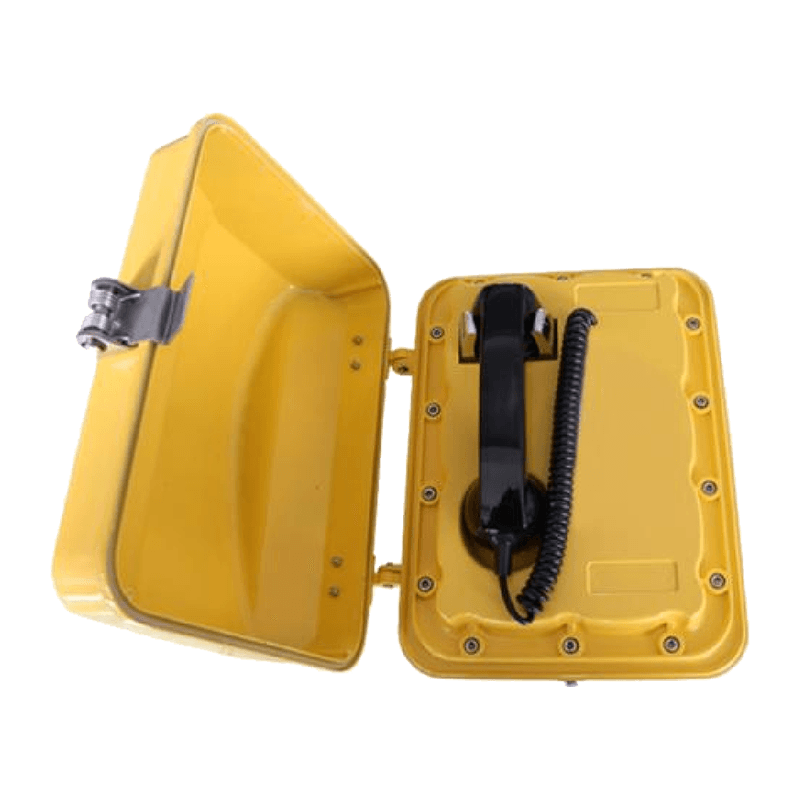
AC Explosion-Proof Digital Telephone
1. The Communication Challenge in High-Risk Industrial Areas
Industrial communication systems operate in conditions that differ substantially from office, commercial, or residential environments. A communication terminal may be exposed to vibration, dust, moisture, corrosive gases, extreme temperature changes, electrical interference, and high ambient noise. In hazardous areas, equipment may also need to limit ignition risks and withstand demanding mechanical and environmental conditions.
Traditional communication solutions often require multiple systems to perform functions that are closely related. A telephone may provide voice communication, while a separate public-address amplifier handles broadcasting and another alarm system manages urgent notifications. This approach can increase installation complexity, introduce more points of failure, and require operators to learn several interfaces.
The FB220 addresses these challenges by combining three important functions:
First, it provides multi-party intercom for communication between terminals or work areas. Second, it supports broadcast functions for distributing voice announcements across a facility. Third, it incorporates alarm communication capability for urgent notices and coordinated responses.
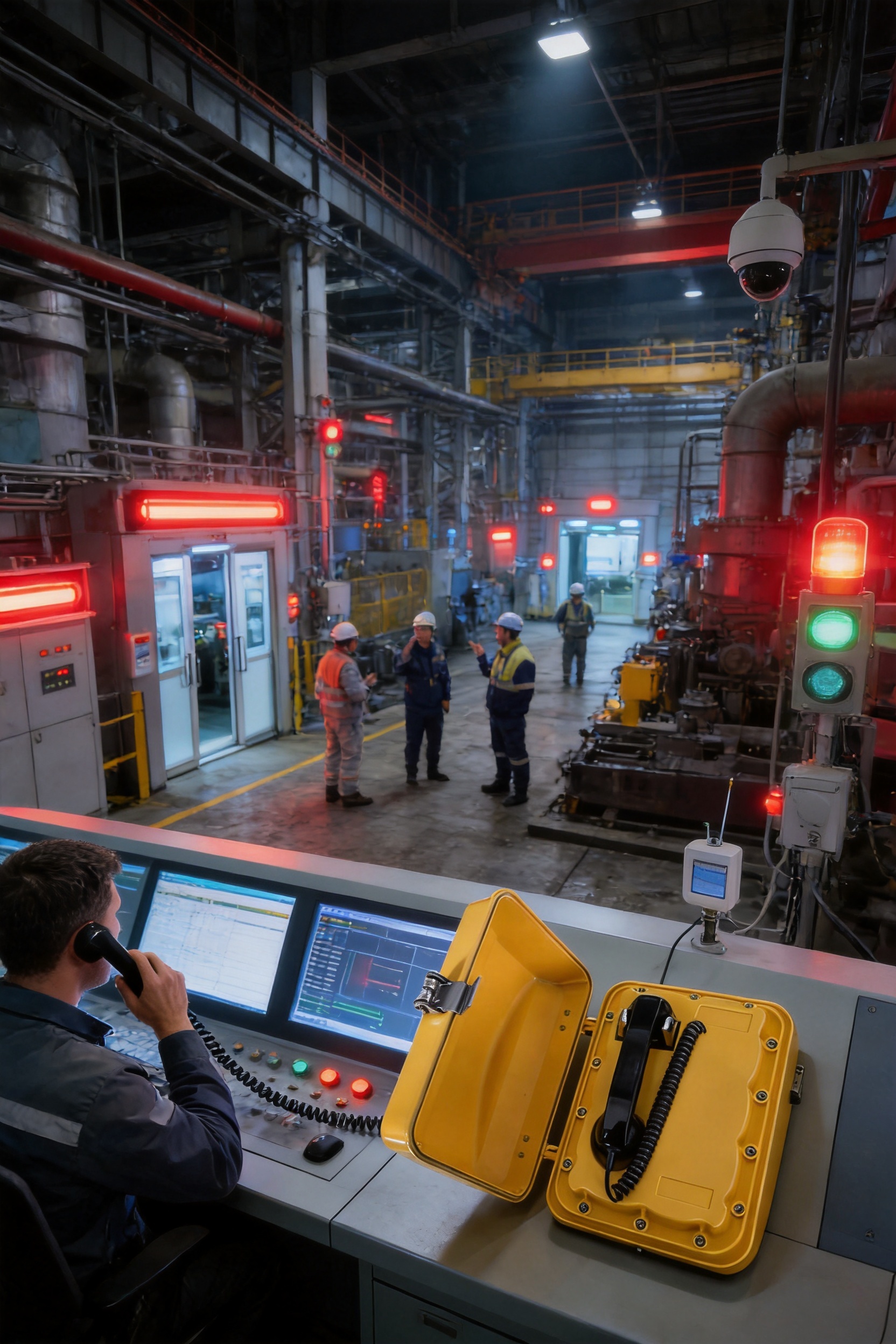
This integrated design is particularly useful where operators need to move quickly between individual communication and group notification. For example, a control room can communicate with a maintenance team, broadcast an instruction to multiple areas, or issue an alarm-related announcement without relying on separate equipment for each activity.
Industrial communication also becomes difficult when buildings, production lines, tunnels, substations, or processing units are spread over a large site. Pulling new communication cables through such locations can involve substantial labor, shutdown coordination, cable protection, conduit construction, and long-term maintenance. A solution that can use an existing AC signal line may provide a practical alternative where the site infrastructure is compatible.
2. Product Overview
The CS618L-FB220 is an AC explosion-proof digital telephone categorized as a PLC digital telephone. In this context, PLC refers to power line communication, in which communication data is carried through a power or signal-line infrastructure rather than through a conventional dedicated Ethernet cable.
The product is designed for industrial environments that already utilize AC power lines for signaling. It connects in parallel to an AC 0–220 V signal line for communication while using an independent DC 24 V supply for equipment operation. This separation gives the system a defined operating power source while allowing the communication signal to travel through the existing AC line.
The product’s main functions include:
Multi-party intercom for communication between connected industrial terminals.
Broadcast communication for sending voice information to a wider area.
Alarm communication for urgent instructions and event notification.
Automatic IP allocation to simplify device addressing.
Self-organizing networking to reduce manual network configuration.
Plug-and-play deployment where the surrounding installation meets the required conditions.
Wideband power carrier communication for data transmission through the signal line.
A stated communication distance of up to 1,000 meters, subject to site conditions.
The equipment is intended for wall mounting and has an overall size of 343 × 294 × 206 millimeters. Its overall weight is approximately 7 kilograms, reflecting the robust enclosure and industrial construction required for demanding locations.
3. Core Technical Specifications
The following table summarizes the main technical parameters provided for the FB220.
| Parameter | Specification |
|---|---|
| Product type | AC explosion-proof digital telephone |
| Item number | CS618L-FB220 |
| Supply voltage | DC 24 V |
| Signal line voltage | AC 0–220 V |
| Communication method | Wideband power carrier |
| Networking mode | Automatic IP assignment and self-organizing network |
| Protection grade | Explosion-proof IP68 |
| Enclosure material | Aluminum alloy |
| Communication or call output reference | 8 ohms, 5 W |
| Speaker output | 8 ohms, 50 W |
| Power consumption | 5 W standby; 50 W full load |
| Working temperature | -40°C to 85°C |
| Relative humidity | 10% to 95%, non-condensing |
| Atmospheric pressure | 80–110 kPa |
| Corrosion protection grade | WF1 |
| Dimensions | 343 × 294 × 206 mm |
| Weight | Approximately 7 kg |
| Installation | Wall mounting |
Project engineers should confirm the final equipment configuration, local hazardous-area requirements, signal-line conditions, installation method, and applicable certification documentation before placing an order. Communication distance, network performance, and audio clarity may vary according to line length, electrical noise, topology, environmental conditions, and the number of connected devices.
4. Wideband Power Carrier Communication
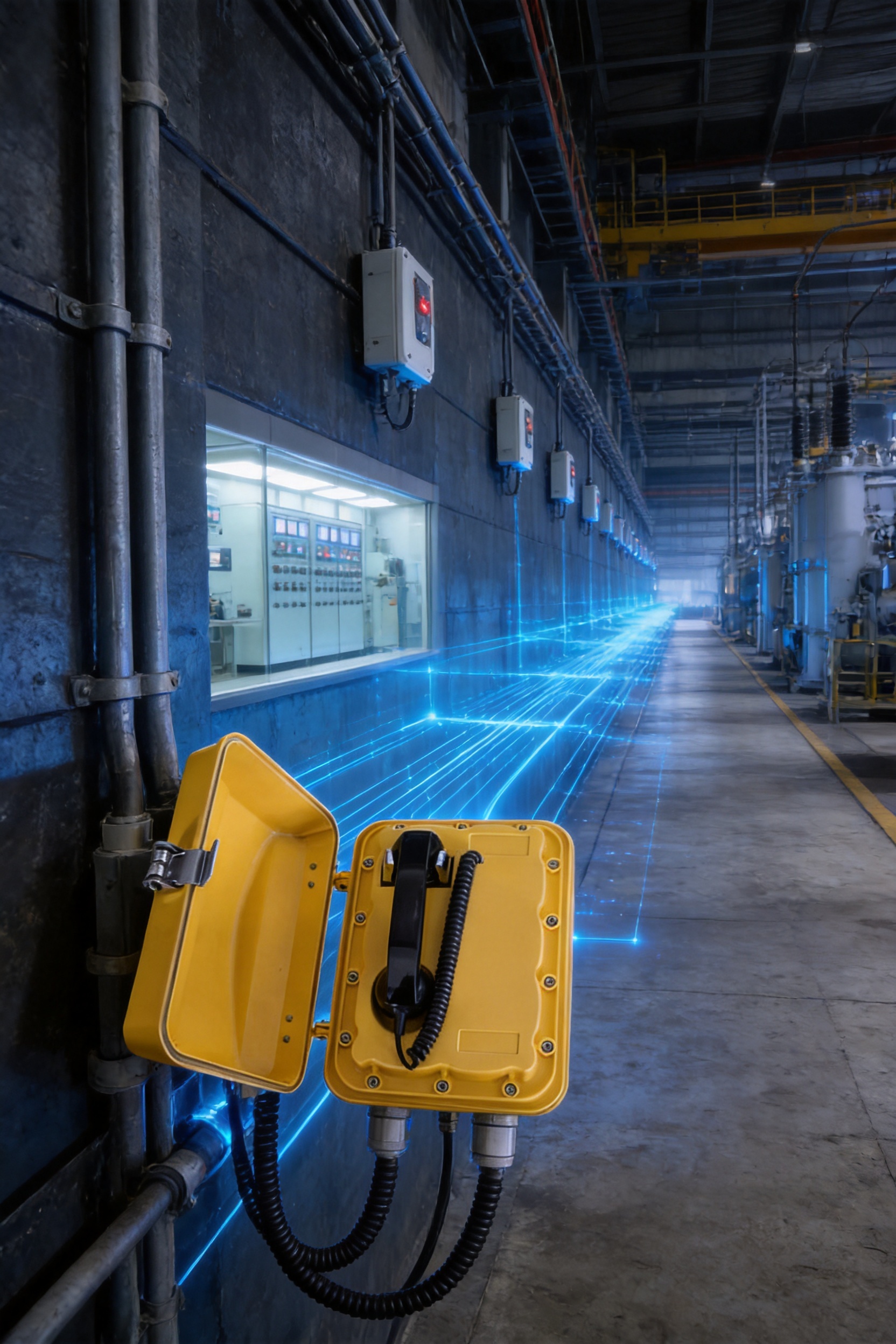
The FB220 uses wideband power carrier communication to transmit information over an AC signal-line environment. This method is valuable in facilities where an existing power or signaling infrastructure is already installed and where adding a separate communication cable would be difficult or expensive.
A power-line communication architecture can reduce the physical work associated with communication deployment. Instead of installing a new cable route to every station, the system can use an appropriate existing line as the signaling path. This may be especially beneficial in long industrial corridors, remote equipment areas, large plants, utility facilities, and locations where construction access is restricted.
Using the existing infrastructure does not mean that every AC line is automatically suitable. Signal quality can be influenced by electrical loads, transformers, filters, variable-frequency drives, switching equipment, cable length, grounding arrangements, line impedance, and interference from other industrial equipment. A proper site assessment remains important. However, when the line environment is compatible, power carrier communication can offer a practical balance between deployment speed and network reach.
The use of a wideband carrier also supports digital network functions rather than limiting the unit to a simple analog call circuit. Automatic IP allocation and self-organizing network behavior can simplify the creation of a multi-device communication system. These features reduce the amount of manual addressing and network planning required during installation.
Automatic IP Assignment
Manual network addressing can be time-consuming when many industrial communication terminals are distributed across a facility. Each device may need to be identified, configured, tested, and recorded. Mistakes can result in duplicate addresses, unavailable devices, or extended commissioning work.
Automatic IP assignment helps reduce these tasks. The network can assign device addresses automatically, allowing installers to concentrate on physical installation, line verification, and functional testing. This is particularly useful when the system is expanded after the initial deployment or when a damaged terminal must be replaced.
Self-Organizing Network Operation
A self-organizing network is designed to reduce the need for extensive manual topology configuration. Devices can participate in a network structure that supports communication between connected terminals without requiring every route to be programmed individually.
For industrial users, the practical advantage is easier deployment and potentially faster restoration. If the installation has been correctly designed, a replacement or additional unit can be integrated with fewer configuration steps than a fully manual system. This does not eliminate the need for engineering verification, but it can reduce the time required for routine commissioning and maintenance.
5. Integrated Intercom, Broadcast, and Alarm Functions
Communication needs in industrial environments change from minute to minute. A worker may need to call a control room, a supervisor may need to contact several teams, or an operator may need to distribute an urgent safety instruction across a production area. A communication terminal that supports only one-to-one calling may not be sufficient.
The FB220 is designed as a multi-purpose communication device. Its intercom function supports direct communication between connected parties. Its broadcast function allows voice information to be distributed beyond a single call recipient. Its alarm-related capability supports rapid notification when an abnormal condition, maintenance issue, or safety event requires attention.
Combining these capabilities in one enclosure can provide several operational benefits:
It can reduce the number of separate devices installed at each communication point.
It can make the operator experience more consistent because calling, broadcasting, and alarm communication are handled through the same product family.
It can simplify maintenance by reducing the number of equipment types and spare-part categories.
It can support faster communication during emergencies, when operators need to issue instructions without changing to a separate system.
It can help facility planners create a more coordinated communication architecture across production, utilities, warehouses, workshops, and remote areas.
In noisy environments, output power is especially important. The FB220 provides a speaker specification of 8 ohms and 50 W, with a full-load power rating of 50 W. This gives the unit the output capability needed for industrial voice distribution, although final intelligibility depends on speaker placement, enclosure acoustics, background noise, line conditions, and site layout.
6. Explosion-Proof and Environmental Construction
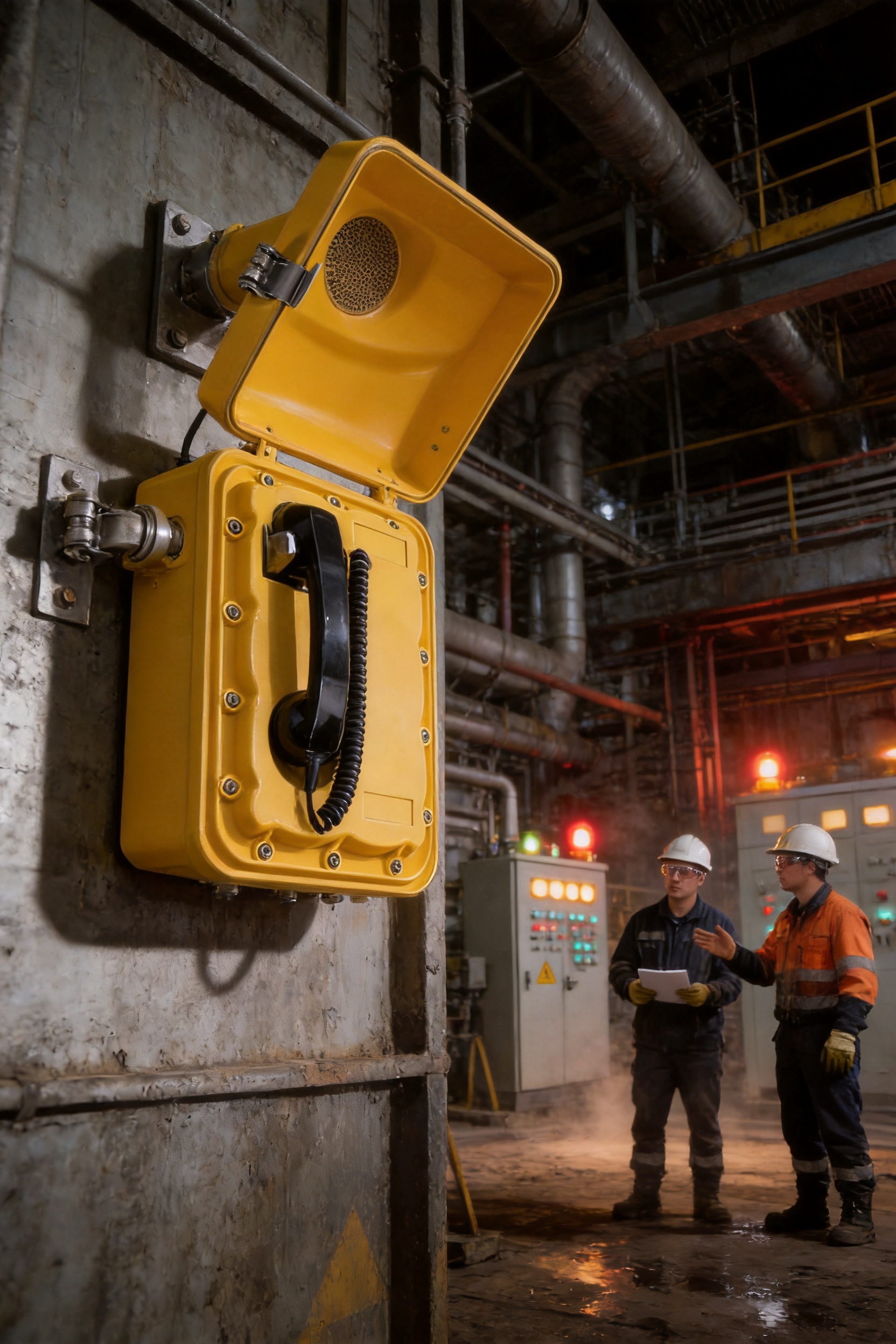
Industrial communication equipment must be designed around its operating environment rather than treated as ordinary office electronics installed inside a stronger box. The FB220 uses an aluminum-alloy enclosure and is specified with an explosion-proof IP68 protection grade. It also carries a WF1 corrosion-proof grade and is designed for operation from -40°C to 85°C.
Aluminum-Alloy Enclosure
Aluminum alloy provides a combination of mechanical strength, relatively low weight, and resistance to many industrial handling demands. At approximately 7 kilograms, the product is substantial enough for a robust wall-mounted installation while remaining manageable for qualified installation teams.
The enclosure also contributes to the protection of the internal electronics from dust, water, impact, and environmental exposure. Its final performance depends on correct assembly, sealing, cable entry, mounting, and maintenance. Industrial enclosure protection can be compromised if covers are not properly secured or if cable glands and seals are not installed according to the equipment requirements.
IP68 Protection
IP68 indicates a high level of protection against solid particles and water ingress under defined test conditions. In practical industrial use, this type of protection is valuable in areas exposed to dust, washdown, humidity, splashing water, or temporary immersion risks.
The IP rating should be considered part of a complete installation strategy. The device must be mounted correctly, and all connection points must maintain the required sealing performance. Routine inspection is also important in facilities where vibration, corrosion, or repeated maintenance activity may affect enclosure integrity.
WF1 Corrosion Protection
Industrial atmospheres may contain moisture, salts, acidic compounds, alkaline substances, process vapors, or airborne contaminants. The stated WF1 corrosion-proof grade indicates that the product is intended for industrial locations where corrosion resistance is a relevant design consideration.
Users should still evaluate the specific chemical environment of the installation. Corrosion performance can vary according to gas concentration, exposure duration, temperature, cleaning chemicals, and mechanical damage. Correct material selection, installation practice, and periodic inspection remain necessary for long service life.
Wide Temperature Range
The specified operating range of -40°C to 85°C enables the product to serve locations that experience severe cold, high summer temperatures, process heat, or outdoor seasonal changes. This range is useful for remote substations, unconditioned industrial buildings, cold regions, and facilities where climate control is unavailable.
Temperature tolerance also supports more consistent operation across changing conditions. Equipment that is installed near furnaces, boilers, process lines, or outdoor structures must be selected with both the lowest and highest expected temperatures in mind. The FB220’s stated range gives system designers considerable flexibility, while the complete installation must still account for direct solar exposure, heat radiation, condensation, and local ventilation.
7. Advantages Compared with Conventional Industrial Communication Equipment
The FB220 offers several advantages when compared with conventional point-to-point telephones, standard public-address equipment, or ordinary network terminals installed in industrial areas.
Reduced Dependence on New Communication Cabling
A conventional digital telephone network often requires dedicated Ethernet or industrial communication cabling. In a large or hazardous facility, installing a new cable route may involve cable trays, protective conduits, penetration sealing, shutdown coordination, and additional inspection work.
Because the FB220 uses a suitable AC signal line for communication, it may reduce the amount of new communication cabling required. This can lower installation disruption and make communication expansion more practical in areas where existing infrastructure is difficult to modify.
Simplified Commissioning
Automatic IP allocation and self-organizing network behavior can reduce the manual work associated with device addressing and network setup. This is a significant advantage over systems that require every terminal to be configured individually before the network can operate.
Simplified commissioning can reduce labor costs, shorten project schedules, and make later system expansion easier. It can also reduce the risk of configuration errors during installation, although qualified technicians should still verify addressing, signal quality, audio performance, and emergency communication functions.
Combined Communication Functions
A separate telephone, amplifier, and alarm terminal may require multiple enclosures, power supplies, maintenance procedures, and spare-part inventories. The FB220 integrates intercom, broadcast, and alarm-related communication in one industrial unit.
This integrated approach can help facility owners use wall space more efficiently and establish a consistent communication interface. It may also simplify operator training because personnel interact with one coordinated communication system rather than several unrelated devices.
High Audio Output
Many ordinary office telephones are not designed to deliver intelligible voice communication in high-noise environments. The FB220’s 50 W speaker output is intended for industrial audio distribution, where communication must compete with machinery, ventilation systems, vehicles, and production activity.
High output does not replace proper acoustic planning, but it provides a stronger foundation for audible communication. The number and position of terminals, the direction of sound, local noise levels, and the use of additional sound distribution equipment should be considered during project design.
Environmental Durability
Ordinary commercial communication devices may not be suitable for extreme temperatures, water exposure, dust, or corrosive industrial atmospheres. The FB220’s aluminum-alloy body, IP68 protection, WF1 corrosion-proof grade, and -40°C to 85°C temperature range are aligned with the requirements of demanding industrial sites.
Long-Distance Communication Potential
The stated communication distance of up to 1,000 meters provides a useful planning reference for large facilities. Actual performance depends on the signal-line network, electrical conditions, installation topology, and connected equipment. Nevertheless, this distance capability can reduce the number of communication stations or help connect areas that are physically separated by long corridors, process zones, or outdoor routes.
8. Manufacturing and Engineering Strengths
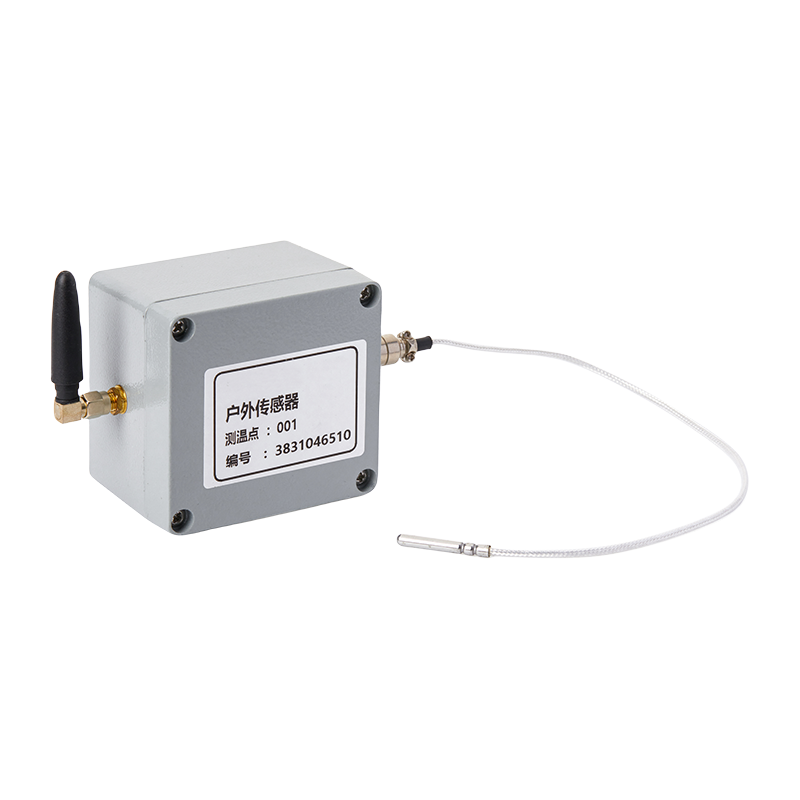
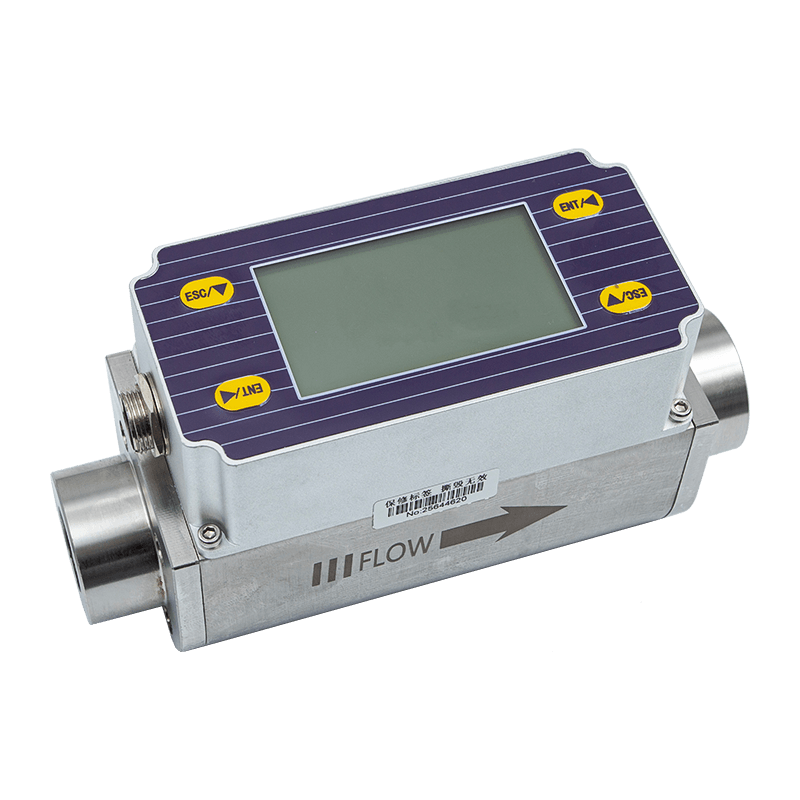
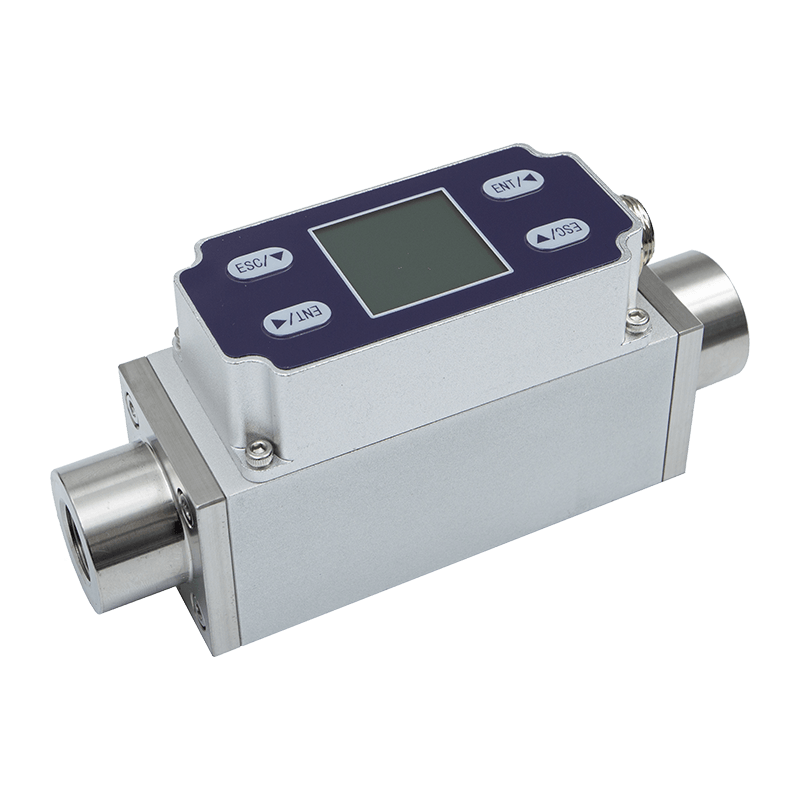
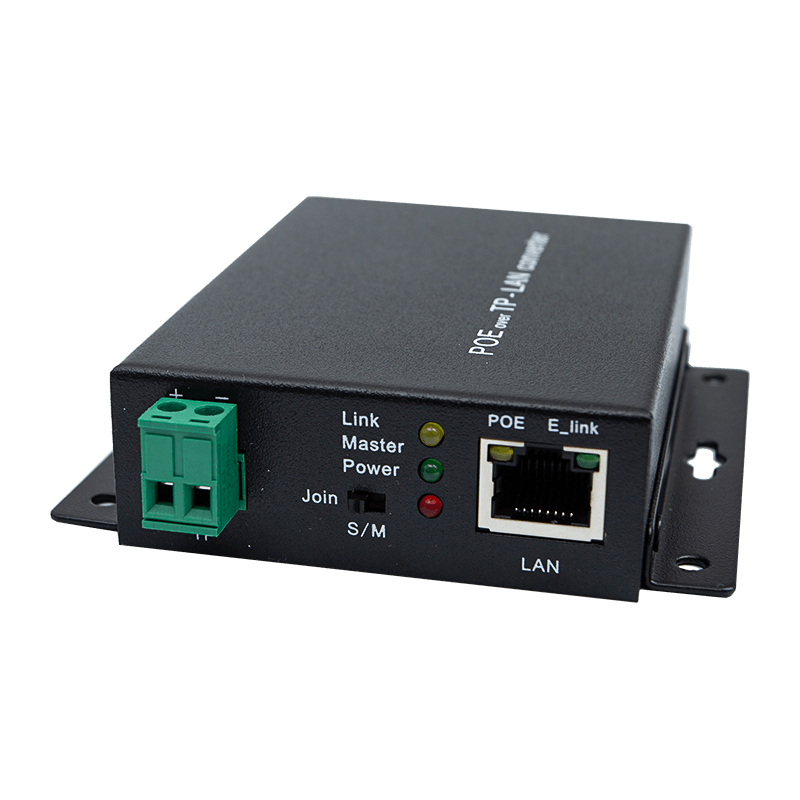
The product is supported by an industrial technology company focused on data sensing, intelligent connectivity, power line carrier products, and industrial data integration. Its broader product portfolio includes broadband power line carriers, wireless temperature monitoring systems, industrial transmitters, thermal gas mass flow meters, and automatic door controllers.
This product range indicates an engineering focus that extends beyond a single communication device. The technologies involved share several industrial requirements: reliable field data transmission, operation in demanding environments, integration with plant infrastructure, and support for smart-factory applications.
Experience in Industrial Connectivity
Developing power-line communication products requires knowledge of signal transmission, interference, line conditions, networking, device addressing, and industrial installation environments. That experience is directly relevant to a PLC digital telephone that must communicate through an AC signal-line system.
The company’s focus on industrial connectivity also supports the development of communication products that are intended for practical field deployment rather than only laboratory or office use. Product engineering must consider enclosure design, environmental protection, power requirements, audio output, network behavior, and serviceability as a complete system.
Integration of Hardware and Industrial Data Solutions
Modern industrial communication is increasingly connected with monitoring and control. A communication terminal may be deployed alongside temperature sensors, transmitters, flow meters, door controllers, and other field devices. A supplier that develops both edge-layer hardware and industrial data integration solutions can better understand how field devices participate in a broader smart-factory architecture.
This integration perspective is useful for customers that plan to expand from basic voice communication toward equipment condition monitoring, energy management, production optimization, and centralized operational visibility. The FB220 can serve as one component in an industrial connectivity strategy while other products address sensing and process data requirements.
Focus on Reliable and Sustainable Industrial Operations
The company’s stated mission emphasizes efficient, reliable, and green smart factories. In practical terms, communication reliability supports these goals by reducing response time, improving coordination, and helping operators manage equipment and production activities more effectively.
Power-line communication can also contribute to more efficient infrastructure utilization when an existing signal-line system can be used instead of installing an entirely separate communication route. Reduced construction work, fewer cable materials, and easier expansion may provide lifecycle benefits, although the actual savings depend on site conditions and project design.
Industrial Product Portfolio
A diversified industrial product portfolio can strengthen manufacturing and application knowledge. Wireless temperature monitoring systems require reliable field sensing and transmission. Industrial transmitters require stable measurement and signal output. Thermal gas mass flow meters require process-oriented measurement capabilities. Automatic door controllers require dependable actuation and control. Power line carrier devices require communication and networking expertise.
These product areas are complementary within industrial automation. Together, they indicate a supplier capable of addressing communication, sensing, measurement, and access-control requirements in industrial environments.
9. Manufacturing Process Considerations
Although detailed factory process records are not included in the supplied product materials, the design requirements of the FB220 imply several important manufacturing and quality-control areas. Explosion-proof industrial equipment must be produced with careful control over enclosure dimensions, material consistency, sealing surfaces, electrical interfaces, assembly procedures, and final inspection.
Material and Enclosure Processing
The aluminum-alloy enclosure must be manufactured with accurate dimensions and stable mechanical interfaces. Cover fit, mounting points, cable entries, speaker openings, and sealing surfaces all influence environmental protection. Dimensional consistency is especially important when products are installed in groups or when replacement units must fit existing mounting arrangements.
Surface treatment and corrosion considerations are also significant. Industrial equipment may be exposed to humidity, process chemicals, dust, and outdoor conditions. The enclosure finish, fasteners, seals, and interfaces should be selected and controlled as part of a complete corrosion-resistance strategy.
Electrical and Communication Assembly
The product combines a DC 24 V operating supply with an AC 0–220 V signal-line connection. This requires careful electrical design and assembly to maintain functional separation, insulation, safety, and reliable signal transmission. Manufacturing inspection should verify connection integrity, polarity, insulation performance, and the correct relationship between power and signaling circuits.
The wideband carrier communication section must also be assembled consistently to support reliable networking. Variation in components, soldering, shielding, or connection quality can affect communication performance. A controlled production process helps maintain consistent behavior across units.
Audio System Testing
Because the product supports intercom, broadcast, and alarm communication, audio testing is an important part of production verification. Testing may include microphone or input response, speaker output, voice clarity, distortion, network audio behavior, and full-load performance.
The 50 W full-load specification also makes thermal and power-consumption verification relevant. The product is specified at approximately 5 W standby consumption and 50 W at full load. Confirming these operating conditions helps ensure that the equipment performs as expected when the speaker is active and communication demand is high.
Environmental and Protection Verification
Products intended for industrial use require attention to environmental performance. Relevant production and quality procedures may include enclosure inspection, sealing verification, temperature-related testing, corrosion considerations, and protection-grade validation. The objective is to ensure that the delivered product is consistent with its intended operating environment.
Customers should request the applicable technical documentation, certification information, test reports, and installation instructions for their project jurisdiction and hazardous-area classification. These documents are essential for confirming suitability before deployment.
Traceability and Quality Management
Industrial customers often require traceability from incoming materials through assembly, testing, packaging, and delivery. Product identification, batch records, inspection results, and service documentation help users manage maintenance and replacement over the equipment lifecycle.
A supplier with organized production and quality processes can provide greater confidence in repeat orders, multi-site deployments, and long-term spare-part support. This is particularly important when the equipment is installed in safety-sensitive or continuously operating facilities.
10. Typical Application Environments
Mining and Tunneling
Mines and tunnels often include long distances, high noise, dust, moisture, and restricted access. Communication stations may need to be installed along transport routes, production areas, equipment chambers, and control points. The FB220’s robust enclosure, long-distance communication capability, and high-output speaker make it suitable for evaluation in these environments.
Power Stations and Substations
Power facilities contain extensive electrical infrastructure and may include remote equipment areas, outdoor installations, control rooms, and maintenance zones. Where an appropriate AC signal-line structure is available, power carrier communication may reduce the need to install separate communication wiring.
Chemical and Process Plants
Chemical plants require communication systems that can function in areas exposed to moisture, vapors, process noise, and strict safety requirements. The explosion-proof enclosure and corrosion-protection characteristics are important considerations, while the intercom and broadcast functions support communication between operators, maintenance teams, and control areas.
Oil and Gas Facilities
Oil and gas installations commonly require communication equipment capable of operating in hazardous areas and under harsh environmental conditions. Equipment selection must be matched to the site’s hazardous-area classification, gas group, temperature class, local regulations, and certification requirements. The FB220 can be considered where its documented approvals and technical characteristics meet those project requirements.
Steel, Cement, and Heavy Manufacturing
Steel mills, cement factories, foundries, and heavy manufacturing plants often have high ambient noise, heat, dust, vibration, and large production areas. A high-output communication terminal with a durable enclosure can support production coordination and emergency announcements where ordinary office equipment would be unsuitable.
Warehouses and Industrial Campuses
Large warehouses, logistics areas, and industrial campuses may require communication between loading zones, workshops, gatehouses, control rooms, and storage buildings. If the existing AC infrastructure can support power carrier communication, the FB220 may help extend communication without requiring a completely new network cable route.
11. Installation and System Planning
Correct installation is essential for achieving reliable performance. The FB220 is designed for wall mounting, so the mounting surface should support the equipment’s approximately 7-kilogram weight and withstand vibration or impact expected at the site.
The installation team should verify the AC 0–220 V signal-line arrangement before connection. The signal line must be compatible with the product’s communication method, and the installation must follow the required electrical safety procedures. The independent DC 24 V power supply should be stable, correctly rated, and protected according to the project’s electrical design.
Communication performance should be checked at representative points across the site. Testing should include calling between terminals, multi-party communication, broadcast coverage, alarm announcements, network formation, and operation during standby and full-load conditions.
Audio coverage should be considered carefully. A high-output speaker is useful only when terminals are positioned to provide effective sound distribution. In a large facility, sound can be blocked by machinery, partitions, tanks, walls, and process equipment. A site survey can identify acoustic shadows and determine whether additional units are required.
Hazardous-area installation must be performed by qualified personnel. Cable entries, grounding, sealing, enclosure closure, and maintenance procedures should comply with the relevant local codes and the product’s technical documentation. The equipment should not be modified in the field in ways that could compromise its protection or certification status.
12. Maintenance and Lifecycle Benefits
Industrial communication equipment is valuable only when it remains available over the long term. The FB220’s integrated design can simplify maintenance by consolidating intercom, broadcast, and alarm communication functions in one product type.
Routine inspection should include the enclosure, mounting hardware, cable entries, seals, external surfaces, speaker condition, and connection points. In corrosive or dusty environments, inspection frequency should reflect the severity of exposure. Any sign of damage, loose hardware, corrosion, water ingress, or unusual audio performance should be addressed promptly.
Network maintenance can also benefit from automatic IP assignment and self-organizing operation. If a unit is replaced, technicians may be able to restore network participation with fewer manual configuration steps, subject to the system architecture and replacement procedures. A maintenance record should still document the device location, item number, installation date, test results, and service history.
The use of a common product family across a facility can reduce spare-parts complexity. Operators and technicians become familiar with the same enclosure, connection approach, and communication functions. This can support faster troubleshooting and reduce training requirements.
13. Selection Considerations for Buyers
Before selecting the FB220 for a project, buyers should evaluate several technical and operational factors.
The first consideration is the existing signal-line infrastructure. The system is designed for an AC 0–220 V signal line and uses a DC 24 V supply for operation. The facility must confirm that the available line arrangement, voltage, topology, and electrical environment are compatible.
The second consideration is hazardous-area suitability. Users should match the product documentation to the required explosion-proof classification and local regulatory requirements. IP68 protection and WF1 corrosion resistance are valuable characteristics, but they do not replace verification of the complete approval requirements for a particular site.
The third consideration is communication capacity. Project planners should determine the number of terminals, required communication groups, broadcast zones, alarm priorities, and control-room interfaces. Automatic networking can simplify deployment, but the system should still be planned to meet operational priorities.
The fourth consideration is audio coverage. The 50 W speaker output provides strong output potential, but the actual result depends on acoustic conditions. A sound-level survey may be appropriate for large, noisy, or highly obstructed facilities.
The fifth consideration is environmental exposure. The product supports -40°C to 85°C operation and includes IP68 and WF1 characteristics, but users should review the actual combination of temperature, humidity, chemicals, dust, vibration, solar exposure, and cleaning methods at the installation location.
The sixth consideration is service support. Buyers should confirm available documentation, replacement procedures, technical support, training, spare parts, and expected delivery schedules. These factors influence total ownership cost and long-term system availability.
14. Frequently Asked Questions
What is the primary purpose of the CS618L-FB220?
The product is an industrial AC explosion-proof digital telephone designed for multi-party intercom, broadcast, and alarm communication in demanding or hazardous environments. It uses wideband power carrier communication over an appropriate AC signal-line system.
Does the unit operate directly from the AC signal line?
The product connects in parallel to an AC 0–220 V signal line for communication signaling, but it requires an independent DC 24 V power supply to operate. The power and signal requirements should be designed and installed according to the product documentation.
How far can the communication signal travel?
The stated communication distance is up to 1,000 meters. Actual distance depends on the signal-line condition, electrical interference, cable structure, network topology, connected devices, and installation environment.
What does automatic IP assignment provide?
Automatic IP assignment reduces the need for technicians to configure each terminal manually. It can simplify commissioning, expansion, and replacement in a compatible self-organizing network.
What does self-organizing networking mean in this product?
It means that connected terminals can form and manage a communication network with reduced manual topology configuration. The exact network behavior depends on the system design and the connected equipment.
Can the product be used outdoors?
The product is designed for industrial use and has an IP68 protection specification and a working temperature range of -40°C to 85°C. Outdoor use still requires correct mounting, cable sealing, grounding, protection from unsuitable mechanical exposure, and confirmation that the local environment meets the product requirements.
Is the product suitable for every hazardous area?
Not automatically. The product’s explosion-proof and environmental specifications must be compared with the hazardous-area classification, gas or dust group, temperature class, local regulations, and project certification requirements. Users should obtain and review the applicable technical documentation before installation.
What is the speaker power?
The product is specified with an 8-ohm, 50 W speaker and a 50 W full-load rating. A separate specification lists 8 ohms and 5 W for the communication or call output reference. The final application should be reviewed against the approved product configuration and technical documentation.
What is the standby power consumption?
The stated standby power consumption is 5 W. Full-load power consumption is listed as 50 W.
What type of installation is used?
The product is designed for wall mounting. The mounting surface and hardware must support the approximately 7-kilogram unit and withstand the vibration and environmental conditions of the site.
What maintenance does the product require?
Maintenance should include inspection of the enclosure, seals, cable entries, mounting hardware, speaker, connections, corrosion condition, and communication performance. Inspection frequency should be based on the severity of the installation environment and the site’s maintenance procedures.
Can the product form part of a smart-factory system?
Yes. The unit can serve as an industrial communication component within a broader connectivity architecture. It may be deployed alongside power line carriers, wireless temperature monitoring systems, transmitters, flow meters, automatic door controllers, and other industrial data devices.
15. Why This Product Merits Industrial Evaluation
The FB220 combines several characteristics that are difficult to obtain in a conventional commercial communication device. It is designed for industrial conditions, uses an existing AC signal-line concept, supports digital networking, provides high speaker output, and integrates intercom, broadcast, and alarm functions.
Its strongest advantage is the combination of communication capability and infrastructure flexibility. In suitable facilities, power carrier communication can reduce the need for new data cabling while automatic networking simplifies commissioning. This makes the product particularly relevant to brownfield projects, plant expansions, remote equipment areas, and locations where cable installation is expensive or disruptive.
Its environmental design is another important strength. The aluminum-alloy enclosure, IP68 explosion-proof specification, WF1 corrosion-proof grade, and -40°C to 85°C temperature range are aligned with the conditions found in many heavy industries. These characteristics can support more reliable operation than ordinary office-grade or lightly protected communication equipment.
The product is also supported by a supplier whose broader focus includes industrial sensing, connectivity, transmitters, flow measurement, automatic door control, and smart-factory integration. This wider capability can be valuable to customers looking for a technology partner rather than a single isolated device.
As with any industrial product, successful implementation depends on engineering assessment. The AC signal-line environment, DC power arrangement, hazardous-area classification, acoustic layout, network size, installation method, and maintenance plan should all be verified. When these factors are correctly addressed, the FB220 can provide a practical foundation for reliable industrial voice and alarm communication.
Conclusion
The CS618L-FB220 AC Explosion-Proof Digital Telephone is designed to meet the communication challenges of high-risk industrial environments. Its combination of wideband power carrier communication, automatic IP assignment, self-organizing networking, multi-party intercom, broadcast, alarm functions, and high-output audio makes it more versatile than a basic industrial telephone.
The product can use an appropriate AC 0–220 V signal line for communication while operating from an independent DC 24 V supply. This architecture may reduce cabling requirements in suitable facilities and simplify communication expansion. Its stated communication distance of up to 1,000 meters supports applications across large plants, corridors, tunnels, substations, and remote industrial areas.
Its construction is equally important. The aluminum-alloy enclosure, IP68 protection, WF1 corrosion-proof grade, and operating temperature range of -40°C to 85°C provide a foundation for operation in environments affected by water, dust, corrosion, noise, and extreme temperature.
Supported by industrial connectivity and smart-factory engineering capabilities, the product can be evaluated as part of a broader industrial communication and data-management strategy. For organizations seeking to improve operational coordination, emergency notification, and infrastructure efficiency, the FB220 offers a strong combination of rugged construction, network simplicity, and integrated communication functions.
References
1. Product technical information for CS618L-FB220 AC Explosion-Proof Digital Telephone, including electrical, communication, environmental, enclosure, and installation parameters.
2. Industrial power line communication engineering principles and application practices.
3. General guidance for IP enclosure protection classifications and environmental sealing.
4. Industrial explosion-proof equipment selection, installation, inspection, and maintenance principles.
5. Smart-factory architecture principles for industrial sensing, edge-layer connectivity, and data integration.
6. Industrial voice communication and public-address system planning for high-noise environments.
7. Industrial corrosion-control practices for equipment installed in humid, chemical, and polluted atmospheres.