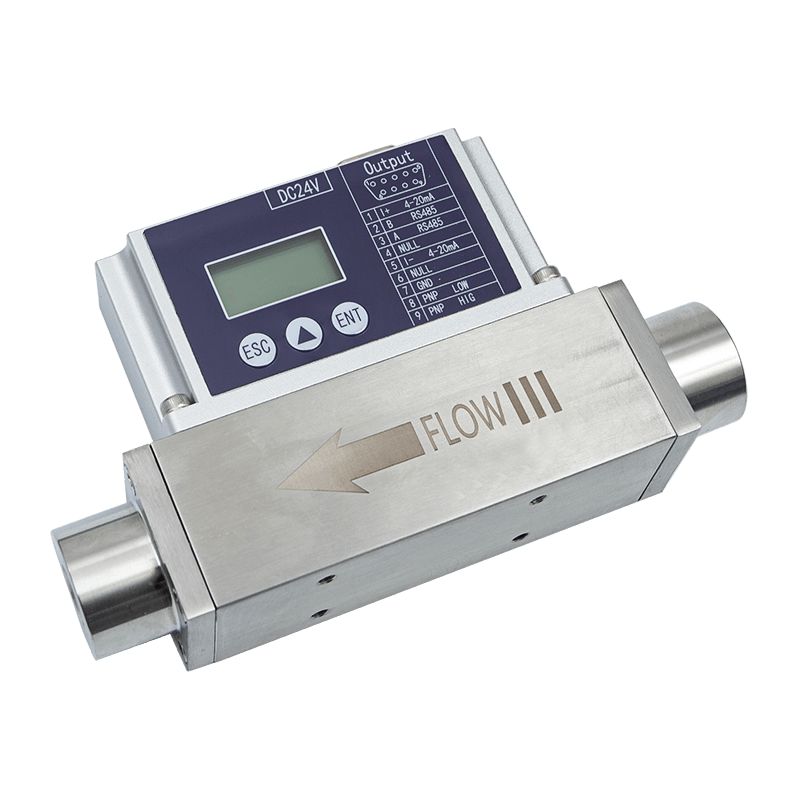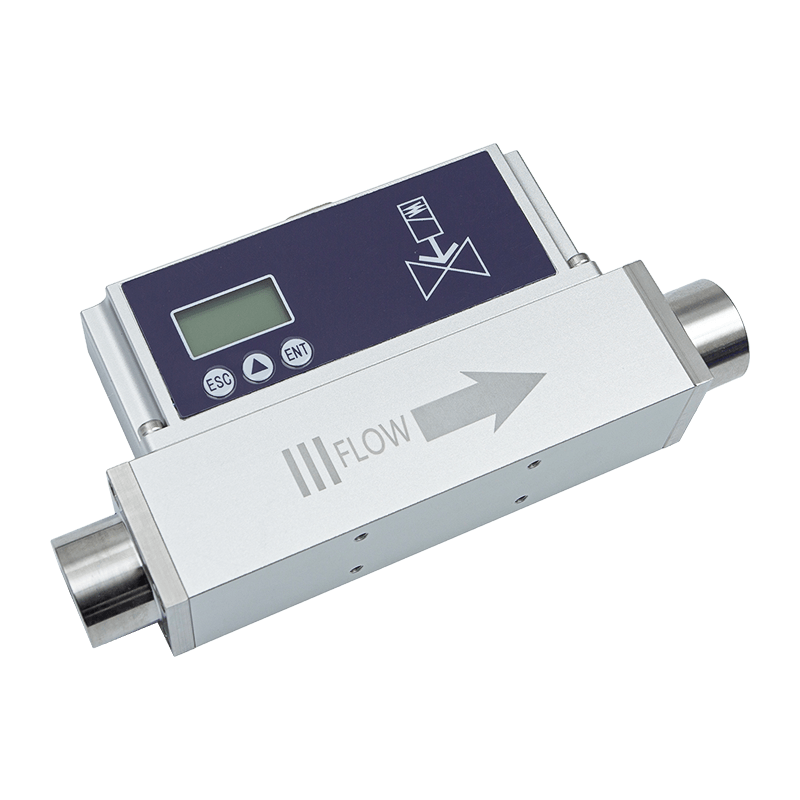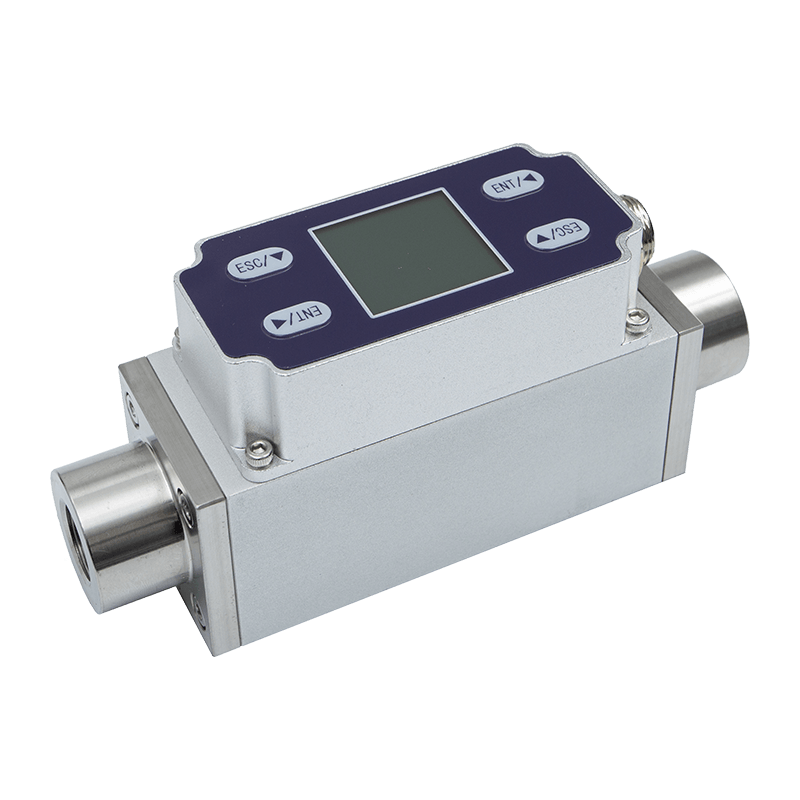


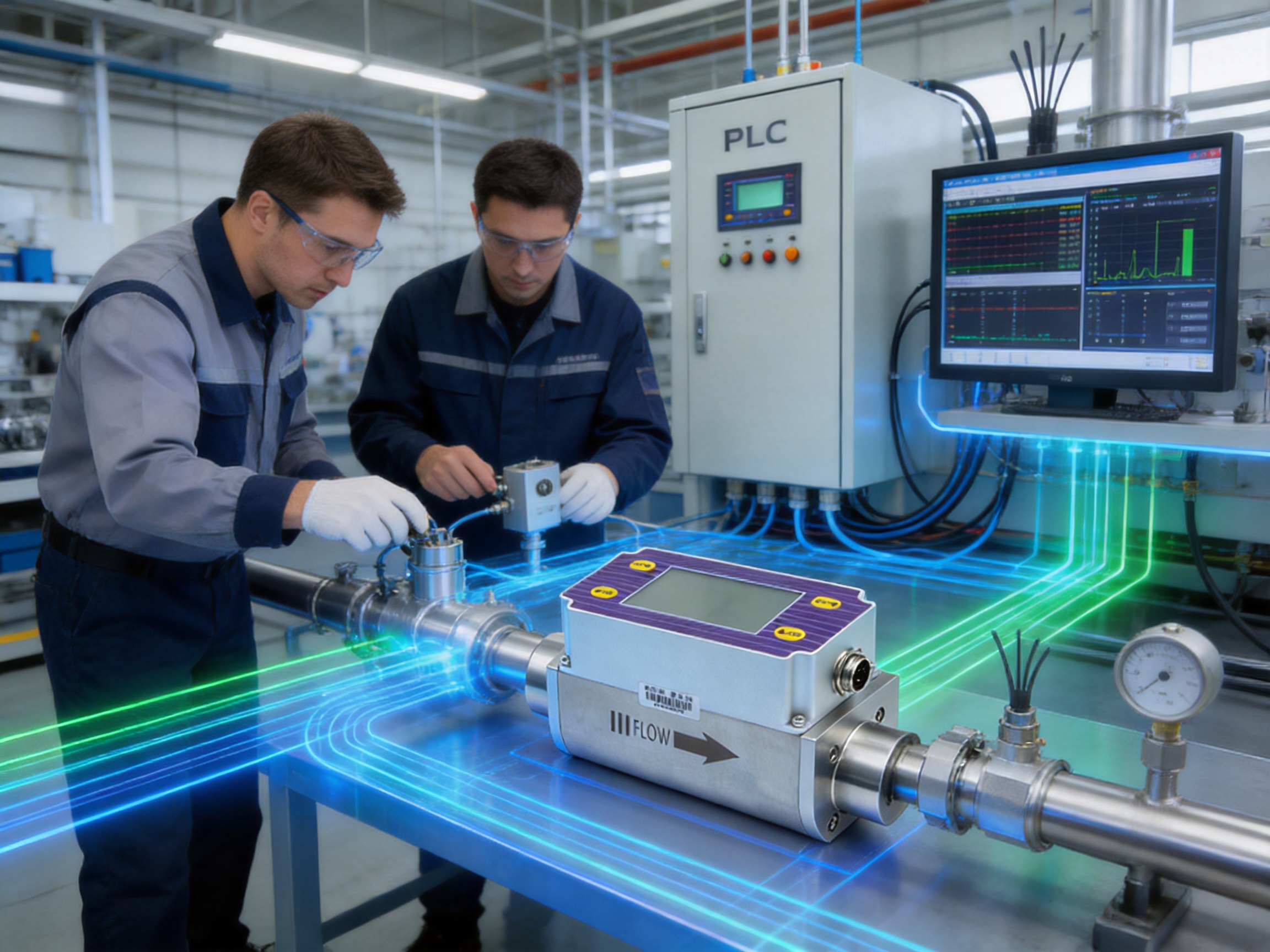
Accurate gas-flow measurement is essential in modern industrial facilities. It supports process control, energy management, emissions reduction, equipment protection, production quality, and operational safety. In applications ranging from compressed-air monitoring and natural-gas management to furnace control, gas-leak detection, and industrial automation, measurement instruments must deliver reliable results under changing operating conditions.
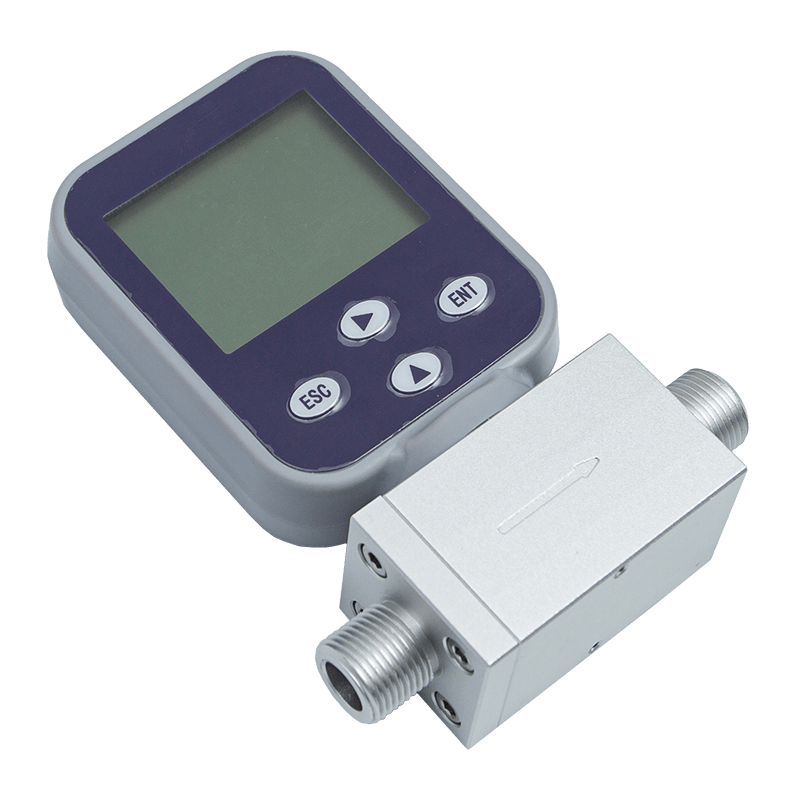
The AI-FT high-performance thermal gas mass flow meter is designed for these demanding requirements. It uses the thermal-diffusion principle and a constant-temperature-difference measurement method to measure gas flow directly. The instrument is available in pipeline configurations for pipe diameters from DN25 to DN50 and provides a flow-velocity range of 1 to 100 Nm/s. With an accuracy of ±1 to ±2.5%, a response time of approximately one second, 4–20 mA output, and RS-485 communication, it is suitable for both stand-alone measurement and integration into industrial control systems.
Unlike conventional flow instruments that may require separate pressure and temperature compensation, a thermal gas mass flow meter measures the relationship between heat transfer and gas movement. This enables direct mass-flow measurement or standard volumetric-flow measurement without requiring users to perform complex corrections during normal operation.
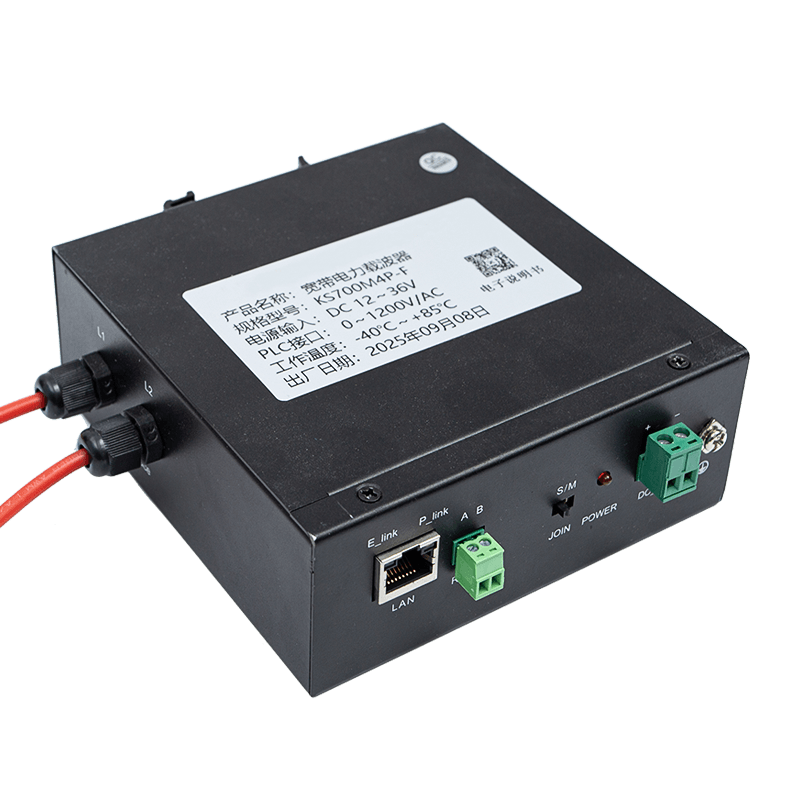
The instrument is manufactured by ASY Electronics (JiaXing) Co., Ltd., a high-tech enterprise focused on data sensing, intelligent connectivity, industrial communication, and smart-factory applications. Its product portfolio includes broadband power-line communication equipment, wireless temperature-monitoring systems, industrial transmitters, thermal gas mass flow meters, and automatic door controllers. These products support equipment condition monitoring, energy management, production optimization, and industrial digitalization.
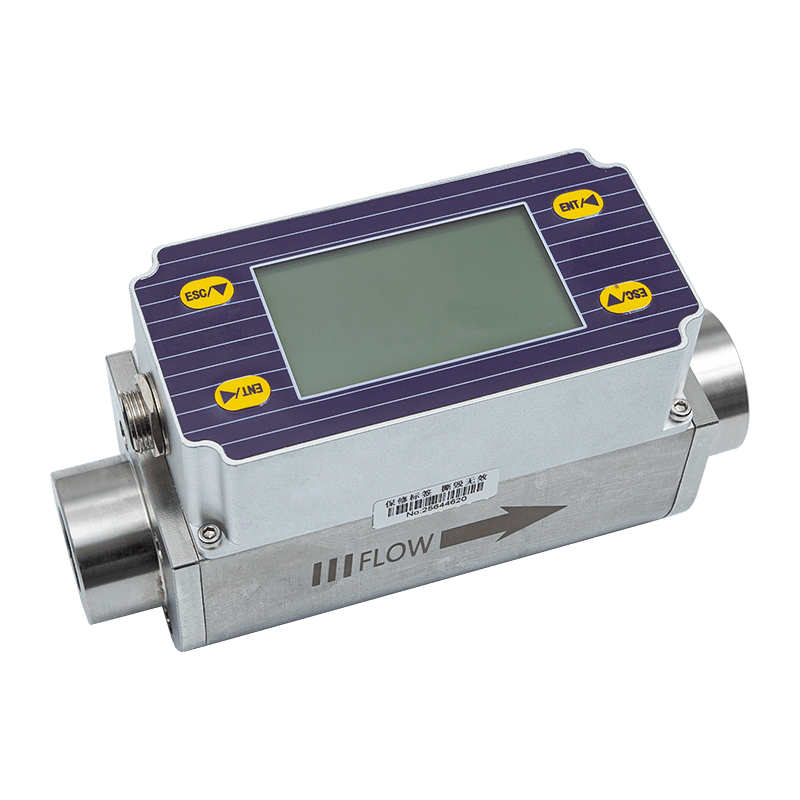
High-Performance Type Thermal Gas Mass Flowmete
1. The Role of Thermal Gas Mass Measurement in Industry
Gas is used throughout industrial production. Compressed air powers pneumatic tools and actuators. Natural gas supplies combustion systems and boilers. Nitrogen, oxygen, hydrogen, carbon dioxide, and other gases support chemical processing, food production, metal treatment, electronics manufacturing, and environmental systems. In each application, knowing the actual gas flow is important.
Traditional monitoring methods may measure pressure, differential pressure, or volumetric displacement. However, gas volume changes with pressure and temperature. A fixed volume of gas at one pressure and temperature does not contain the same mass as the same volume at another pressure and temperature. If the measurement system does not account for these variations, the displayed flow can differ significantly from the actual process condition.
Thermal mass flow measurement addresses this issue by measuring the mass-related heat transfer produced when gas moves past a heated sensing element. Because the measurement is based on the interaction between the gas and the sensor, it can provide a direct indication of mass flow or flow under defined standard conditions.
This approach offers several benefits for industrial users:
• It reduces the need for separate temperature and pressure compensation.
• It can measure low and high gas-flow conditions across a wide range.
• It does not require moving mechanical components in the sensor.
• It can be installed in automated production and energy-management systems.
• It can support leak detection and consumption analysis.
• It provides both analog and digital communication options.
For facilities seeking better energy visibility, thermal gas mass flow measurement can be particularly valuable. Compressed-air systems, for example, may consume a large amount of electricity even when production output is unchanged. A flow meter installed at the compressor outlet, production line, or critical branch can help identify abnormal demand, leaks, and inefficient operating conditions.
2. Product Overview
The AI-FT is a high-performance thermal gas mass flow meter designed for pipeline gas measurement. Its compact sensing technology, digital circuit architecture, and industrial communication functions make it suitable for applications where measurement accuracy, straightforward installation, and system connectivity are important.
| Item | Specification |
|---|---|
| Product type | Thermal gas mass flow meter |
| Structural form | Pipeline |
| Applicable pipe diameter | DN25 to DN50 |
| Measuring medium | Various gases, except acetylene |
| Flow-velocity range | 1 to 100 Nm/s |
| Accuracy | ±1% to ±2.5% |
| Sensor operating temperature | -40°C to +250°C |
| Converter operating temperature | -20°C to +55°C |
| Medium pressure | Up to 3.0 MPa |
| Power supply | DC 24 V, 25 W |
| Response speed | Approximately 1 second |
| Analog output | 4–20 mA, maximum load 500 Ω |
| Digital communication | RS-485 |
| Structure options | Split or integrated structure |
| Pipe material | Anodized aluminum or stainless steel |
| Sensor material | 316 stainless steel |
| Display | Four-line Chinese-character LCD display |
| Protection level | IP40 |
The specifications show that the product is positioned for general industrial gas measurement rather than a single specialized process. Its DN25–DN50 pipeline range suits many plant branches, utility lines, equipment connections, and process gas lines. The split-structure option can be useful when the sensing point and display or converter must be positioned separately, while the integrated structure is suitable for compact installations.
The stated operating range of the sensor extends from -40°C to +250°C, while the converter is rated from -20°C to +55°C. The product information also identifies a suitable media-temperature range of approximately -40°C to +220°C in the operating description. Final selection should therefore consider the complete installation configuration, process temperature, converter location, gas composition, and customer-specific requirements.
3. Measurement Principle: Constant Temperature Difference
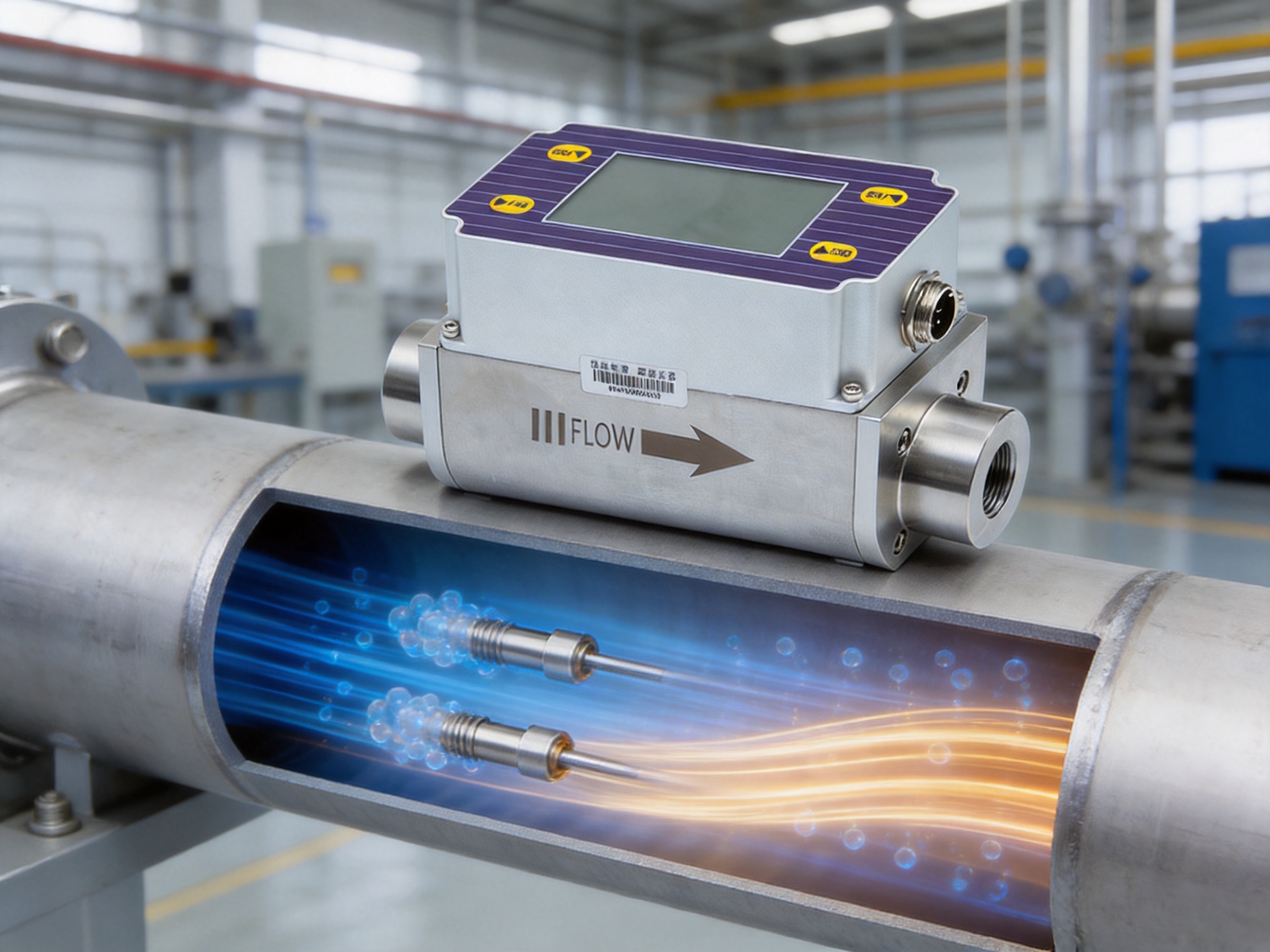
The AI-FT uses two reference-grade platinum resistance temperature sensors. One sensor measures the temperature of the gas, identified as T1. The second sensor is electrically heated to a temperature above the gas temperature and functions as the velocity sensor, identified as T2.
The temperature difference between the two sensors is represented as:
ΔT = T2 − T1
During operation, the meter maintains a relatively constant temperature difference between the heated sensor and the reference sensor. When gas is stationary or moving slowly, relatively little heat is carried away from the heated sensor. As gas velocity increases, more gas molecules collide with the sensor and remove more heat. The instrument must then supply additional electrical power to maintain the preset temperature difference.
The amount of heating power required is related to the gas flow velocity and the thermal properties of the medium. The electronic circuit evaluates this relationship and converts it into a flow reading.
The basic variables involved in the measurement include gas density, flow velocity, a balance coefficient, heating capacity, and temperature difference. Gas density is influenced by the gas type, operating pressure, and operating temperature. The meter’s thermal measurement method uses the heat-transfer behavior of the gas to obtain a mass-related flow result.
A key characteristic of the constant-temperature-difference method is that the sensor temperature is automatically maintained at approximately 30°C above the surrounding medium temperature. Because the temperature difference is actively controlled, the meter does not require conventional temperature compensation in principle. This simplifies the measurement system and reduces the number of external variables that users must calculate.
The system is also designed to provide standard volumetric-flow information. Standard volumetric flow is calculated with reference to defined standard conditions. The supplied product information identifies standard conditions of 101.325 kPa and 20°C for the stated density relationship. Users should confirm the required standard reference conditions when integrating the instrument into a plant-wide monitoring platform, because different industries may use different reference temperatures or pressures.
4. Why Direct Thermal Mass Measurement Is Valuable
4.1 Reduced compensation requirements
Many gas-flow systems require a pressure transmitter, a temperature sensor, and a calculation unit to convert actual volume into mass or standard volume. Each additional measurement point introduces wiring, installation work, calibration requirements, and possible error sources.
The thermal gas mass flow meter combines the sensing and calculation functions in one instrument. Its operating principle is inherently related to gas mass transfer, so users do not normally need to calculate separate temperature and pressure corrections for routine measurement. This can simplify system design and lower the total cost of ownership.
4.2 Wide flow range
The specified flow-velocity range is 1 to 100 Nm/s. The product information also describes a broader measurement capability extending down to approximately 0.5 Nm/s for suitable configurations and leak-detection applications. The actual minimum measurable velocity depends on gas composition, pipe conditions, installation quality, calibration, and the selected model.
A wide range is useful when a pipeline experiences substantial changes between low-demand and high-demand conditions. It can also help identify small abnormal flows when equipment is expected to be shut down. In compressed-air systems, for example, a persistent low flow during non-production hours may indicate leakage.
4.3 No moving parts in the sensor
The sensor has no mechanical turbine, paddle, impeller, or differential-pressure diaphragm. This gives it an important advantage in environments where vibration, mechanical wear, or contamination could affect moving components. With fewer mechanical parts, the sensor can offer stable long-term operation and reduced routine maintenance.
The absence of moving parts also supports compact equipment design. It reduces the risk of mechanical blockage and eliminates the need for bearing replacement or mechanical rotor servicing. However, the sensor should still be protected from heavy deposits, liquid carryover, and unsuitable gas conditions through appropriate process design.
4.4 Fast response
The stated response speed is approximately one second. This enables the instrument to react quickly to changes in gas demand. Fast response is beneficial in automated process control, burner management support, compressed-air monitoring, and equipment protection applications where delayed flow information can reduce control quality.
4.5 Digital communication
The 4–20 mA output supports traditional industrial control systems, programmable logic controllers, distributed control systems, and data-acquisition equipment. The maximum load is specified as 500 Ω. RS-485 communication provides a digital connection for factory automation and system integration.
Using both analog and digital interfaces allows the product to serve different generations of industrial infrastructure. A facility can use the analog output for a control loop while using RS-485 for configuration, diagnostics, data collection, or supervisory monitoring, subject to the communication protocol and final configuration.
5. Advantages Compared with Conventional Gas-Flow Technologies
No single flow technology is ideal for every gas or installation. Differential-pressure, vortex, turbine, positive-displacement, ultrasonic, and thermal meters each have suitable application areas. The AI-FT’s competitive advantage is strongest where users need direct gas-flow measurement, wide rangeability, simple integration, and low mechanical maintenance.
5.1 Compared with differential-pressure meters
Differential-pressure meters use a restriction, such as an orifice plate, to create a pressure difference. The pressure difference is then related to flow. This method is widely used, but it can create permanent pressure loss and usually requires additional pressure and temperature inputs for accurate gas measurement.
The thermal gas mass flow meter does not depend on a primary restriction in the same way. It can measure without deliberately creating a large pressure drop, helping preserve system pressure and reduce energy waste. It also avoids the need for a separate differential-pressure transmitter and associated impulse tubing.
5.2 Compared with turbine meters
Turbine meters use a rotating element. They can provide good performance in clean, stable gas streams, but the moving parts may wear over time. Their performance can also be affected by mechanical friction, bearing condition, and flow disturbances.
The AI-FT sensor contains no moving parts. This is advantageous in installations where long service life, vibration resistance, and lower mechanical maintenance are priorities.
5.3 Compared with vortex meters
Vortex meters detect vortices generated behind a bluff body. They can be effective for many industrial fluids, but their performance depends on sufficient flow velocity and suitable upstream and downstream piping conditions. They may also introduce a pressure obstruction.
The thermal measurement method is particularly useful for gas applications requiring sensitivity over a broad flow range. It can also support low-flow monitoring and leak detection, which are important in utility and energy-management systems.
5.4 Compared with volumetric meters
Positive-displacement meters measure a defined volume that passes through the instrument. Although this can provide accurate volumetric measurement, gas pressure, temperature, mechanical wear, and maintenance requirements must be considered.
The AI-FT focuses on thermal mass measurement, which is more directly related to the amount of gas moving through the pipe. It is therefore well suited to applications where users want mass-flow information or standard volumetric flow instead of only actual pipe volume.
5.5 Compared with manual measurement
Portable instruments and periodic manual measurements may be useful for troubleshooting, but they do not provide continuous process information. The AI-FT can remain installed and deliver a live signal to the control or monitoring system. Continuous data supports trend analysis, alarms generated by the supervisory system, maintenance planning, and energy optimization.
6. Product Design and Manufacturing Strengths
Reliable industrial instrumentation depends not only on the measurement principle but also on the quality of product design, component selection, manufacturing control, calibration, and application support. ASY Electronics combines sensing products with industrial communication and data-integration capabilities. This allows the company to understand the requirements of both field instruments and the larger factory system in which they operate.
6.1 Reference-grade platinum temperature sensors
The sensing section uses two platinum resistance temperature sensors. Platinum sensors are valued for repeatable temperature characteristics and stable electrical behavior. In a thermal flow meter, the quality and matching of the reference and heated sensors directly influence the ability of the instrument to maintain a consistent temperature difference.
The use of two dedicated sensors separates the measurement of gas temperature from the measurement of flow-related heat loss. This supports stable thermal control over changing ambient and process conditions.
6.2 316 stainless-steel sensor construction
The sensor material is specified as 316 stainless steel. This material is widely used in industrial equipment where corrosion resistance and mechanical durability are important. It is suitable for many general gas applications, although the exact compatibility must always be checked against gas composition, moisture, contaminants, pressure, and temperature.
Material selection is an important part of manufacturing quality. The sensor must withstand installation forces, process exposure, thermal cycling, and long-term operation without compromising the sensing elements.
6.3 Anodized aluminum and stainless-steel pipe options
The product information identifies anodized aluminum and stainless steel as pipe-material options. Anodized aluminum can provide a lightweight and corrosion-resistant structure for appropriate industrial environments. Stainless steel can be selected where greater mechanical strength, chemical resistance, or process compatibility is required.
Offering more than one material option allows the instrument to be adapted to different industrial installation conditions instead of forcing every customer into one fixed construction.
6.4 Digital circuit design
The product uses an overall digital circuit design. Digital processing can improve repeatability, support mathematical conversion between sensor output and flow, simplify parameter management, and enable communication with automation systems. It also supports a clear local display of standard volumetric flow, cumulative flow, standard flow velocity, and other operating information.
Digital architecture is particularly important in smart-factory applications. Field instruments are no longer isolated devices; they are data sources connected to industrial networks. A flow meter that can deliver both a standardized analog signal and digital communication data is easier to incorporate into an energy-management or production-monitoring platform.
6.5 Split and integrated structures
The AI-FT is available in split or integrated structures. An integrated structure minimizes the space between the sensor and converter and can be convenient for compact installations. A split structure allows the converter and display to be mounted away from the sensing point, which may be useful when the pipeline is hot, difficult to access, subject to vibration, or located in a confined area.
This structural flexibility is an important engineering advantage. It enables the same measurement platform to serve different equipment layouts and environmental conditions.
6.6 Manufacturing aligned with industrial connectivity
ASY Electronics develops products in several related categories: broadband power-line carriers, wireless temperature-monitoring systems, industrial transmitters, flow meters, and automatic door controllers. This portfolio indicates a broader capability in data sensing and intelligent connectivity rather than a narrow focus on one isolated instrument.
For customers building a connected factory, this can simplify communication between field sensors, edge devices, control systems, and management platforms. A thermal gas mass flow meter can provide gas-consumption data while other products monitor temperature, equipment status, and industrial communication channels.
7. Industrial Applications
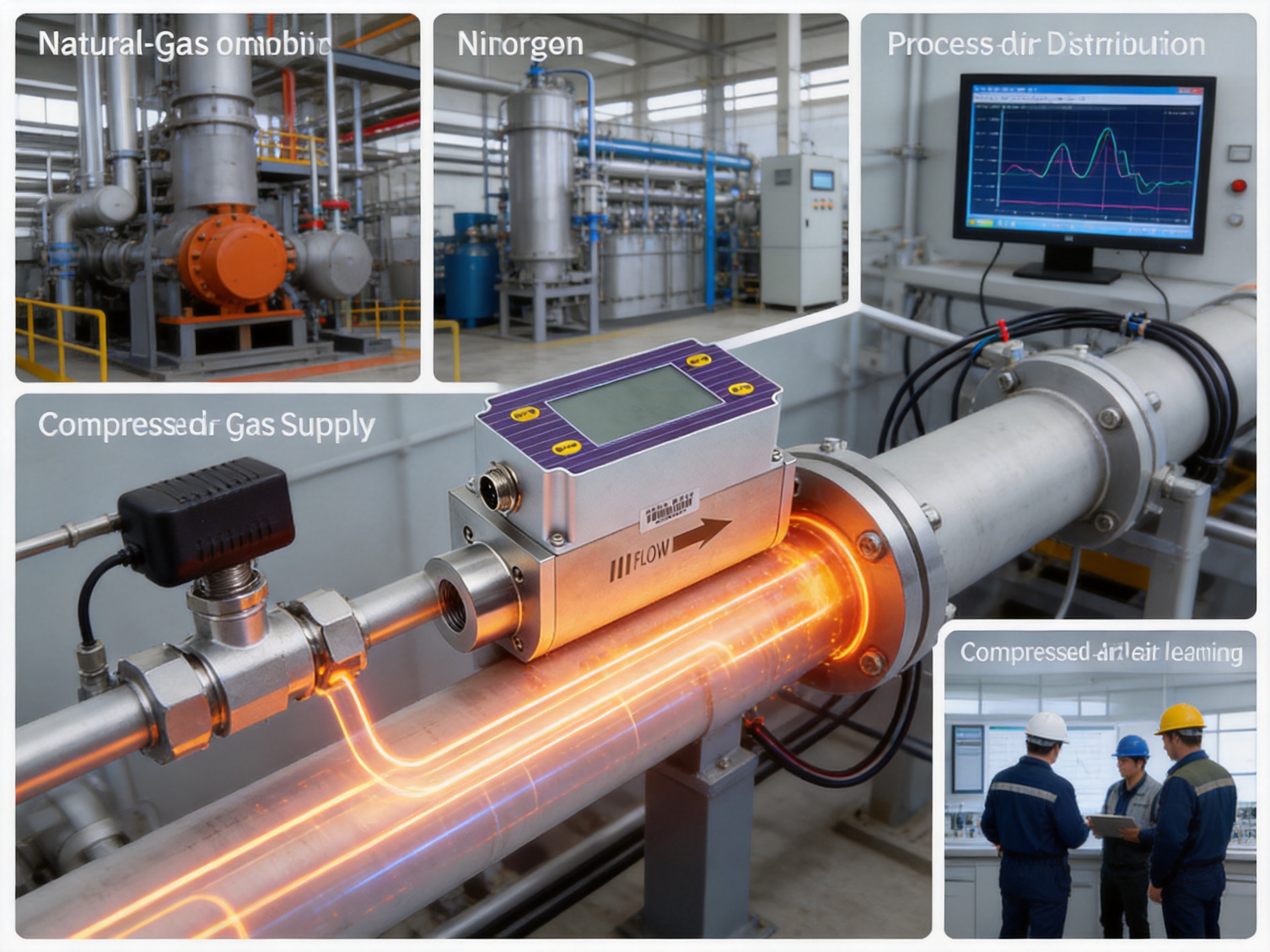
7.1 Compressed-air monitoring
Compressed air is one of the most common industrial utilities and one of the easiest to waste. Leaks, oversized compressors, inappropriate pressure settings, and inefficient end-use equipment can increase energy consumption.
Installed at the compressor outlet or on individual production branches, the AI-FT can measure air consumption and provide a flow signal to a monitoring system. Comparing flow during production and non-production periods can help identify leakage. Comparing flow among departments can also support energy-cost allocation and improvement projects.
7.2 Natural-gas and fuel-gas systems
Combustion equipment requires a stable gas supply. Flow monitoring can support burner control, fuel-consumption reporting, process optimization, and abnormal-condition detection. The meter’s direct thermal measurement approach can be useful where users need mass-related information and want to avoid a complex external compensation system.
Gas compatibility must be confirmed before installation. The product is specified for various gases except acetylene, and the customer should provide the gas type, composition, pressure, temperature, humidity, and possible contaminants for final technical evaluation.
7.3 Nitrogen and inert-gas distribution
Nitrogen is often used for purging, blanketing, oxidation prevention, and process protection. A flow meter can help verify that the required flow is available and can identify excessive use. Standard volumetric-flow information can also assist with supply planning and operating-cost analysis.
7.4 Oxygen and process gases
Oxygen and other process gases require careful material and safety assessment. Where the application is compatible with the instrument’s construction and operating limits, the meter can provide continuous gas-flow information for production monitoring and control. All oxygen-service requirements, cleanliness procedures, installation rules, and certification needs must be reviewed before ordering.
7.5 Gas-leak detection
A flow meter can serve as one element of a gas-leak detection strategy. If equipment is expected to be inactive but the meter continues to record flow, the data may indicate leakage or an open valve. The product information identifies the wide measurement range as suitable for gas-leak detection.
The meter itself is listed with no dedicated alarm function. Therefore, alarm logic can be implemented in a PLC, supervisory control system, energy-management platform, or other external controller using the 4–20 mA or RS-485 signal.
7.6 Process equipment monitoring
Gas flow is often an indirect indicator of equipment condition. A sudden reduction may indicate a blocked filter, closed valve, insufficient supply pressure, or control malfunction. An unexpected increase may indicate a leak, damaged seal, failed regulator, or process deviation.
By combining flow data with temperature monitoring, pressure information, equipment status, and production data, users can develop a more complete condition-monitoring system.
8. Installation Considerations
Correct installation is essential for any flow meter. Before selecting the instrument, the user should confirm pipe diameter, gas type, operating pressure, operating temperature, expected minimum and maximum flow, pipe material, available straight-pipe length, installation orientation, and required output interface.
The sensor should be installed in a location where the gas is representative of the process and where liquid accumulation, heavy dust, and severe turbulence are minimized. Upstream valves, elbows, reducers, expanders, filters, and branch connections can disturb the velocity profile. The recommended installation arrangement should be confirmed with the supplier for the actual piping system.
For hot pipelines, the split structure may be preferable because the converter has a lower operating-temperature limit than the sensor. The converter should be installed where the ambient temperature remains within -20°C to +55°C and where the display and wiring can be accessed safely.
Electrical wiring should follow the requirements of the selected control system. The 4–20 mA circuit must be designed within the specified load limit. RS-485 wiring should use suitable industrial practices for polarity, shielding, grounding, termination, and network topology.
The pipeline should be free from conditions that can damage or coat the sensing elements. Gas composition and contamination are especially important because thermal measurement depends on heat-transfer behavior. Changes in gas composition can change thermal conductivity, specific heat, and density, which may influence the relationship between heating power and flow.
Although the instrument can measure many gases, it should not be assumed that calibration for one gas automatically provides identical performance for another gas. The gas type and operating conditions should be stated when requesting a quotation or technical confirmation.
9. Commissioning and Calibration
Commissioning begins with verification of the mechanical installation. The installer should check that the meter is correctly oriented, securely mounted, and compatible with the pipeline pressure and temperature. Electrical connections should be inspected before power is applied.
The next step is parameter configuration. Depending on the product version and application, parameters may include gas type, pipe size, standard reference conditions, flow units, output range, communication settings, and display preferences. These settings affect the conversion of the sensor signal into displayed flow values.
After configuration, the system should be checked under known process conditions. The displayed reading can be compared with a reference instrument, a controlled flow condition, or a validated process balance. Any difference should be evaluated in relation to installation effects, gas properties, reference conditions, and the stated accuracy range.
Calibration and verification should be performed according to the user’s quality-management requirements and the criticality of the application. For general utility monitoring, periodic verification may be sufficient. For custody-related measurement, safety-critical control, or regulated processes, a more formal calibration program may be required.
The digital design supports maintenance and parameter management. RS-485 communication can assist with centralized access when the instrument is integrated into a suitable industrial network. The local four-line LCD display provides field personnel with direct access to operating information without necessarily requiring a laptop or separate handheld device.
10. Data, Automation, and Smart-Factory Integration
Industrial digitalization depends on reliable field data. A flow meter is valuable not only because it displays a number but also because it provides a trustworthy data point that can be combined with other information.
The AI-FT can send a continuous 4–20 mA signal to a PLC, data logger, or control system. The signal can be scaled to the configured flow range and used for control, trend recording, consumption reporting, or external alarm logic.
RS-485 communication provides an additional path for digital integration. In a factory network, the meter can become part of a broader data architecture that includes wireless temperature sensors, industrial transmitters, power-line communication devices, and edge-layer hardware.
Typical data applications include:
• Daily, weekly, and monthly gas-consumption reporting.
• Production-line energy benchmarking.
• Comparison of gas use against production output.
• Detection of flow during scheduled shutdowns.
• Identification of abnormal process demand.
• Monitoring of equipment start-up and shutdown behavior.
• Support for preventive maintenance.
• Verification of process recipes and operating procedures.
• Centralized management of distributed utility meters.
When flow data is connected to an industrial platform, organizations can move from occasional manual inspection to continuous improvement. Historical trends help engineers determine whether a process change has reduced consumption, whether a leak has returned, or whether equipment performance is degrading.
11. Maintenance and Long-Term Reliability
The AI-FT is designed to reduce mechanical maintenance because the sensor has no moving parts. This is valuable in production facilities where interrupting a pipeline may be difficult or expensive.
Maintenance should nevertheless include periodic visual inspection, wiring checks, display verification, communication checks, and review of measurement trends. If the gas contains dust, oil vapor, moisture, or other contaminants, the sensing section should be inspected according to site conditions.
Unexpected changes in measurement should not immediately be attributed to instrument failure. Engineers should first check whether the gas composition, operating pressure, temperature, process demand, pipe configuration, or valve position has changed. A thermal meter responds to the heat-transfer properties of the gas, so changes in gas mixture can affect the measurement relationship.
The converter should be protected from excessive heat, water ingress, impact, and unauthorized adjustment. The specified IP40 protection level means that the installation environment should be selected carefully. Where the site contains washdown, outdoor exposure, or heavy dust, additional enclosure or installation protection may be necessary.
Long-term reliability is supported by several design characteristics: platinum sensing elements, 316 stainless-steel sensor construction, digital signal processing, no moving parts, and selectable split or integrated installation. These features do not eliminate the need for proper application engineering, but they help reduce common sources of failure and measurement instability.
12. ASY Electronics as an Industrial Technology Partner
ASY Electronics is positioned as a provider of industrial IoT communication solutions and sensing products. Its stated mission is to help build efficient, reliable, and green smart factories through data sensing and intelligent connectivity.
The company’s capabilities extend beyond individual instruments. Its products address several layers of an industrial system:
• Sensing: thermal gas mass flow meters, wireless temperature-monitoring sensors, and industrial transmitters.
• Connectivity: broadband power-line carriers and industrial communication equipment.
• Control and access: automatic door controllers and related automation devices.
• Integration: industrial data solutions for equipment condition monitoring, energy management, and production optimization.
This broader portfolio can be useful for customers seeking coordinated solutions rather than isolated components from multiple vendors. For example, a factory may use the AI-FT to measure compressed-air flow, wireless sensors to monitor motor or cabinet temperatures, transmitters to collect process variables, and power-line communication devices to connect equipment in locations where new network cabling is difficult.
As a China-based manufacturer, ASY Electronics can support product customization and application-specific development. The supplied information identifies custom power-line carrier solutions and industrial IoT solution capabilities as part of its business focus. For the flow meter, customers should discuss gas composition, pipe size, installation method, output requirements, display language, communication protocol, materials, and environmental conditions during the technical review.
The combination of manufacturing, sensing, and connectivity capabilities gives the company a practical understanding of industrial deployment. A successful smart-factory project must account for installation, data transmission, system integration, maintenance, and operator use—not only sensor performance in a laboratory.
13. Engineering Selection Guide
Before purchasing a thermal gas mass flow meter, users should prepare a complete application record. The following information helps determine whether the AI-FT is suitable:
• Gas name and composition.
• Whether the gas is dry, wet, clean, dusty, oily, or corrosive.
• Normal, minimum, and maximum operating flow.
• Pipe diameter and pipe material.
• Operating pressure and pressure fluctuations.
• Minimum and maximum gas temperature.
• Available straight-pipe length.
• Required output signal and communication method.
• Whether a local display is required.
• Whether the converter must be installed remotely.
• Required accuracy and calibration documentation.
• Applicable electrical, safety, and industry standards.
• Whether the application involves hazardous or regulated gas service.
The AI-FT is specified for various gases except acetylene. This exclusion is important and should be observed strictly. Other gases may also require special evaluation because of chemical compatibility, thermal properties, oxygen-service requirements, flammability, or calibration needs.
The stated accuracy is ±1% to ±2.5%. The exact performance depends on the selected configuration and application. Users should request the applicable accuracy conditions, including gas type, flow range, temperature, pressure, installation arrangement, and calibration method.
14. Competitive Value and Total Cost of Ownership
Product competitiveness should be evaluated across the full operating life rather than only by purchase price. A flow meter with simple installation, low pressure loss, minimal mechanical wear, flexible communication, and reduced external compensation requirements can produce savings over many years.
The AI-FT offers several potential total-cost-of-ownership advantages:
• Fewer external compensation devices may be required.
• The absence of moving parts can reduce mechanical servicing.
• Digital communication can reduce manual data collection.
• Fast response can improve process control.
• Wide measurement capability can reduce the need for separate low-flow instruments.
• Split or integrated structures can reduce installation redesign.
• Standard 4–20 mA output supports existing automation infrastructure.
• RS-485 supports networked monitoring and centralized data access.
• Direct gas-flow information can support energy-saving projects.
These advantages are most significant when the meter is used as part of a complete measurement strategy. Installing a single instrument may provide a local reading, but connecting multiple meters to a factory data platform can produce more valuable information about utility distribution, production efficiency, and abnormal consumption.
15. Practical Limitations and Application Discipline
A professional product evaluation should also consider limitations. Thermal mass meters are sensitive to gas properties. If the gas composition changes substantially, the heat-transfer relationship may change. Calibration and configuration should therefore match the intended gas service.
Installation conditions can influence accuracy. Swirling flow, insufficient straight pipe, sudden changes in pipe diameter, upstream obstructions, liquid contamination, and sensor coating may affect results. Proper piping design and application review are important.
The converter temperature range is narrower than the sensor temperature range. A high-temperature installation may require a split structure and careful mounting of the converter in a cooler environment.
The protection level is IP40, so the instrument should not be treated as inherently suitable for exposed washdown or severe outdoor conditions. Enclosure design and environmental protection must be handled as part of the installation plan.
The product is not described as having a built-in alarm output. If the process requires high-flow, low-flow, or leak alarms, these functions should be implemented through the PLC, supervisory system, or another external controller.
Finally, the instrument should not be selected solely by pipe diameter. Gas type, flow range, operating conditions, installation geometry, and required measurement reference conditions are equally important.
16. Frequently Asked Questions
Q1. What is the AI-FT thermal gas mass flow meter used for?
It is used to measure the flow of gases in industrial pipelines. Common applications include compressed-air monitoring, utility management, process-gas measurement, fuel-gas monitoring, nitrogen distribution, equipment monitoring, and gas-leak detection.
Q2. How does the meter measure gas flow?
It uses two platinum resistance temperature sensors. One measures the gas temperature, while the other is heated above the gas temperature. As gas moves past the heated sensor, it removes heat. The additional power required to maintain a constant temperature difference is related to gas flow velocity.
Q3. Does the meter require a separate temperature sensor?
In principle, no separate temperature compensation sensor is required for normal thermal measurement because the instrument maintains the heated sensor at a controlled temperature difference above the medium. However, users should follow the supplier’s application requirements for gas composition, reference conditions, and system integration.
Q4. What pipe sizes are supported?
The stated pipeline range is DN25 to DN50. A final selection should also consider the actual pipe dimensions, connection method, installation location, and required flow range.
Q5. What gases can be measured?
The meter is specified for various gases except acetylene. Gas compatibility should be confirmed before purchase, particularly for corrosive, reactive, wet, contaminated, oxygen-rich, flammable, or mixed-gas applications.
Q6. What is the maximum operating pressure?
The stated medium pressure limit is up to 3.0 MPa. The customer should verify the pressure rating for the complete selected structure, connections, pipe material, and installation configuration.
Q7. What is the accuracy?
The listed accuracy is ±1% to ±2.5%. The applicable value depends on the selected configuration and operating conditions. The gas type, flow range, installation quality, and calibration conditions should be reviewed for a specific project.
Q8. Can the meter detect gas leaks?
It can support gas-leak detection by measuring low or unexpected flow, especially when equipment should be inactive. The product information does not list a dedicated built-in alarm function, so alarm logic would normally be handled by an external control or monitoring system.
Q9. What outputs are available?
The meter provides a 4–20 mA output with a maximum load of 500 Ω and RS-485 communication. These interfaces support connection to PLCs, distributed control systems, data loggers, industrial computers, and factory automation networks.
Q10. Is the meter available in a remote-display version?
Yes. The product is available in split or integrated structures. A split structure allows the converter and display to be positioned away from the sensing point, which can be useful for hot, vibrating, or difficult-to-access pipelines.
Q11. What information is shown on the local display?
The four-line LCD display can show standard volumetric flow rate, cumulative flow rate, standard flow velocity, and other operating information, depending on the configured product version.
Q12. What is the response time?
The specified response speed is approximately one second. This allows the meter to respond quickly to changing gas-flow conditions.
Q13. Does the meter have moving parts?
No. The sensor has no moving mechanical parts or pressure-sensing components. This supports vibration resistance, long service life, and reduced mechanical maintenance.
Q14. What is the sensor material?
The sensor material is specified as 316 stainless steel. The pipe or body can be supplied in anodized aluminum or stainless steel, depending on the selected configuration and application requirements.
Q15. What should be checked before ordering?
Users should provide the gas type and composition, pipe diameter, flow range, pressure, temperature, installation arrangement, material requirements, communication needs, display requirements, and environmental conditions. These details are necessary for correct selection and performance evaluation.
17. Conclusion
The AI-FT high-performance thermal gas mass flow meter provides a practical solution for direct industrial gas-flow measurement. Its constant-temperature-difference thermal-diffusion principle, platinum temperature sensors, 316 stainless-steel sensing section, digital circuit design, fast response, and flexible communication interfaces make it suitable for a wide range of applications.
Its main advantages over conventional technologies include reduced dependence on external temperature and pressure compensation, no moving parts, low maintenance requirements, broad flow capability, support for leak detection, and straightforward connection to automation systems. The split and integrated structure options further improve installation flexibility.
For modern factories, the value of the instrument extends beyond local flow indication. Through 4–20 mA and RS-485 connectivity, it can become part of a wider industrial IoT system that tracks energy consumption, supports equipment monitoring, identifies abnormal demand, and improves production efficiency.
ASY Electronics strengthens this product offering with broader capabilities in industrial sensing, connectivity, transmitters, wireless monitoring, power-line communication, and smart-factory data integration. By combining field measurement with industrial communication technologies, the company can support customers developing efficient, reliable, and more sustainable production systems.
Successful deployment still depends on correct gas selection, installation design, calibration, environmental protection, and system integration. When these factors are properly addressed, the AI-FT can provide dependable gas-flow data for process control, energy management, maintenance, and long-term industrial optimization.
References
1. Product technical information for the AI-FT high-performance thermal gas mass flow meter, including operating ranges, materials, outputs, and structural options.
2. Internal product description of constant-temperature-difference thermal-diffusion measurement technology.
3. Industrial instrumentation principles for thermal mass flow measurement and gas-density relationships.
4. Industrial automation practices for 4–20 mA signal transmission and RS-485 field communication.
5. Smart-factory application concepts covering equipment condition monitoring, energy management, and industrial data integration.
6. General engineering guidance for gas-flow meter selection, installation, calibration, and maintenance.