


Industrial communication systems must continue operating when ordinary office-grade equipment cannot. In mining areas, chemical plants, utility facilities, transport infrastructure, process plants, and other demanding locations, communication equipment may be exposed to dust, moisture, corrosive gases, vibration, temperature extremes, and difficult installation conditions. A communication terminal installed in such an environment must do more than transmit voice. It must support dependable coordination, rapid alarm notification, straightforward networking, and long service life.
The CS618L-FB24 DC explosion-proof digital telephone is designed for this type of application. It combines a heavy-duty aluminum alloy enclosure, an explosion-proof IP68 protection grade, wideband power carrier communication, automatic IP assignment, self-organizing networking, and a DC 24V power-and-signal architecture. The result is an industrial communication device intended to simplify deployment while supporting multi-party intercom, broadcasting, and alarm functions.
Unlike a conventional telephone that depends on a separately installed telecommunications cable, this unit uses the DC power line as the communication signal path. That design can reduce wiring complexity and make it easier to establish communication networks in locations where new cable routes are expensive, disruptive, or difficult to maintain. With a specified communication distance of up to 1,000 meters, the system can support communication across sizable industrial zones, depending on site conditions and network configuration.
This article examines the product’s operating concept, protection features, networking method, industrial advantages, manufacturing strengths, installation considerations, and suitability for demanding communication projects.
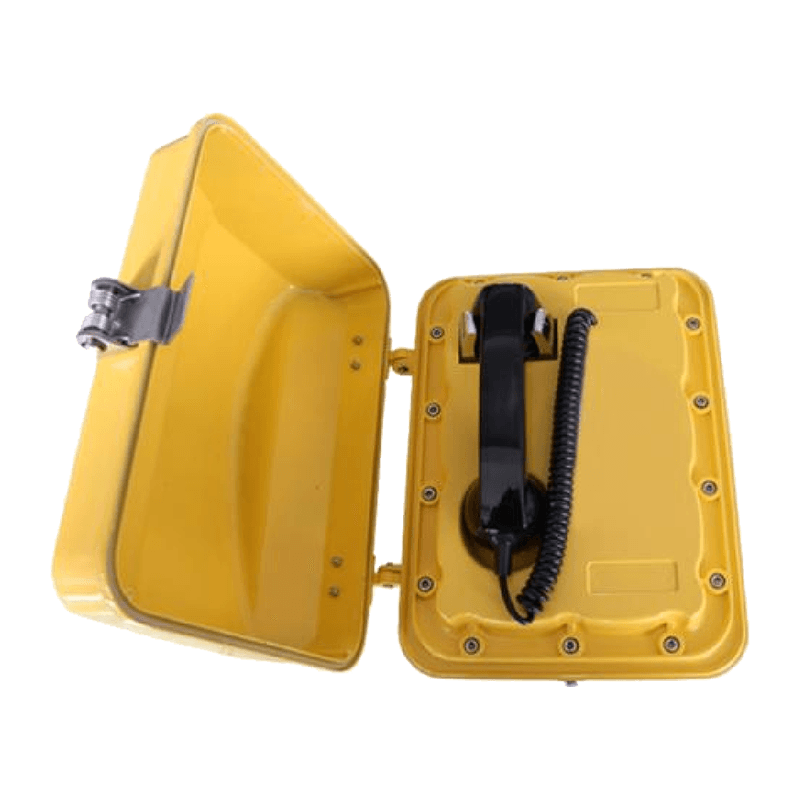
DC Explosion-Proof Digital Telephone
1. The Role of Reliable Communication in Hazardous Industrial Areas
Communication reliability is a core part of industrial safety and operational continuity. Production personnel need to exchange instructions, maintenance teams need to coordinate work, and control-room operators may need to broadcast warnings or emergency information. When an incident occurs, communication delays can increase downtime and complicate emergency response.
Many industrial sites are divided into separate workshops, production lines, storage areas, substations, tunnels, loading zones, and outdoor equipment areas. These areas may be separated by concrete walls, metal structures, machinery, pipes, tanks, or long open distances. Traditional communication systems can require extensive cabling, network switches, junction boxes, and separate power arrangements. Every additional component adds installation work and introduces more points that may require inspection or maintenance.
Hazardous or severe environments create further challenges. Equipment may need to withstand water ingress, dust, corrosive atmospheres, temperature fluctuations, and mechanical handling. A telephone designed for an office or commercial building is generally not suitable for these conditions. The enclosure, power architecture, communication method, mounting structure, and internal components must all be considered as part of one industrial system.
The CS618L-FB24 addresses these needs through an integrated design. Its power supply and signal line use the same DC 24V connection, while wideband power carrier technology provides the communication channel. The enclosure is made from aluminum alloy and is specified with an explosion-proof IP68 rating and WF1 corrosion-proof grade. These features are intended to support use in demanding industrial environments where protection and simplified deployment are equally important.
2. Product Overview
The CS618L-FB24 is a DC explosion-proof digital telephone classified as a PLC digital telephone. Its core function is not limited to point-to-point voice calling. It is described as a multi-party intercom, broadcast, and alarm all-in-one machine. This makes it suitable for facilities that need both routine operational communication and centralized or distributed notification.
The product operates from a DC 24V supply. The same DC 24V line also serves as the signal line, allowing power and communication data to travel through the same connection. The communication method is wideband power carrier, and the networking mode includes automatic IP assignment and self-organizing network formation.
The product’s key characteristics include:
• DC 24V operating and signal voltage.
• Wideband power carrier communication.
• Automatic IP allocation.
• Self-organizing network capability.
• Plug-and-play deployment without separate signal wiring.
• Multi-party intercom, broadcasting, and alarm functions.
• Communication distance of up to 1,000 meters under suitable conditions.
• Explosion-proof IP68 protection grade.
• WF1 corrosion-proof grade.
• Aluminum alloy enclosure.
• Working temperature from -40°C to 85°C.
• Wall-mounting installation.
• Approximate overall weight of 7 kg.
These characteristics position the unit as an industrial communication terminal for facilities where installation simplicity, environmental protection, and coordinated voice communication are priorities.
3. Power-Line Communication Architecture
3.1 Power and Signal on One Line
A major design advantage of the product is its combined power-and-signal architecture. The supply voltage is DC 24V, and the signal line voltage is also DC 24V. Instead of installing a dedicated power cable and a separate communication cable, the system uses the power cord as the communication signal path.
This arrangement can reduce the amount of wiring required for a project. It can also simplify cable routing in existing plants where conduits are congested or where new cable installation would require extended shutdowns. In remote equipment areas, the reduction in cable infrastructure may make a communication point more practical to install.
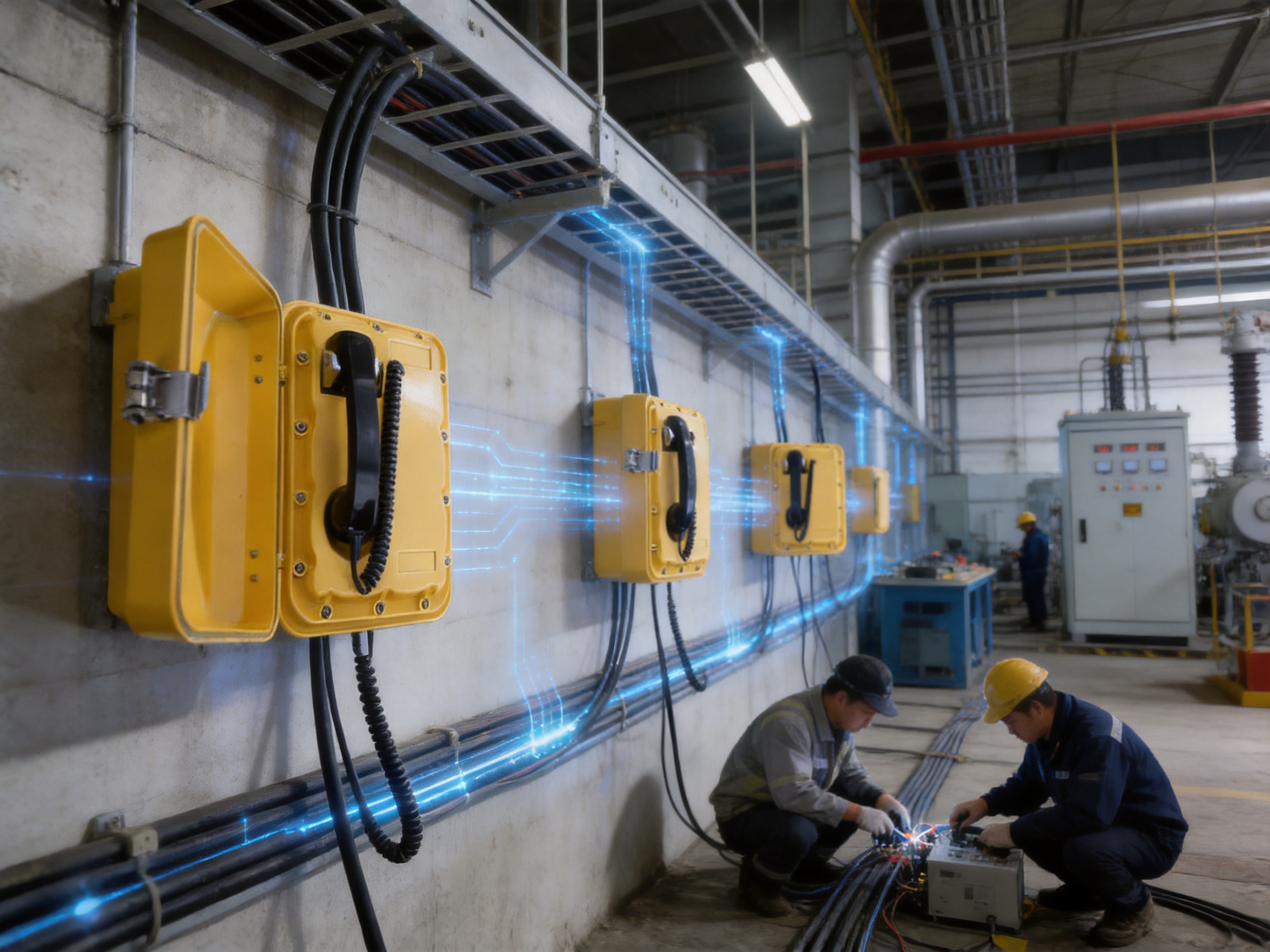
Power-line communication is especially useful where the electrical infrastructure already reaches the required equipment locations. A project can potentially use the available DC distribution path as the foundation for the communication network, subject to system design, compatibility, line quality, and safety requirements. This approach can shorten deployment time and reduce the number of independent connections that technicians must terminate and test.
3.2 Wideband Power Carrier Communication
The CS618L-FB24 uses wideband power carrier communication. In this architecture, communication information is carried over the power line using a carrier signal. The system therefore combines the functions of a power connection and a data connection within one industrial communication infrastructure.
Wideband carrier communication can support networked voice and control functions while avoiding the need for conventional telephone wiring at every terminal. For large or distributed installations, this may be an important alternative to systems that require extensive dedicated communication cable. The actual performance of any power-line communication network depends on cable characteristics, electrical noise, line length, distribution structure, and the number and arrangement of connected devices. These factors should be evaluated during project planning.
Even with those engineering considerations, the integrated architecture provides a strong practical advantage: communication can be added to an existing DC-powered industrial area without automatically creating a second, parallel wiring system. This is particularly valuable for retrofit projects and phased expansions.
4. Automatic IP Assignment and Self-Organizing Networking
Network configuration is often a major source of installation time. Conventional systems may require engineers to assign addresses manually, configure network parameters, commission switches, and verify each endpoint individually. Such work can become complicated when the site includes many terminals or when equipment is installed across multiple zones.
The CS618L-FB24 supports automatic IP assignment and a self-organizing network mode. These features are intended to reduce the configuration burden. When devices are connected, the network can automatically allocate IP information and organize participating terminals without the same level of manual addressing work required by conventional systems.
The self-organizing approach is particularly useful for industrial projects in which devices are added progressively. A production facility may begin with a small number of communication terminals and later expand to additional workshops, emergency points, or control stations. A network that can organize new nodes with limited manual intervention can make expansion easier and reduce the risk of configuration errors.
Automatic network organization also supports the product’s plug-and-play concept. The term does not eliminate the need for professional engineering, safety inspection, or commissioning. However, it indicates that the product is designed to reduce unnecessary setup steps compared with systems that demand extensive manual network debugging at every endpoint.
4.1 Benefits for System Integrators
For a system integrator, simplified networking can produce several practical benefits:
• Faster initial deployment.
• Less manual IP address management.
• Reduced risk of duplicate address settings.
• Easier replacement of a failed terminal.
• More straightforward expansion of the communication network.
• Lower training requirements for routine installation tasks.
• Shorter commissioning procedures when site conditions are suitable.
The value of these functions becomes greater as the number of terminals increases. A small installation may not require sophisticated network automation, but a large industrial facility can benefit significantly from reduced configuration effort.
5. Multi-Party Intercom, Broadcasting, and Alarm Functions
The product is designed as an all-in-one communication machine with multi-party intercom, broadcast, and alarm capabilities. Combining these functions in one industrial terminal can simplify the overall system architecture. Instead of deploying separate devices for routine calls, announcements, and emergency signaling, a facility can use a unified communication platform.
5.1 Multi-Party Intercom
Multi-party intercom supports communication among multiple terminals or users. This is useful when a maintenance team, control room, production supervisor, and field operator need to participate in the same conversation. In industrial operations, decisions often require input from more than two people, especially during equipment troubleshooting, process changes, or emergency coordination.
A networked intercom function can also reduce the need for personnel to travel between areas simply to exchange information. This saves time and helps keep employees away from hazardous or restricted zones unless their physical presence is necessary.
5.2 Broadcasting
Broadcasting allows information to be distributed to multiple locations. Typical examples include shift instructions, production announcements, maintenance notices, evacuation directions, and operational reminders. When a message must reach several work areas at once, broadcasting is more efficient than making a series of individual calls.
The specified output spread is 8 ohms and 25 watts, while the rise-up specification is listed as 8 ohms and 5 watts. These audio parameters indicate that the product is designed for industrial voice output rather than quiet office conversation alone. The appropriate speaker arrangement and acoustic coverage should be determined according to the site’s background noise, area size, enclosure layout, and required sound pressure level.
5.3 Alarm Communication
Alarm communication is an important part of industrial response. A networked telephone that also supports alarm functions can help bring communication and notification into one system. Operators may use the network to alert personnel, coordinate response teams, and share status information during abnormal conditions.
The product should be integrated into the site’s broader emergency plan. A communication terminal is one element of a safety system and should not be treated as a substitute for required detection, shutdown, fire protection, or evacuation equipment. Its value lies in providing a robust channel for human communication and notification within the approved system architecture.
6. Protection for Severe Industrial Environments
6.1 Explosion-Proof IP68 Enclosure
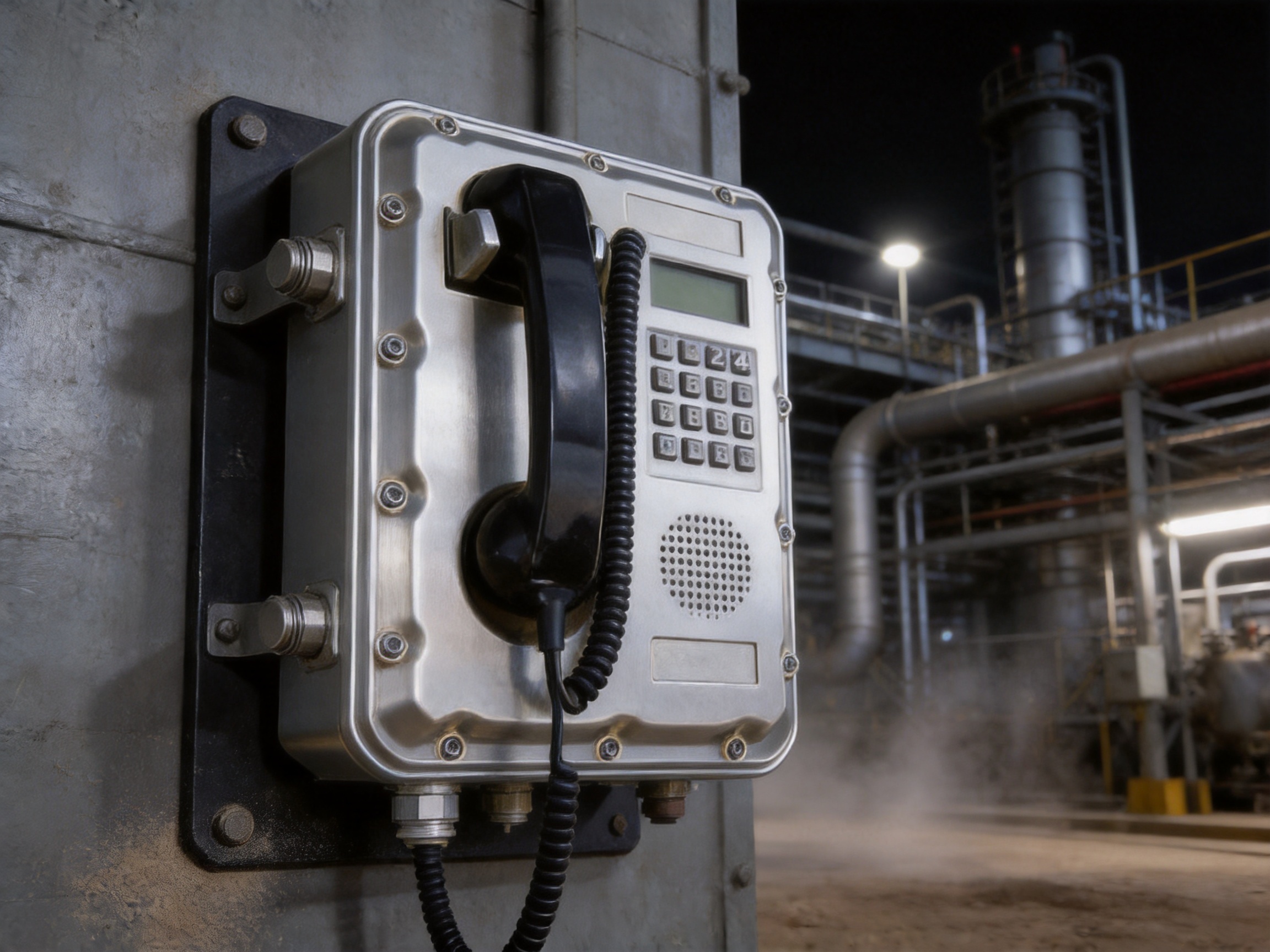
The product is specified with an explosion-proof IP68 protection grade. This is a significant distinction from ordinary industrial telephones with basic dust or splash resistance. The enclosure is intended for use in environments where equipment protection and containment requirements are more demanding.
IP68 generally indicates a high level of protection against dust ingress and water immersion under defined test conditions. The exact test depth, duration, installation limitations, and applicable certification requirements should always be confirmed through the official technical documentation and project approval process. Protection ratings are meaningful only when the device is installed correctly and all cable entries, covers, seals, and mounting interfaces are maintained according to the manufacturer’s instructions.
For industrial users, a sealed enclosure can reduce the risk that dust, moisture, or process contamination will reach sensitive internal components. This supports reliability in outdoor areas, washdown zones, dusty workshops, and locations exposed to changing weather conditions.
6.2 Aluminum Alloy Construction
The enclosure is made from heavy-duty aluminum alloy. Aluminum alloy offers a useful balance between structural strength and weight. At approximately 7 kg, the product is substantial enough for industrial use while remaining practical for wall mounting by a qualified installation team.
A rigid metal enclosure helps protect internal electronics from accidental impact, handling damage, and environmental stress. It can also provide a stable mounting structure for the telephone and associated audio components. The enclosure material contributes to the product’s professional industrial form factor and differentiates it from lightweight plastic communication devices intended for less demanding locations.
6.3 Corrosion Resistance
The product has a WF1 corrosion-proof grade. This specification is important for facilities where the atmosphere may contain corrosive substances or where equipment is exposed to humidity and industrial pollutants. Examples may include chemical processing areas, wastewater facilities, coastal plants, metal treatment workshops, and some mining or energy installations.
Corrosion protection is not determined by the enclosure material alone. Surface treatment, fasteners, cable glands, seals, mounting brackets, and maintenance practices also affect long-term performance. The stated WF1 grade nevertheless indicates that corrosion resistance was considered as part of the product’s industrial design.
6.4 Wide Temperature Range
The specified working temperature range is -40°C to 85°C. This broad range allows the product to be considered for cold outdoor installations, unheated industrial buildings, hot equipment rooms, and facilities with substantial seasonal temperature changes.
Temperature resistance is valuable because communication equipment may be installed in locations where conventional indoor electronics would experience shortened life or unstable operation. The enclosure and internal components must work together to manage thermal stress, expansion, contraction, and heat generated during operation.
Users should distinguish between the product’s rated operating temperature and the temperature conditions of the entire installation. Direct solar radiation, nearby hot surfaces, enclosed cabinets, ventilation limitations, and local heat sources can create conditions that differ from the general ambient temperature. Site engineering should account for these factors.
7. Electrical and Operating Specifications
The following table summarizes the available technical information for the CS618L-FB24.
| Parameter | Specification |
|---|---|
| Product type | DC explosion-proof digital telephone |
| Item number | CS618L-FB24 |
| Supply voltage | DC 24V |
| Signal line voltage | DC 24V |
| Communication method | Wideband power carrier |
| Networking mode | Automatic IP assignment and self-organizing network |
| Protection grade | Explosion-proof IP68 |
| Enclosure material | Aluminum alloy |
| Rise-up output | 8 ohms, 5W |
| Spread output | 8 ohms, 25W |
| Power consumption, standby | 5W |
| Power consumption, full load | 25W |
| Working temperature | -40°C to 85°C |
| Relative humidity | 10% to 95%, non-condensing |
| Barometric pressure | 80 to 110 kPa |
| Corrosion-proof grade | WF1 |
| Outline dimensions | 343 × 294 × 206 mm |
| Overall weight | Approximately 7 kg |
| Installation method | Wall mounting |
The product’s standby power consumption is listed as 5W, increasing to 25W at full load. This provides useful information for power-system planning. Engineers can estimate the DC distribution requirements, backup capacity, and energy budget for a network containing multiple units. Actual system calculations should include cable losses, power-supply efficiency, startup conditions, connected equipment, and the operating state of all network components.
The relative humidity specification is 10% to 95% non-condensing. Non-condensing operation means that moisture should not form liquid water on internal surfaces. If the product is installed in a location subject to condensation, suitable environmental controls, enclosure positioning, drainage, or protective design measures may be necessary.
8. Advantages Compared with Conventional Industrial Communication Terminals
8.1 Reduced Wiring Complexity
One of the clearest advantages is the use of the power line for communication. Conventional communication terminals may require separate power and signal cables, additional cable trays, junction boxes, and more termination points. The CS618L-FB24 is designed to combine power and communication on the DC 24V line, potentially reducing material use and installation labor.
This advantage is especially relevant in retrofit environments. Existing plants often have limited space for new cables, and installing a separate communication network may require costly civil work. A power-line communication solution can offer a more adaptable path when the required DC power infrastructure is already available.
8.2 Simplified Commissioning
Automatic IP allocation and self-organizing networking reduce the need for manual network setup. Competing solutions based on conventional Ethernet or dedicated telephone networks may require more individual configuration, especially when the system contains many endpoints or when devices are distributed across difficult areas.
The product does not eliminate commissioning, but it can make the commissioning process more focused. Installers can concentrate on verifying power quality, line conditions, endpoint operation, audio coverage, and safety compliance rather than performing repetitive address assignment at every device.
8.3 Integrated Communication Functions
Multi-party intercom, broadcast, and alarm features are integrated into one product concept. This reduces the need to combine separate intercom stations, amplifiers, alarm terminals, and public-address devices. A unified system can be easier for operators to understand and easier for maintenance teams to support.
8.4 Environmental Protection
The combination of aluminum alloy construction, explosion-proof IP68 protection, WF1 corrosion resistance, and a -40°C to 85°C operating range gives the product an environmental specification suited to challenging industrial applications. Many general-purpose communication terminals cannot offer this combination of protection and temperature capability.
8.5 Long-Distance Industrial Communication
The product is described as supporting a talking distance of up to 1,000 meters. This can be beneficial for large workshops, long production lines, underground or semi-enclosed areas, plant perimeters, and distributed equipment zones. The actual achievable distance must be confirmed against the project’s cable structure and electrical environment, but the stated range provides a useful design reference.
8.6 Wall-Mounted Industrial Form Factor
Wall mounting allows the unit to be positioned at a fixed, accessible location without requiring a separate desk, cabinet, or portable stand. The dimensions of 343 × 294 × 206 mm provide a substantial enclosure suitable for industrial handling. A fixed installation can also make the communication point easier to identify during routine operations or emergencies.
9. Manufacturing and Engineering Strengths
The product is supplied by ASY Electronics, a high-tech enterprise focused on smart-factory development, industrial data sensing, intelligent connectivity, and integrated industrial solutions. Its stated product portfolio includes broadband power line carriers, wireless temperature monitoring systems, industrial transmitters, flow meters, and automatic door controllers.
This broader product range is important because the manufacturer’s capabilities are not limited to one isolated communication device. The company operates across several industrial technology categories that involve sensing, connectivity, data transmission, and equipment integration. Such experience can support a more complete understanding of how communication terminals must function within real production environments.
9.1 Industrial Product Development
Developing a product such as the CS618L-FB24 requires coordination between mechanical design, electrical engineering, communication technology, audio performance, environmental protection, and industrial installation. The product’s specifications show that these aspects have been brought together in one design:
• Mechanical protection through a heavy-duty aluminum alloy enclosure.
• Electrical operation through DC 24V power.
• Communication through a wideband power carrier.
• Network management through automatic IP assignment and self-organization.
• Industrial audio output for intercom and broadcasting.
• Environmental resistance across a broad temperature and humidity range.
• Wall-mounting for practical field installation.
These combined requirements demand more than the assembly of standard office communication components. The product must be engineered for the interaction between industrial power infrastructure and networked communication functions.
9.2 Data Sensing and Intelligent Connectivity
The company’s stated focus on data sensing and intelligent connectivity is relevant to the future of industrial communication. Modern factories increasingly require equipment to exchange information with control systems, monitoring platforms, energy-management tools, and maintenance applications. A digital telephone with IP-based self-organizing communication can form part of this connected industrial environment.
The same manufacturing philosophy can support other industrial products, including wireless temperature monitoring systems and transmitters. These products address different data requirements, but they share common engineering priorities: dependable field operation, practical installation, clear signal transmission, and integration with industrial workflows.
9.3 Smart-Factory Orientation
The company describes its mission as helping manufacturers create efficient, reliable, and green smart factories. The CS618L-FB24 contributes to this objective by simplifying communication infrastructure and supporting faster information exchange across production areas.
Effective industrial digitalization is not limited to sensors and software. Human communication remains essential. Operators, maintenance staff, supervisors, and emergency personnel need immediate access to reliable voice channels. A protected digital telephone can therefore complement automated monitoring systems and provide an important human interface within a smart factory.
9.4 Manufacturing Process Considerations
Although detailed factory process records are not provided, the product’s design implies several important manufacturing priorities. A product intended for explosion-proof and IP68 applications requires careful control of enclosure machining, sealing surfaces, fastener assembly, cable-entry compatibility, acoustic component installation, and electrical testing.
Quality manufacturing for this class of equipment generally depends on:
• Consistent aluminum alloy enclosure production.
• Controlled machining and finishing of mating surfaces.
• Correct installation of gaskets and sealing components.
• Verification of electrical insulation and power connections.
• Functional testing of intercom, broadcast, and alarm operation.
• Confirmation of network formation and address allocation.
• Inspection of audio output and load performance.
• Traceable assembly and final quality checks.
• Packaging designed to protect the enclosure during transport.
For system buyers, the manufacturer’s ability to combine product engineering with industrial data integration is a valuable strength. It indicates that the product can be considered not only as a standalone telephone but also as part of a broader industrial communication and monitoring solution.
10. Applications Across Industrial Sectors
10.1 Mining and Tunneling
Mines and tunnels often include long distances, restricted access, high dust levels, and difficult cable routes. Communication points may be required at equipment stations, transfer points, entrances, maintenance areas, and emergency locations. The explosion-proof enclosure and long-distance communication capability make the product a candidate for suitable approved mining communication projects.
The DC power-and-signal architecture may reduce the need to install separate communication wiring along long routes. Multi-party intercom and alarm functions can help coordinate work between field personnel and control areas. Project engineers must confirm that the product’s protection classification and certification meet the specific requirements of the mine, tunnel, and hazardous zone.
10.2 Chemical and Petrochemical Facilities
Chemical and petrochemical facilities may contain hazardous zones, corrosive atmospheres, extensive pipe racks, tank farms, and large process areas. Communication equipment in these locations must be selected according to the applicable hazardous-area classification and environmental conditions.
The CS618L-FB24’s explosion-proof IP68 protection, aluminum alloy construction, WF1 corrosion-proof grade, and broad temperature range address several important environmental considerations. It can support communication between control rooms, process units, field operators, maintenance areas, and emergency response points when incorporated into an approved system.
10.3 Power and Utility Infrastructure
Substations, utility plants, transformer areas, and distributed energy facilities require communication for routine switching, inspection, maintenance, and emergency coordination. These locations may be outdoors or may include high levels of electrical equipment and background noise.
The unit’s DC 24V operation is compatible with many industrial control and auxiliary power architectures, although the specific power system must be verified before installation. Its wall-mounted structure and protected enclosure can help provide a fixed communication point near critical equipment.
10.4 Manufacturing Plants
Large manufacturing plants often contain high-noise production lines, separated workshops, storage areas, and automated equipment zones. Broadcast capability can be useful for shift announcements and operational instructions, while intercom functions support maintenance and production coordination.
The product may also complement the manufacturer’s other industrial technologies. For example, temperature monitoring sensors can identify equipment conditions, while the digital telephone can provide a voice channel for response and coordination. Transmitters, flow meters, and communication products can similarly be combined into a larger industrial data and communication architecture.
10.5 Ports, Terminals, and Outdoor Facilities
Ports, loading areas, logistics yards, and outdoor processing facilities can expose communication equipment to rain, humidity, dust, salt-laden air, and temperature changes. A sealed aluminum alloy enclosure with corrosion-resistant design can be more appropriate than an indoor telephone or consumer-grade intercom.
The 1,000-meter communication distance can be useful for distributed yards and equipment corridors. The actual system layout should consider obstructions, cable routing, power distribution, and the acoustic environment created by vehicles and machinery.
11. Installation and Commissioning Guidance
Proper installation is essential to achieving the intended performance of any explosion-proof industrial device. The CS618L-FB24 is designed for wall mounting, so the installation surface must be strong, stable, and appropriate for the product’s approximate 7 kg weight.
11.1 Site Assessment
Before installation, the project team should assess:
• Hazardous-area classification.
• Ambient temperature and humidity.
• Exposure to water, dust, chemicals, and corrosive gases.
• Availability and quality of DC 24V power.
• Power-line route and expected communication distance.
• Electrical noise and interference sources.
• Wall strength and mounting access.
• Required voice coverage.
• Emergency communication procedures.
• Cable-entry and grounding requirements.
• Inspection and maintenance access.
The power-line communication design should be reviewed against the existing DC distribution system. The line must be able to provide the required voltage and current while supporting the communication carrier. Loads, converters, filters, switching devices, and other equipment connected to the same electrical network may affect performance and should be included in the engineering assessment.
11.2 Mounting
The telephone should be mounted on a surface capable of supporting its weight and resisting vibration. The enclosure should be positioned so that users can access the communication controls safely and so that the speaker output is not blocked by nearby structures.
Clearance around the unit may be needed for inspection, cable connection, cleaning, and service. Installation should avoid locations where the device may be struck by moving equipment or exposed directly to avoidable heat sources.
11.3 Power Connection
The DC 24V supply should be selected and installed according to the product requirements and the site’s electrical safety rules. System designers should calculate the total load for all connected units, including standby and full-load conditions. Voltage drop over long cable routes should also be checked.
Because the power line also carries the communication signal, the quality and structure of the supply connection are particularly important. Unplanned filters, incompatible power supplies, or electrical devices that attenuate the carrier signal may reduce communication performance. Testing should be conducted after installation under normal operating conditions.
11.4 Network Commissioning
Once the devices are powered, the installer should verify automatic IP assignment and self-organizing network operation. Each terminal should be checked for network presence, call functionality, multi-party communication, broadcasting, and alarm operation.
The commissioning record should include the terminal location, power source, network status, audio test result, alarm test result, and any observed limitations. A documented test process makes future maintenance and troubleshooting more efficient.
11.5 Audio Testing
Audio performance depends on enclosure placement, background noise, speaker orientation, room geometry, and the selected output configuration. The 8-ohm, 25W spread output should be tested at representative operating levels. Areas with high machinery noise may require careful positioning or additional system planning to ensure that messages are clearly understood.
12. Maintenance and Lifecycle Considerations
Industrial communication equipment should be included in the site’s preventive maintenance program. Regular inspection can help identify damaged seals, loose mounting hardware, corrosion, cable-entry problems, surface contamination, or changes in audio performance.
Maintenance teams should pay particular attention to the enclosure and its interfaces. IP68 and explosion-proof protection depend on the continued integrity of the housing, covers, seals, and cable connections. Unauthorized drilling, modification, or replacement with unsuitable parts can compromise protection.
Routine maintenance may include:
• Visual inspection of the aluminum alloy enclosure.
• Checking for corrosion or impact damage.
• Inspecting cable entries and seals.
• Confirming secure wall mounting.
• Testing routine calls and multi-party intercom.
• Testing broadcast clarity.
• Testing alarm communication.
• Checking standby and full-load power behavior.
• Reviewing network status and terminal availability.
• Cleaning the speaker area according to approved procedures.
• Recording faults and corrective actions.
For facilities with harsh conditions, maintenance intervals should be based on actual exposure rather than a generic calendar. Coastal, chemical, dusty, and high-vibration environments may require more frequent inspection.
13. How the Product Supports Efficient Smart Factories
Smart factories depend on reliable links between machines, sensors, software platforms, and people. Automated systems can monitor temperature, pressure, flow, energy use, equipment status, and production performance. However, when a condition requires human judgment, voice communication remains essential.
The CS618L-FB24 can provide a human communication layer within a connected industrial environment. A sensor may detect an abnormal temperature, a transmitter may report a process deviation, or a flow meter may indicate an unexpected condition. Personnel can then use the intercom or broadcast network to coordinate inspection, maintenance, and response.
This interaction between automated sensing and human communication supports several operational objectives:
• Faster response to equipment abnormalities.
• Better coordination between control rooms and field teams.
• Reduced travel time across large facilities.
• More consistent distribution of operating instructions.
• Improved communication during maintenance shutdowns.
• Stronger support for emergency procedures.
• Better integration of voice communication with industrial data systems.
The manufacturer’s portfolio of power-line carriers, wireless temperature monitoring products, transmitters, flow meters, and automatic door controllers creates opportunities for broader industrial solutions. Each product category addresses a different part of factory connectivity, while the shared focus on data sensing and intelligent connectivity can support system-level design.
14. Selection Considerations for Buyers
Organizations evaluating the CS618L-FB24 should consider the product within the full application environment. The correct device depends on the hazardous-area requirements, communication layout, power infrastructure, environmental exposure, and expected operating pattern.
14.1 Confirm Regulatory Requirements
Explosion-proof equipment must be selected according to the regulations and certification requirements applicable to the installation country and hazardous zone. Buyers should obtain the appropriate technical certificates, protection documentation, installation instructions, and approval information before placing the product into service.
14.2 Evaluate the Power Network
The DC 24V power network must be suitable for both energy delivery and carrier communication. Engineers should review cable length, voltage drop, connected loads, power-supply characteristics, electrical noise, and the effects of branch connections.
14.3 Determine Communication Coverage
The stated communication distance of up to 1,000 meters is a useful reference, but actual performance depends on the installation. A site survey or pilot test may be appropriate for large facilities, complex distribution systems, or electrically noisy environments.
14.4 Plan for Expansion
Automatic IP assignment and self-organizing network features can support future growth. Buyers should nevertheless define the expected number of endpoints, broadcast groups, alarm zones, control-room interfaces, and expansion areas. A scalable plan helps avoid unnecessary redesign later.
14.5 Consider Environmental Exposure
IP68 protection, WF1 corrosion resistance, and the -40°C to 85°C temperature range provide a strong starting point, but the actual environment must still be examined. Direct chemical exposure, salt spray, abrasive dust, intense sunlight, vibration, and condensation may require additional installation measures.
15. Why an Integrated Industrial Solution Is Valuable
A single product can solve a specific communication requirement, but an integrated industrial technology provider can offer additional value during project planning. Manufacturers with capabilities across power-line communication, wireless sensing, transmitters, flow measurement, and automatic control are positioned to understand how individual devices interact within a larger factory system.
For customers, this can simplify technical communication. Instead of working with unrelated suppliers for every layer of a project, the customer may be able to discuss communication, sensing, monitoring, and control requirements with one experienced industrial technology partner. This can improve compatibility planning and reduce the risk of isolated subsystems.
ASY Electronics identifies industrial data sensing and intelligent connectivity as central capabilities. Its stated goal is to help manufacturers develop efficient, reliable, and sustainable digital productivity. The CS618L-FB24 reflects this orientation by combining physical protection with network intelligence and practical installation features.
The company’s product approach is also relevant to customized projects. Industrial facilities often have unique layouts, power systems, environmental conditions, and operating procedures. A supplier experienced in industrial integration can support application-specific discussions involving network structure, field installation, monitoring requirements, and future expansion.
16. Practical Advantages in Retrofit Projects
Retrofit projects often face greater constraints than new construction. Existing cable trays may be full, production cannot be interrupted for long periods, and documentation may be incomplete. Installing a new conventional telephone system can require significant civil and electrical work.
The CS618L-FB24’s plug-and-play power-line communication concept can reduce some of these obstacles. Where a compatible DC 24V infrastructure already exists, the system may be deployed without a separate signal cable to every terminal. Automatic network organization can further reduce the amount of manual setup required.
Retrofit benefits may include:
• Less disruption to existing production equipment.
• Reduced demand for new cable trays.
• Fewer separate communication conductors.
• Faster installation at remote locations.
• Easier addition of communication points in later project phases.
• Simplified replacement of individual terminals.
Each retrofit site must still be evaluated individually. Existing power supplies, electrical noise, hazardous-area classifications, and cable conditions can affect the result. A site test is recommended when the communication network is mission-critical.
17. Reliability Through Product Integration
Reliability is not produced by one specification alone. It results from the interaction of enclosure design, electrical architecture, communication technology, manufacturing quality, installation practice, and maintenance discipline.
The CS618L-FB24 integrates several reliability-oriented features. The aluminum alloy housing provides mechanical protection. IP68 protection helps defend against dust and water ingress. WF1 corrosion resistance addresses harsh atmospheres. The wide temperature rating supports operation across severe climatic conditions. The DC power-line communication architecture reduces the number of separate connections that may otherwise require inspection.
The self-organizing network further supports operational continuity by reducing dependence on complex manual configuration. When equipment is replaced or expanded, simplified network participation can reduce the risk of configuration errors. Together, these features create a product designed for dependable field use rather than occasional indoor communication.
18. Frequently Asked Questions
Q1: What is the CS618L-FB24?
The CS618L-FB24 is a DC explosion-proof digital telephone designed for industrial power-line communication. It supports multi-party intercom, broadcasting, and alarm functions in a protected wall-mounted enclosure.
Q2: What power supply does it use?
It uses a DC 24V supply. The signal line voltage is also DC 24V, allowing the power line to serve as the communication signal path.
Q3: Does it require a separate communication cable?
The product is designed for plug-and-play communication through the power line, so a separate signal cable is not required in the intended architecture. The complete installation must still use suitable power wiring, approved cable entries, and proper industrial installation practices.
Q4: What communication technology does it use?
It uses wideband power carrier communication. Communication data is transmitted over the DC power line.
Q5: How is the network configured?
The network supports automatic IP assignment and self-organizing network operation. These functions are intended to reduce manual address configuration and simplify commissioning.
Q6: What functions are integrated into the device?
The device combines multi-party intercom, broadcast, and alarm communication functions in one industrial terminal.
Q7: What is the maximum communication distance?
The stated talking distance is up to 1,000 meters. Actual distance depends on cable characteristics, power distribution, electrical noise, network structure, and site conditions.
Q8: Is the enclosure suitable for wet or dusty locations?
The product is specified with an explosion-proof IP68 protection grade. This indicates a high level of resistance to dust and water ingress under defined test conditions. Correct installation and maintenance are essential to preserve the rating.
Q9: What material is used for the enclosure?
The enclosure is made from aluminum alloy. The heavy-duty construction is intended to provide mechanical protection for industrial use.
Q10: What temperature range can it handle?
The specified working temperature is -40°C to 85°C.
Q11: Is it corrosion resistant?
It has a stated WF1 corrosion-proof grade. Site conditions should still be reviewed, especially where corrosive chemicals, salt spray, or persistent condensation are present.
Q12: How is it installed?
The product uses a wall-mounting installation method. The mounting surface must be strong enough to support the approximately 7 kg unit and suitable for the applicable hazardous-area requirements.
Q13: What is its power consumption?
Standby power consumption is listed as 5W, while full-load power consumption is listed as 25W.
Q14: Can it be used in any hazardous area?
Not automatically. Buyers must confirm that the product’s explosion-proof certification, protection classification, electrical parameters, and installation method satisfy the specific requirements of the intended hazardous area and local regulations.
Q15: Can it be integrated with other industrial products?
It can form part of a broader industrial communication and monitoring architecture. The manufacturer also provides power-line carriers, wireless temperature monitoring systems, transmitters, flow meters, and automatic door controllers, which may support integrated project planning.
Q16: Why is power-line communication useful in a factory?
It can reduce wiring complexity by allowing power and communication to share the same line. This is particularly useful in retrofit projects, remote field areas, and facilities where separate communication cable installation is difficult.
19. Conclusion
The CS618L-FB24 DC explosion-proof digital telephone is designed for industrial environments where communication reliability, environmental protection, and simplified installation are all important. Its combination of DC 24V power, wideband power carrier communication, automatic IP assignment, self-organizing networking, and plug-and-play deployment provides a practical alternative to communication terminals that require separate signal wiring and extensive manual configuration.
The product’s protection features further strengthen its industrial value. An aluminum alloy enclosure, explosion-proof IP68 rating, WF1 corrosion-proof grade, and -40°C to 85°C operating range make it suitable for consideration in demanding applications, subject to project-specific certification and installation requirements. Multi-party intercom, broadcasting, and alarm functions allow one terminal to support several essential communication tasks.
Its advantages are especially relevant to large plants, retrofit projects, hazardous production areas, utility facilities, mining environments, chemical installations, and outdoor industrial sites. The stated communication distance of up to 1,000 meters can support distributed layouts, while the power-line architecture can help reduce installation complexity.
The manufacturer’s broader capabilities in industrial IoT, power-line carrier systems, wireless temperature monitoring, transmitters, flow meters, and automatic door controllers provide a foundation for integrated smart-factory solutions. By combining field communication with industrial sensing and data connectivity, the product can contribute to faster coordination, improved operational efficiency, and more reliable response across connected facilities.
For buyers and system integrators, the best results will come from evaluating the device as part of a complete industrial communication plan. Hazardous-area certification, power-line compatibility, network scale, environmental exposure, acoustic coverage, installation quality, and maintenance procedures should all be confirmed before deployment. When these factors are properly addressed, the CS618L-FB24 offers a robust and flexible communication option for modern industrial infrastructure.
References
1. Product technical information for CS618L-FB24, including electrical, environmental, enclosure, networking, and installation specifications.
2. Industrial communication system design principles for power-line carrier networks.
3. General guidance on ingress protection classifications for electrical enclosures.
4. Industrial practices for hazardous-area equipment selection, installation, inspection, and maintenance.
5. Smart-factory architecture principles covering industrial sensing, intelligent connectivity, and equipment data integration.
6. Manufacturer-provided company information concerning industrial IoT communication solutions, power-line carrier products, wireless temperature monitoring, transmitters, flow meters, and automatic door controllers.
7. General engineering practices for DC 24V industrial power distribution and field communication networks.