

Reliable temperature monitoring is essential wherever electrical equipment operates under high load, elevated voltage, changing outdoor conditions, or limited accessibility. A small increase in temperature at a contact, terminal, busbar joint, or transformer connection can indicate increased resistance, loose fastening, oxidation, overload, insulation deterioration, or an emerging equipment fault. If the condition is not detected early, it may develop into insulation damage, unplanned shutdown, fire, or a serious power-quality and safety incident.
The KL-DS33YS copper-plate wireless temperature sensor is designed for this type of application. It combines direct surface contact, low-power wireless communication, long battery life, an industrial operating range, and an IP68 enclosure in a compact device. The sensor is mounted directly on the measured copper or conductive component by bolt fixing and transmits temperature data to a wireless temperature measurement host through a LoRa wireless network.
Unlike conventional inspection methods based on manual readings, infrared patrols, or wired sensors, this device is intended to provide continuous and automatic condition awareness. It can monitor locations that are difficult to reach, located inside electrical enclosures, exposed to weather, or connected to high-voltage energized objects where routine physical access should be minimized.
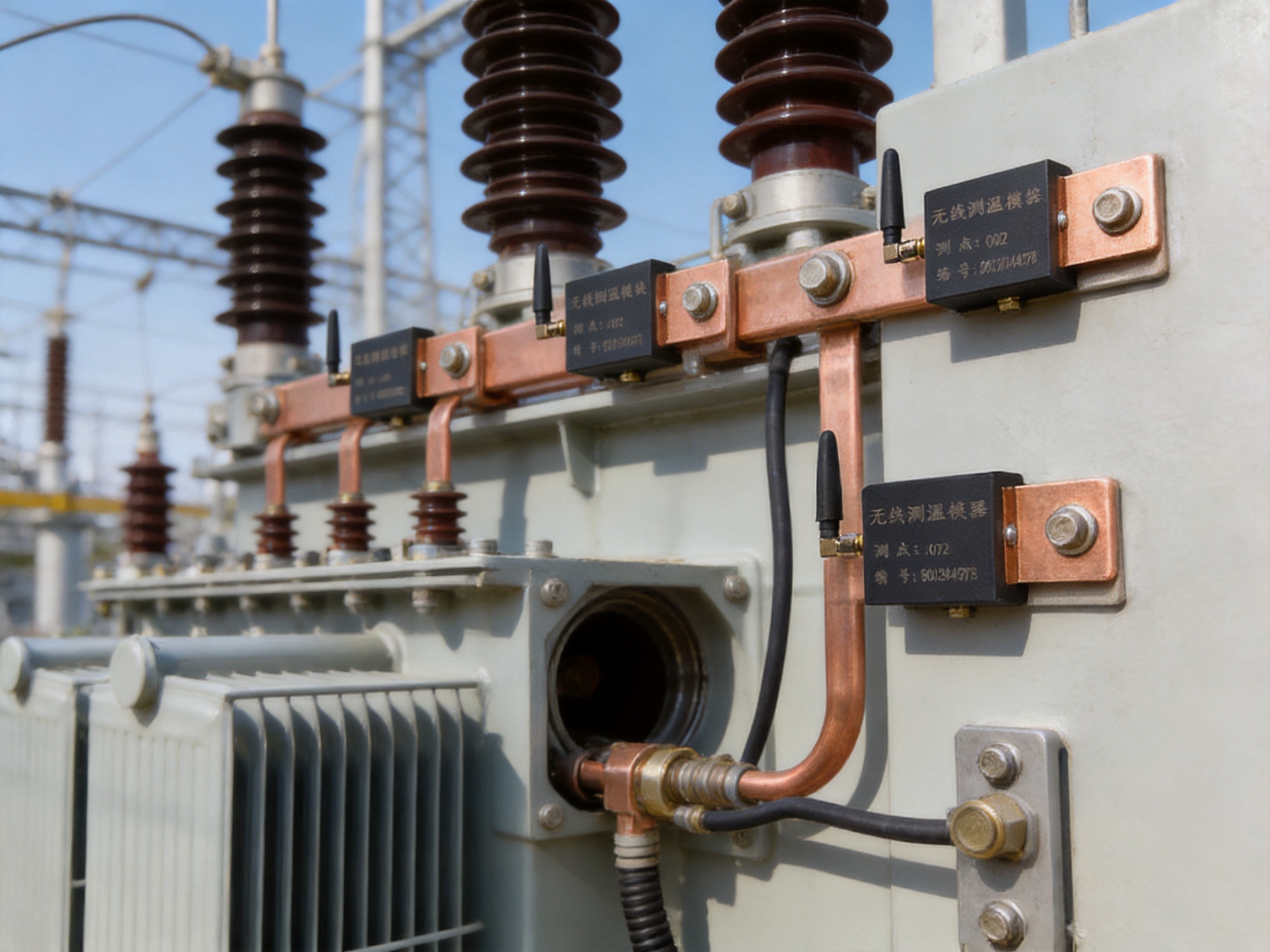
The product is particularly suitable for outdoor isolating switches, wall-penetrating cable clamps, transformer inlet and outlet terminals, flexible copper busbar connections, high-voltage switchgear contacts, high-power motors, and other comparable electrical connection points.

Copper Plate Temperature Sensor
Why Temperature Monitoring Matters in Electrical Systems
Electrical connections are normally designed to carry current with a predictable level of heat generation. When the connection is clean, tight, correctly sized, and adequately cooled, its temperature remains within an acceptable range. However, operating conditions can change over time. Mechanical vibration, thermal cycling, corrosion, contamination, overloading, and aging can increase contact resistance.
Even a small increase in resistance can produce additional heat according to the relationship between current, resistance, and power loss. Because the heat generated by a connection increases rapidly as current rises, a minor defect may become more serious during peak demand. The resulting temperature increase can accelerate oxidation and weaken the connection further, creating a progressive failure cycle.
Traditional maintenance programs often depend on periodic visual checks and scheduled infrared inspections. These methods remain useful, but they may not detect a fault between inspection intervals. A connection that appears normal during a scheduled visit may become overheated later when the current load changes or when weather conditions affect the equipment.
A permanently installed wireless sensor provides a different approach. It creates a regular stream of temperature information that can be reviewed by a monitoring host. Operators can identify abnormal trends, compare temperatures among similar components, and arrange maintenance before a localized issue becomes an outage.
Common Monitoring Challenges
High-voltage temperature monitoring presents several practical challenges. Sensors must be installed close to the actual heat source, yet they must not compromise electrical clearance, insulation, mechanical strength, or equipment operation. Communication must remain dependable in an environment that may contain metal cabinets, busbars, transformers, motors, and electromagnetic interference. The sensor must also operate for long periods without frequent battery replacement.
Wiring can create additional complexity. Cable routing may require shutdowns, drilling, insulation work, protective conduits, and periodic inspection. In some locations, a cable connection can be more difficult to maintain than the sensing element itself. Wireless transmission reduces the need for long signal cables and makes it more practical to place a sensor directly at a critical connection.
The KL-DS33YS addresses these requirements through a compact copper-plate structure, a PT1000 temperature-sensing element, low-power electronics, LoRa communication, and a sealed IP68 enclosure.
Product Architecture and Operating Principle
The sensor consists of a temperature-sensing element, signal modulation and amplification circuitry, a logic control circuit, a wireless communication circuit, a lithium battery, and an antenna. These elements work together as a dedicated measurement node rather than as a general-purpose wireless device.
The copper-plate construction enables the sensor to be installed directly on the surface of the target component. Heat from the monitored copper plate, terminal, contact, or connection is transferred to the sensing area. The PT1000 element changes its electrical characteristics according to temperature. The internal electronics process this signal and convert it into temperature data for wireless transmission.
The logic control circuit manages sampling, battery monitoring, data processing, and communication timing. Because the sensor is battery powered, the design must balance measurement frequency, transmission frequency, radio output, processing activity, and standby duration. The standard temperature sampling frequency is once every 10 seconds, providing regular updates while supporting the stated battery lifespan of approximately five to eight years, depending on application conditions and operating settings.
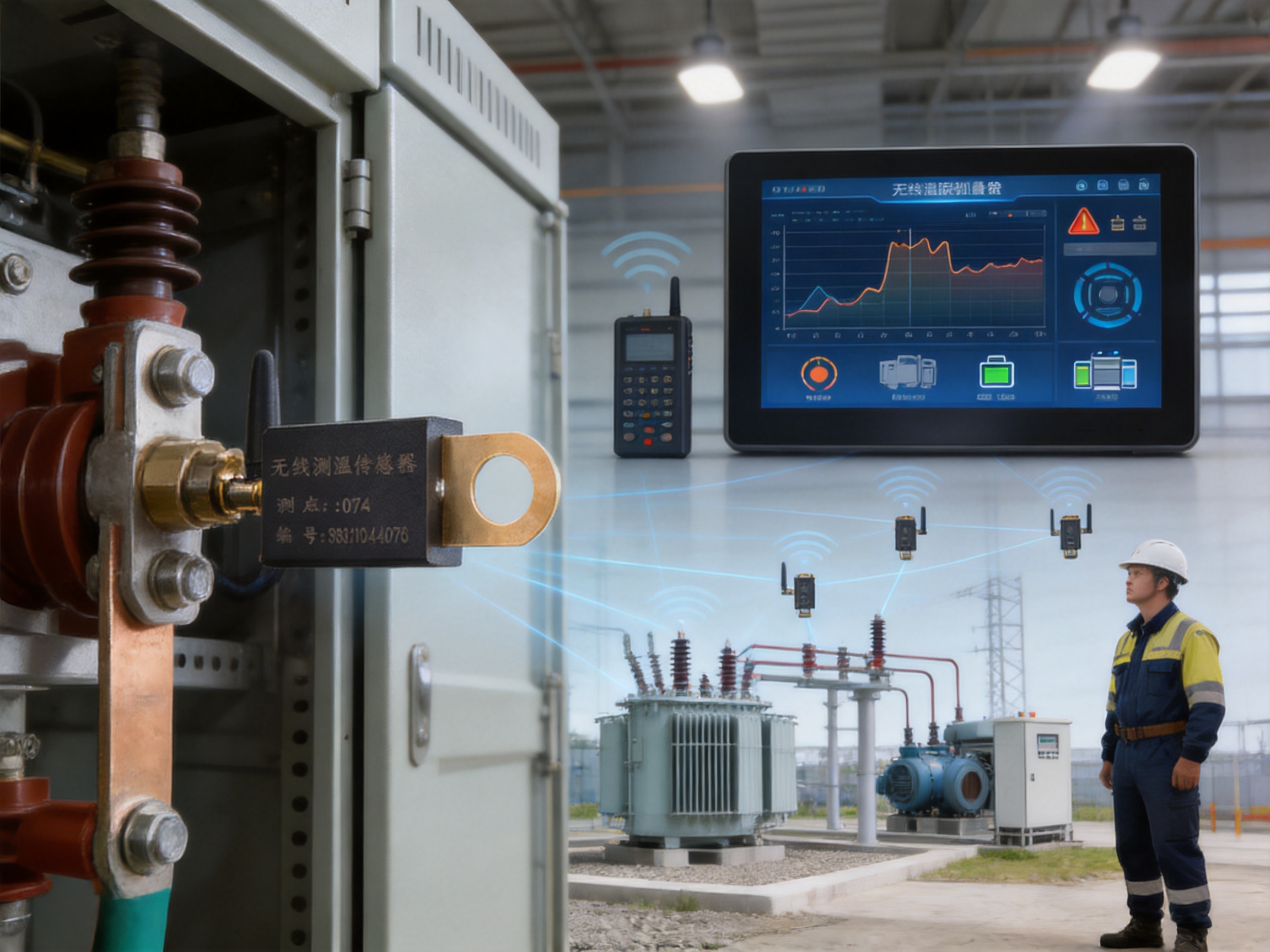
After data is collected, it is transmitted through a LoRa wireless network to the wireless temperature measurement host. The host can receive data from multiple sensor nodes and provide a centralized view of monitored equipment. The sensor also reports its internal battery voltage, allowing maintenance personnel to assess the remaining power condition rather than relying only on an estimated replacement schedule.
| Item | Specification | Practical significance |
| Temperature measurement range | -40 to +200 degrees Celsius | Supports outdoor and high-temperature electrical applications |
| Measurement accuracy | Plus or minus 1 degree Celsius | Useful for identifying meaningful temperature differences and trends |
| Temperature element | PT1000 | Provides a stable resistance-based measurement principle |
| Sampling frequency | 10 seconds by default | Provides frequent condition updates for continuous monitoring |
| Wireless communication | LoRa | Designed for low-power, long-distance sensor communication |
| Wireless frequency | 470 to 510 MHz | Supports the specified regional radio configuration |
| Transmission distance | Up to 800 meters | Helps cover distributed outdoor and industrial installations |
| Battery lifespan | Approximately 5 to 8 years | Reduces the frequency of battery-related maintenance |
| Installation | Bolt fixing | Provides a direct and mechanically stable attachment method |
| Protection rating | IP68 | Supports use in demanding outdoor and industrial environments |
| External dimensions | 60 mm by 45 mm by 25 mm | Allows installation where available space is limited |
| General dimension | 105 mm | Defines the overall installation envelope indicated for the product |
Direct Copper-Plate Installation
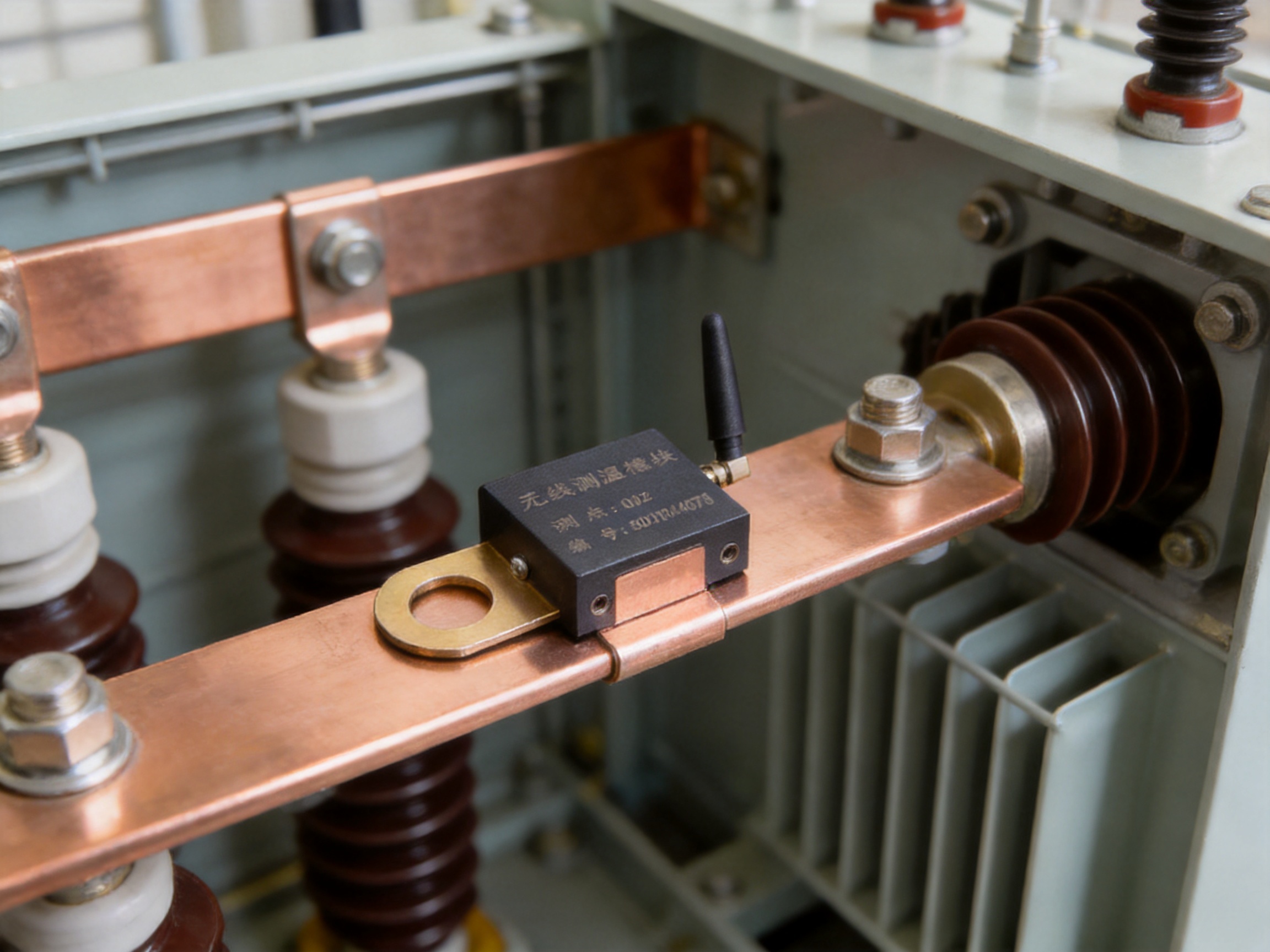
The most important physical feature of this product is its copper-plate form. The sensor is intended to be installed directly on the measured part rather than positioned at a distance and connected through a separate long probe. This approach helps place the sensing element close to the thermal source.
Direct contact is particularly valuable for monitoring electrical joints. A busbar connection, cable clamp, switch contact, or transformer terminal may develop a localized hot spot that is not accurately represented by the surrounding air temperature. Measuring the nearby ambient environment would not provide the same information as measuring the temperature of the component itself.
Bolt fixing also provides a repeatable installation method. When properly installed according to the equipment design and applicable safety procedures, a bolted connection can hold the sensor firmly against the monitored surface. Stable mechanical contact helps reduce measurement variation caused by movement, vibration, or accidental displacement.
The installation method is suitable for locations such as outdoor disconnectors, wall-penetrating cable clamps, transformer inlet and outlet terminals, and outdoor flexible copper busbar connections. Before installation, engineers should verify electrical clearances, mechanical compatibility, insulation requirements, fastening torque, and the equipment manufacturer’s restrictions. Installation on energized high-voltage equipment must be performed only by qualified personnel using approved procedures.
Compact Form for Restricted Locations
Electrical equipment often provides limited space for additional monitoring hardware. A large enclosure or an external probe assembly may interfere with access panels, insulation barriers, moving mechanisms, or existing protection components. With dimensions of approximately 60 millimeters by 45 millimeters by 25 millimeters, the KL-DS33YS is designed for a relatively compact installation footprint.
The compact format can simplify planning in crowded switchgear compartments and around busbar connections. It may also reduce the risk that the sensor becomes an obstruction during inspection or maintenance. At the same time, the installer must confirm that the selected location provides adequate radio performance and does not place the device in a position where metal shielding prevents communication with the host.
Measurement Performance and Data Reliability
The sensor provides a measurement range from -40 to +200 degrees Celsius and a stated accuracy of plus or minus 1 degree Celsius. This range covers cold outdoor conditions as well as the elevated temperatures that may occur around electrical terminals and high-current connections.
Accuracy is important, but it is not the only factor that determines the value of a temperature monitoring system. Consistent installation, good thermal contact, stable calibration, regular sampling, and correct interpretation of data are equally important. The KL-DS33YS supports this broader monitoring objective by combining the PT1000 element with direct installation and repeated wireless reporting.
A 10-second default sampling interval gives the system a relatively frequent view of the monitored point. It allows operators to observe gradual heating, cooling after a load reduction, and differences between equipment sections. In practical applications, temperature data can be considered together with load current, ambient temperature, switching activity, and equipment operating status.
For example, a temperature that rises and falls in line with current demand may represent normal thermal behavior. A connection that remains hotter than comparable connections under similar load may require inspection. A slow upward trend over several weeks may indicate aging, contamination, or progressive loosening even when the absolute temperature has not yet reached an emergency threshold.
Battery Voltage Self-Test
A wireless sensor is only useful when it remains available to transmit data. The built-in battery voltage self-test function provides visibility into the internal lithium battery condition. The sensor detects the current battery voltage and uploads that information to the wireless temperature measurement host along with the temperature data.
This feature supports condition-based maintenance. Instead of replacing batteries according to a rigid calendar or waiting until communication is lost, maintenance teams can review battery voltage and plan service for sensors that are approaching a defined maintenance level. In a large installation, this can reduce unnecessary site visits and help prioritize work.
The stated battery lifespan of five to eight years is a significant practical advantage for distributed monitoring. The actual duration depends on factors such as sampling behavior, transmission frequency, radio conditions, ambient temperature, battery characteristics, and network configuration. Even so, a multi-year service interval can be substantially more convenient than systems that require frequent battery replacement or permanent wired power.
LoRa Wireless Communication for Industrial Monitoring
LoRa communication is designed for low-power, long-distance data transmission. This makes it suitable for sensor networks in which small packets of measurement data must travel from many remote nodes to a central host. The KL-DS33YS operates in the specified 470 to 510 MHz wireless frequency range and offers a transmission distance of up to 800 meters under appropriate conditions.
Actual coverage depends on the installation environment. Metal structures, concrete walls, equipment cabinets, terrain, antenna orientation, interference, and the position of the receiving host can all affect radio performance. The stated distance should therefore be treated as a design reference rather than a guarantee for every site. A professional deployment should include a radio survey, suitable host placement, and communication testing after installation.
Compared with short-range wireless technologies intended primarily for consumer devices, a low-power industrial radio network can be more appropriate for distributed electrical assets. Compared with a fully wired sensor system, wireless communication can reduce cabling, simplify expansion, and make it easier to monitor components where cable installation would be disruptive.
The sensor’s wireless architecture also supports centralized supervision. Multiple sensors can report to the same wireless temperature measurement host, allowing operators to review several switchgear sections, transformers, busbar joints, or outdoor disconnectors from one location. This creates a foundation for alarm management, historical analysis, maintenance planning, and broader industrial Internet of Things integration.
Wireless Communication Compared with Conventional Alternatives
Manual measurement is inexpensive at the initial stage, but it provides only periodic snapshots and depends heavily on operator availability. It may also require personnel to enter areas containing electrical hazards or difficult-to-access equipment.
Infrared inspection can identify surface temperature differences without physical contact, but it is usually performed during scheduled rounds. It can be affected by viewing angle, emissivity, line-of-sight restrictions, weather, and enclosure design. A wireless sensor installed at the critical point can provide data between inspection visits and can remain active when the equipment is operating under changing conditions.
Wired temperature sensors can offer continuous measurement, but they require cables, routing, connectors, protective conduits, and often a more complicated installation process. Wiring may be impractical on moving equipment, high-voltage assemblies, outdoor structures, or retrofit projects where shutdown time is limited.
Wireless infrared or battery-powered alternatives may not provide the same direct copper-plate mounting method. The KL-DS33YS is differentiated by combining direct attachment to the measured conductive component, a PT1000 sensing element, a sealed enclosure, long-range low-power communication, and battery self-monitoring in one dedicated product.
Environmental Protection and Outdoor Suitability
Outdoor electrical equipment must withstand rain, humidity, dust, temperature changes, condensation, and contamination. A sensor installed on a disconnector, transformer terminal, or exposed busbar joint may experience conditions that would quickly affect an inadequately protected device.
The KL-DS33YS has an IP68 protection rating. This indicates a high level of protection against dust ingress and water exposure under the conditions defined by the applicable protection standard and test arrangement. IP68 is especially relevant for outdoor monitoring because it helps protect the sensor’s internal electronics, battery, and communication circuits from environmental exposure.
Protection against water and dust does not eliminate the need for correct installation. The mounting surface should be suitable, fasteners should be selected for the environment, and the sensor should not be installed in a location where mechanical impact, chemical exposure, excessive vibration, or electrical arcing exceeds the product’s intended application. Cable-free installation reduces one possible ingress path, but the complete installation still requires engineering review.
The -40 to +200 degree Celsius measurement range further supports demanding conditions. The lower limit accommodates cold outdoor environments, while the upper limit gives sufficient measurement headroom for applications involving hot electrical contacts and high-current components. Operators can use the range to establish alert levels appropriate to the specific equipment, insulation system, load profile, and safety policy.
Advantages for High-Voltage Equipment
Monitoring Energized Objects
The product is intended for measuring the surface or contacts of high-voltage energized objects. This is a key application distinction. It is not merely an ambient temperature sensor for a room or cabinet. Its copper-plate configuration is designed to be associated with the actual conductive or metallic component whose thermal condition matters.
Monitoring energized objects helps maintenance teams move from general environmental observation to asset-specific condition monitoring. A temperature value tied to a particular connection can be more useful than an average cabinet temperature because it points directly toward the possible source of a thermal problem.
Reducing Inspection Exposure
When data is available remotely, personnel may be able to reduce the frequency of routine approaches to certain equipment. Remote monitoring does not replace required safety inspections or operating procedures, but it can provide an additional layer of information before a technician visits the site.
Early warning can also improve planning. If the system shows a developing abnormality, the maintenance team can review the equipment history, prepare tools and replacement parts, coordinate an outage, and apply the correct safety controls instead of responding to an unexpected failure.
Supporting Retrofit Projects
Many electrical installations were built before continuous temperature monitoring became common. Retrofitting such systems can be difficult if new signal cables, control cabinets, or communication gateways are required. A battery-powered wireless sensor can offer a less disruptive route to adding monitoring capability.
The compact housing and bolt-fixing method can be considered for modernization projects where physical access is possible but extensive rewiring is undesirable. A staged deployment can begin with the most critical terminals and expand to additional locations after the communication coverage and maintenance workflow have been validated.
Manufacturing Strengths and Engineering Capabilities
Product performance depends not only on the specification sheet but also on how the device is engineered, assembled, tested, and integrated into a complete monitoring system. ASY Electronics is a high-tech enterprise focused on data sensing, intelligent connectivity, edge-layer hardware, and industrial data integration. These capabilities are directly relevant to the development of a wireless temperature sensor for smart-grid and industrial applications.
The company’s product portfolio includes broadband power line carriers, wireless temperature monitoring systems, industrial transmitters, flow meters, and automatic door controllers. This range indicates experience across sensing, communication, control, and industrial equipment interfaces. Such cross-domain knowledge can support the design of products that must operate as part of a larger industrial system rather than as isolated instruments.
Integrated Hardware Development
The KL-DS33YS combines sensing, analog signal conditioning, logic control, radio communication, battery management, and antenna functions. Developing these subsystems together requires attention to electrical noise, power consumption, thermal behavior, mechanical packaging, and communication reliability.
A company with self-developed edge-layer hardware capabilities can coordinate these functions at the product level. The result is a compact monitoring node that performs local measurement and processing before transmitting information to the host. Edge-side processing can reduce unnecessary data traffic and make it possible to manage sampling and communication in a power-efficient manner.
Industrial Data Integration
A sensor becomes more valuable when its data can be incorporated into an operational workflow. ASY Electronics develops industrial data integration solutions intended to support equipment condition monitoring, refined energy management, and production process optimization. This background is relevant to the use of temperature data in maintenance and asset-management systems.
Temperature readings can be combined with other industrial information, including equipment status, load conditions, alarm history, and maintenance records. The sensor is therefore suitable as one component within a broader Industrial Internet of Things architecture. It can contribute field data to a monitoring host and help organizations build a more complete view of equipment health.
Manufacturing and Quality Considerations
Although detailed factory process records are not provided, the product architecture implies several important manufacturing priorities. The sensing element must be correctly positioned and electrically connected. The signal-conditioning circuit must provide stable measurement performance. The radio module and antenna must be installed consistently to support communication. The battery must be integrated securely, and the enclosure must maintain its environmental protection after assembly.
For a product used on high-voltage equipment, manufacturing quality should also include traceable component control, controlled assembly procedures, inspection of soldered and mechanical connections, verification of sensor response, battery-voltage checks, wireless communication tests, and enclosure inspection. These activities help ensure that individual units perform consistently in the field.
The company’s focus on industrial hardware and smart-factory applications supports a manufacturing philosophy centered on reliability, repeatability, and practical integration. The sensor is not presented simply as a low-cost wireless thermometer. It is an industrial monitoring component designed for long service intervals and installation on critical electrical assets.
Competitive Positioning
When evaluating temperature sensors for high-voltage equipment, buyers commonly compare measurement accuracy, sensing location, wireless range, battery life, environmental protection, installation method, network compatibility, and system integration. The KL-DS33YS offers a balanced combination across these categories.
| Evaluation area | Typical limitation of basic alternatives | KL-DS33YS value |
| Sensing location | Ambient or remote probe measurement may not represent the hottest connection point | Direct copper-plate mounting places the sensor close to the measured component |
| Maintenance model | Manual rounds provide intermittent readings | Regular wireless transmission supports continuous remote supervision |
| Installation | Wired systems may require cables, conduits, and extensive retrofit work | Bolt fixing and wireless communication simplify distributed installation |
| Operating environment | General-purpose devices may lack protection for outdoor locations | IP68 construction supports demanding industrial and outdoor applications |
| Power management | Frequent battery service increases labor requirements | Five-to-eight-year stated battery lifespan reduces service frequency |
| Asset coverage | Short-range links can require many gateways or repeaters | LoRa communication and up-to-800-meter stated distance support wider coverage |
| Battery awareness | Battery failure may be discovered only after communication is lost | Battery voltage self-test allows proactive maintenance planning |
| System development | Standalone sensors may require separate integration resources | Industrial data integration capability supports broader monitoring solutions |
These advantages should be considered in relation to the application rather than treated as universal claims. A wired sensor may be preferable where power and communication cables are already available and permanent connection is mandatory. A different radio technology may be required by local regulations or an existing infrastructure. However, for distributed high-voltage assets where direct mounting, long battery life, and reduced wiring are priorities, the KL-DS33YS presents a strong practical configuration.
Deployment Planning
A successful project begins with an equipment survey. Engineers should identify the components most likely to experience overheating, including high-current joints, frequently switched contacts, transformer terminals, outdoor cable clamps, and connections with a history of abnormal temperature or maintenance activity.
The survey should record the component material, available mounting surface, bolt pattern, operating temperature, insulation arrangement, radio path, environmental exposure, and electrical clearance. The position of the sensor should represent the thermal condition of the component while maintaining compliance with all applicable safety and equipment requirements.
Communication planning is equally important. The wireless temperature measurement host should be positioned to provide effective coverage of the sensor population. Large metal structures can attenuate radio signals, so installation teams should test the actual path rather than relying solely on a theoretical distance. Where necessary, the network layout may be adjusted by changing host placement or adding appropriate infrastructure.
After installation, each sensor should be identified by asset location and assigned to the correct monitored component. Baseline temperatures should be recorded under normal operating conditions. This baseline helps distinguish normal variation from a developing abnormality.
Data Interpretation
Temperature thresholds should be established using the characteristics of the equipment, conductor, contact material, insulation, ambient environment, and operating load. A single universal alarm value may not be suitable for every installation. Relative comparison can be valuable: if one phase, terminal, or connection is consistently hotter than equivalent points, the difference may deserve investigation even when the absolute temperature appears moderate.
Trend analysis can also reveal faults earlier than a single alarm. A gradual increase over time may indicate contact degradation. Repeated temperature spikes associated with switching or peak load may suggest a mechanical or electrical issue. A sudden loss of data may indicate a battery, radio, installation, or host problem rather than a normal temperature event.
The battery voltage data should be reviewed as part of the same maintenance process. Sensors with declining battery voltage can be grouped into planned service visits. This is particularly useful in substations, industrial plants, renewable-energy facilities, and large distribution networks where access may require significant coordination.
Applications Across Industrial Sectors
Power Distribution
Distribution substations and switching stations contain numerous connections where heat monitoring can improve maintenance visibility. Sensors can be installed on outdoor isolating switches, transformer terminals, busbar joints, and cable clamps. Wireless data can help operators compare equipment across a site and identify unusual thermal behavior.
Industrial Manufacturing
Factories depend on motors, switchgear, distribution panels, and high-current production equipment. An overheated connection can interrupt a production line and create a safety risk. The sensor can be used as part of a condition-monitoring program that supports preventive maintenance and reduces unexpected stoppages.
Renewable-Energy Installations
Solar farms, wind facilities, and energy-storage sites often contain widely distributed electrical assets. Long cable runs, outdoor exposure, and limited staffing make remote monitoring valuable. The LoRa communication method and long battery life can support monitoring of selected terminals and connections where conventional wiring is inconvenient.
Transportation and Infrastructure
Railway substations, charging infrastructure, tunnels, pumping stations, and public utility installations may contain high-current connections that operate continuously or under variable load. A compact, sealed wireless sensor can provide additional information for maintenance teams responsible for assets spread across a large area.
Commercial and Institutional Facilities
Large buildings, data centers, hospitals, and campuses contain electrical distribution systems with critical loads. Temperature monitoring can be applied to selected switchboards, busbar connections, and transformer terminals. The sensor can complement existing building-management and electrical-monitoring systems when the installation environment and communication design are suitable.
Safety and Installation Responsibilities
Temperature monitoring does not remove the hazards associated with high-voltage equipment. Installation, inspection, and maintenance must be performed by trained and authorized personnel. The sensor must not reduce creepage distance, clearance, insulation performance, mechanical strength, or the safe operation of switches and disconnectors.
Before installation, the responsible engineering team should review the equipment drawings and determine whether a shutdown, isolation, grounding, or special work permit is required. The correct fasteners and mounting surfaces should be selected. The sensor should be positioned so that it can measure the intended component without creating a path for electrical tracking or interfering with moving parts.
Environmental conditions should also be reviewed. Chemical vapors, corrosive atmospheres, extreme vibration, impact, or unusual thermal radiation may require additional protective measures. The IP68 rating is valuable, but it should be applied within the product’s specified operating context.
Wireless communication should be verified after the equipment is returned to normal operation. Metal doors, shielding covers, and changes in antenna orientation can affect the final signal path. The host should receive both temperature and battery-voltage information from every installed sensor before the project is accepted.
Maintenance Benefits Over the Product Life Cycle
The value of a wireless temperature sensor extends beyond the initial installation. It can support a complete life-cycle maintenance process: identifying critical assets, establishing normal operating conditions, detecting trends, prioritizing inspections, planning outages, documenting repairs, and verifying the result after maintenance.
When a connection is repaired or replaced, the sensor can continue to monitor the same location or a new component. A comparison of pre-maintenance and post-maintenance temperature data can help confirm whether the abnormal condition has improved. Historical records can also support future engineering decisions and help organizations identify recurring installation or loading issues.
Long battery life reduces the service burden associated with a large number of distributed nodes. Battery voltage self-testing further improves planning because maintenance teams can combine battery replacement with scheduled electrical inspections. This is more efficient than treating every sensor as an emergency service call.
The use of wireless communication can also make system expansion more manageable. A facility can begin with a limited number of high-priority measurement points and then add sensors as the value of the data becomes clear. This scalable approach is suitable for organizations that want to develop industrial IoT capability without replacing their existing electrical infrastructure all at once.
Why Choose an Integrated Industrial Solution Provider
Industrial customers often need more than a sensor. They may require assistance with application selection, network planning, installation strategy, host configuration, data interpretation, and integration with existing monitoring processes. A supplier with experience in sensing and intelligent connectivity can help address these requirements as one connected project.
ASY Electronics combines wireless temperature monitoring products with power line communication equipment, industrial transmitters, thermal gas mass flow meters, and automatic door controllers. This broader portfolio reflects an understanding of multiple industrial data sources and control requirements. It also provides a foundation for projects that may eventually combine temperature, flow, energy, equipment status, and access information.
The company’s stated mission is to help build efficient, reliable, and green smart factories. In this context, the KL-DS33YS contributes field-level data that can support improved equipment reliability, reduced maintenance waste, and more informed use of industrial assets.
Its strengths are especially relevant to customers seeking a China-based manufacturing partner for industrial IoT hardware. Self-developed edge-layer products, communication expertise, sensing technologies, and data integration capabilities can support customized solutions for different equipment layouts and operating environments.
Q&A: Copper-Plate Wireless Temperature Sensor
What does the sensor measure?
It measures the temperature of the surface or contact area where the copper-plate sensor is installed. Typical targets include high-voltage contacts, busbar connections, transformer terminals, cable clamps, motor connections, and outdoor disconnectors.
What temperature range does it support?
The stated measurement range is -40 to +200 degrees Celsius. This range is suitable for cold outdoor conditions and elevated temperatures associated with electrical connections and industrial equipment.
How accurate is the measurement?
The stated measurement accuracy is plus or minus 1 degree Celsius. Actual field performance also depends on correct installation, thermal contact, equipment conditions, and the surrounding environment.
What temperature element is used?
The sensor uses a PT1000 thermistor or resistance temperature element. Its resistance changes with temperature, allowing the internal electronics to calculate the measured temperature.
How often does the sensor sample temperature?
The default temperature sampling frequency is once every 10 seconds. The final data behavior may depend on the configured monitoring system and application requirements.
How does the sensor communicate?
It uses LoRa wireless communication in the specified 470 to 510 MHz frequency range. The collected temperature and battery data are transmitted to a wireless temperature measurement host.
What is the wireless transmission distance?
The stated transmission distance is up to 800 meters. Actual coverage depends on antenna position, metal obstructions, building materials, terrain, interference, and host placement.
How long can the battery last?
The stated battery lifespan is approximately five to eight years. Actual service life depends on sampling, transmission conditions, ambient temperature, radio performance, and other operating factors.
Can the sensor report battery condition?
Yes. It includes a battery voltage self-test function and uploads the detected internal battery voltage to the wireless temperature measurement host.
How is the sensor installed?
The specified installation method is bolt fixing. The sensor is mounted directly on the selected copper or conductive component, subject to electrical, mechanical, and safety requirements.
Is it suitable for outdoor use?
It is designed for applications that include outdoor isolating switches, outdoor flexible copper busbar connections, transformer terminals, and other similar components. Its IP68 protection rating supports demanding outdoor and industrial environments when it is installed correctly.
Does it replace infrared inspection?
It is better viewed as a complement to infrared inspection rather than a universal replacement. The sensor provides regular data from a fixed location, while infrared inspection can examine a broader area during a scheduled survey. Combining both methods can improve condition-monitoring coverage.
Can it be used on energized high-voltage equipment?
The product is intended for monitoring the surface or contacts of high-voltage energized objects, but installation must follow the equipment design and applicable safety procedures. Only qualified personnel should determine whether installation can be performed safely and whether isolation is required.
What makes it different from a basic wireless thermometer?
It is designed specifically for industrial electrical monitoring. Its copper-plate mounting arrangement, PT1000 element, 10-second default sampling, LoRa communication, IP68 protection, long battery-life target, and battery-voltage self-test are configured for distributed equipment condition monitoring.
What information should be collected before ordering?
Customers should provide the equipment type, monitored component, installation location, available mounting space, expected temperature range, communication distance, environmental conditions, quantity of sensors, host requirements, and any applicable electrical or regional radio requirements.
Conclusion
The KL-DS33YS copper-plate wireless temperature sensor is designed to make high-voltage and industrial equipment temperature monitoring more continuous, more accessible, and less dependent on manual inspection. Its direct mounting approach places the sensor close to the component that generates heat. Its PT1000 element, plus-or-minus 1 degree Celsius accuracy, -40 to +200 degree Celsius range, and default 10-second sampling support detailed condition awareness.
LoRa communication, a stated transmission distance of up to 800 meters, five-to-eight-year battery life, and battery-voltage self-testing address the practical demands of distributed wireless monitoring. The IP68 enclosure and compact dimensions support outdoor and space-constrained installations, while bolt fixing provides a straightforward mechanical attachment method.
The product’s competitive value comes from the combination of these features rather than from any single specification. It offers an alternative to periodic manual inspection, complex wired retrofits, and general-purpose wireless thermometers that are not designed for direct electrical connection monitoring.
Supported by ASY Electronics’ capabilities in industrial sensing, intelligent connectivity, edge-layer hardware, and data integration, the sensor can serve as part of a broader smart-grid or industrial IoT solution. For power distribution operators, manufacturers, infrastructure owners, and facility managers, it provides a practical way to collect temperature and battery information from critical electrical assets and use that data to improve maintenance planning, equipment reliability, and operational safety.
References
1. Product technical information for the KL-DS33YS copper-plate wireless temperature sensor, including operating range, accuracy, communication, battery, installation, and protection specifications.
2. Industrial condition-monitoring principles for electrical connections, busbars, terminals, switchgear, transformers, and high-current equipment.
3. General guidance on resistance temperature detectors and PT1000 temperature measurement elements.
4. General guidance on LoRa low-power wide-area wireless communication for industrial sensor networks.
5. General principles of IP protection ratings for electrical enclosures and industrial electronic equipment.
6. General practices for high-voltage equipment inspection, thermal monitoring, electrical clearance, safe installation, and preventive maintenance.