

Humidity control is an essential requirement in electrical cabinets, control enclosures, instrumentation rooms, communication equipment areas, storage compartments, and other enclosed industrial spaces. Excess moisture can cause condensation, accelerate corrosion, reduce insulation performance, promote mold growth, and interfere with the stable operation of sensitive electronic components. In many applications, a large commercial dehumidifier is unnecessary or impractical. What is needed instead is a compact device that can monitor humidity continuously, respond automatically to changing environmental conditions, and remove moisture without consuming excessive power or occupying valuable cabinet space.
The KL-CS15W Mini Dehumidifier is designed for this type of focused humidity-control application. It combines a one-channel temperature and humidity input module with semiconductor refrigeration dehumidification, automatic humidity-based control, manual operating modes, and a broad AC/DC power input. With a rated starting consumption of only 15 W, the unit is suitable for installations where energy efficiency, compact integration, and dependable operation are more important than high-volume room dehumidification.
Unlike a basic fan or passive moisture absorber, this smart dehumidifier actively measures the surrounding environment and makes a control decision according to the configured humidity value and hysteresis range. It can operate automatically when humidity rises above the defined upper limit, or it can be manually enabled for continuous dehumidification. This dual operating logic allows the product to serve both unattended equipment-protection applications and situations in which an operator needs direct control.
Its value is especially clear in industrial environments where stable conditions are needed but installation space, power availability, and maintenance resources are limited. The product is not intended to replace a large building HVAC system. Instead, it offers a targeted solution for local humidity control in enclosed or semi-enclosed spaces.
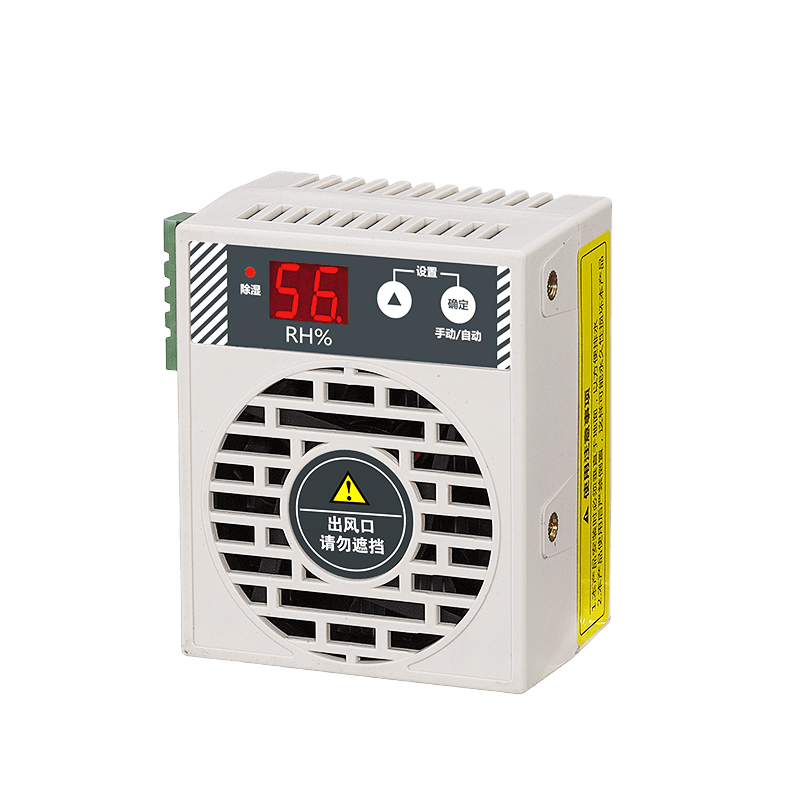
Mini Dehumidifier
Why Local Humidity Control Matters
Humidity problems are often underestimated because the effects may not be visible immediately. A cabinet can appear dry while internal surfaces are already approaching the dew point. When temperature falls, moisture may condense on circuit boards, terminals, relays, sensors, connectors, and metal components. Repeated condensation and evaporation cycles can create a long-term reliability problem even when no single event appears severe.
In electrical and automation systems, moisture may reduce insulation resistance and create leakage paths. In communication equipment, it can affect connectors and signal integrity. In instrumentation, humidity may influence measurement stability or cause corrosion around terminals. In mechanical control systems, moisture can damage bearings, fasteners, and moving components. These risks are amplified in facilities where temperature changes occur between day and night, where equipment is installed near cooling systems, or where cabinets are exposed to humid air.
A local dehumidifier can address the problem at the point where it occurs. Rather than conditioning an entire room, the device can be installed in or near a closed enclosure and activated only when measured humidity exceeds the desired level. This approach reduces unnecessary energy use and provides a more direct response to the actual environment surrounding the protected equipment.
The KL-CS15W is built around this principle. Its control behavior is based on measured humidity rather than a fixed timer alone. When the automatic function is active, the controller compares the real-time ambient humidity with the configured setting and the associated hysteresis value. The dehumidifier starts when humidity rises above the maximum humidity value and stops after humidity falls below the minimum humidity value.
This operating method prevents the equipment from switching on and off at every small fluctuation. The hysteresis band creates a practical separation between the starting threshold and the stopping threshold. As a result, the device can operate more steadily, reduce unnecessary switching, and provide a more predictable humidity-control cycle.
Semiconductor Refrigeration Dehumidification
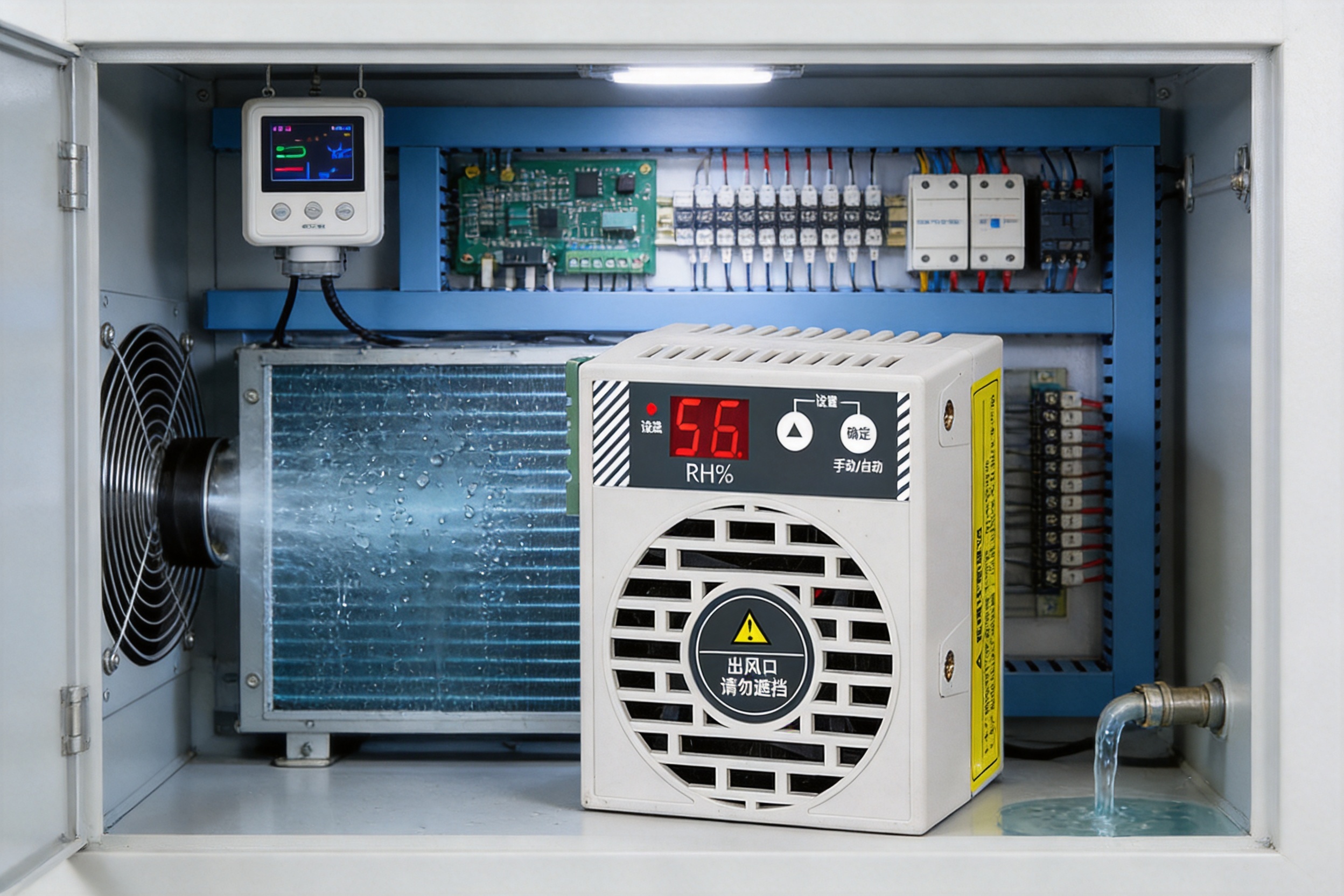
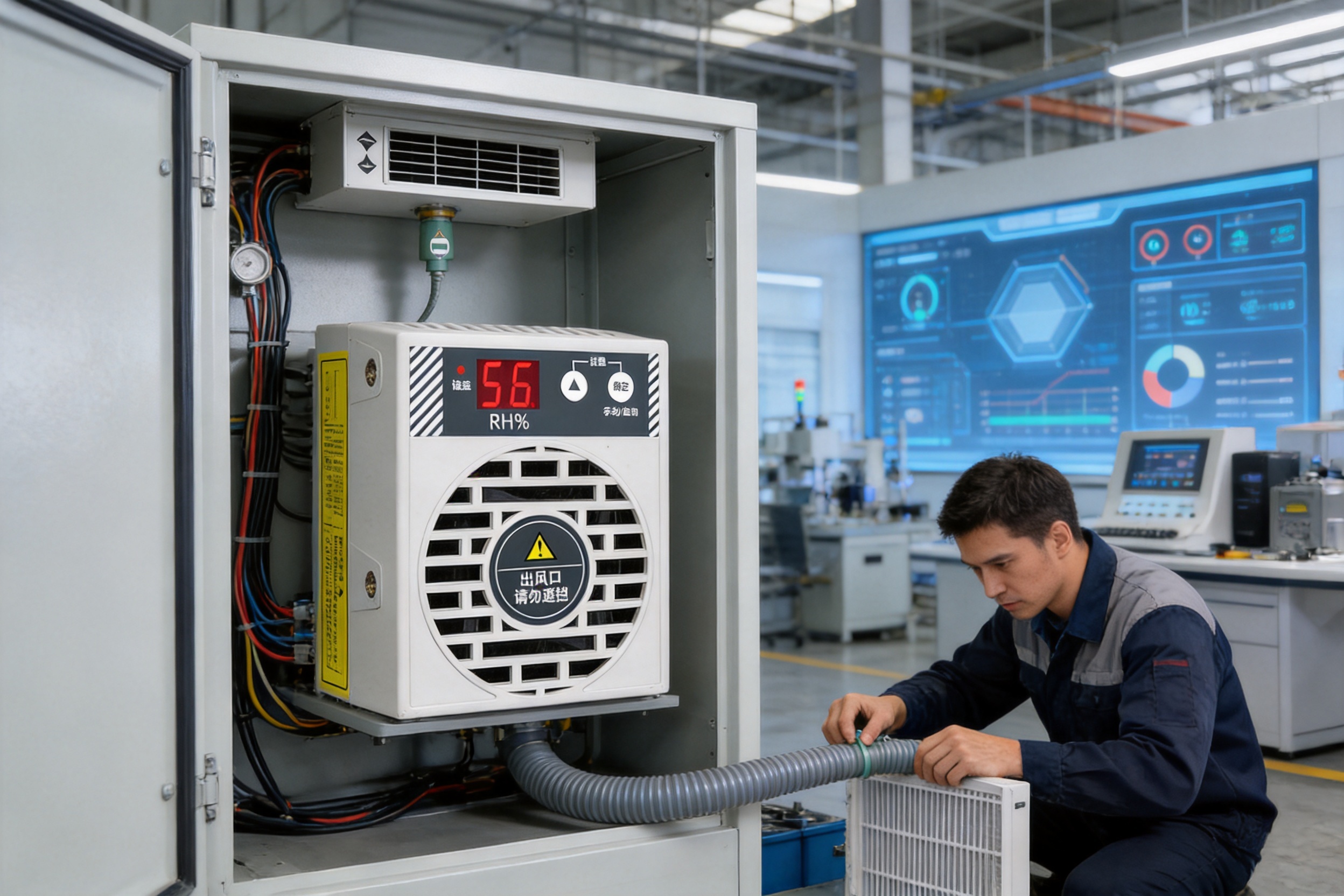
The KL-CS15W uses semiconductor refrigeration dehumidification rather than a conventional compressor-based refrigeration system. Its working process is compact and suitable for small enclosed spaces. A fan draws humid air into the internal dehumidification duct. The air passes through the semiconductor refrigeration mechanism, where the moisture in the air condenses into liquid water. The collected water is then discharged from the cabinet through a water pipe.
This design has several advantages for specialized industrial applications. A semiconductor refrigeration module can be arranged in a compact housing and does not require the large mechanical structure associated with a compressor. The absence of a compressor also helps simplify the mechanical layout and makes the product appropriate for installations where limited space is available.
Compact semiconductor technology is particularly useful where the main objective is to control local humidity rather than rapidly reduce the moisture content of a large room. Electrical cabinets, control boxes, sensor enclosures, and equipment compartments often have a limited internal volume. A small, purpose-designed unit can therefore be more practical than an oversized residential or commercial appliance.
The air path is another important part of the design. Active fan circulation helps bring humid air into contact with the cooling mechanism. This is more effective than relying only on natural diffusion. Once the air is cooled sufficiently for moisture to condense, the resulting water can be guided away through the drain arrangement. Proper water discharge is important because removing moisture from the air is only useful when the condensed water is safely removed from the protected space.
Compared with passive desiccant products, the KL-CS15W offers active and repeatable control. A passive absorber gradually becomes saturated and normally requires replacement or regeneration. The smart dehumidifier, by contrast, can continue operating as long as it receives power and the condensate is properly managed. Its automatic mode also means that it does not need to run continuously when the environment is already within the desired humidity range.
Intelligent Automatic Control
The product’s automatic function is designed around a set humidity value and a humidity hysteresis value. The setting establishes the desired control point, while the hysteresis determines how far humidity must move before the operating state changes. When ambient humidity is higher than the maximum humidity value, defined as the setting value plus hysteresis, the dehumidifier starts. When humidity drops below the minimum humidity value, defined as the setting value minus hysteresis, the dehumidifier stops.
This control strategy is widely used in industrial automation because it is simple, stable, and easy to understand. A control output that responds to every minor measurement change could cause frequent cycling. Frequent cycling may increase wear on switching components and reduce the consistency of the dehumidification process. By using upper and lower boundaries, the KL-CS15W can maintain a more stable control pattern.
For example, if an operator selects a target humidity of 60%RH and a hysteresis value of 5%RH, the effective upper threshold would be 65%RH and the effective lower threshold would be 55%RH. The exact setting used in a particular installation depends on the protected equipment, enclosure characteristics, local climate, and operating requirements. The example illustrates how the control band separates activation from deactivation.
The automatic mode is useful in installations that operate continuously or without regular supervision. Once the desired parameters are configured, the product can respond to humidity changes without requiring an operator to start and stop it manually. This supports equipment protection in remote cabinets, utility rooms, network enclosures, and other areas where routine attendance may be limited.
Manual control is also provided. When the dehumidification function is manually turned on, the unit continues to dehumidify until the function is manually turned off. This can be useful during commissioning, maintenance, troubleshooting, seasonal preparation, or a temporary high-humidity event. It also gives technicians a direct way to verify the operation of the air path, condensate drainage, and control output.
The combination of automatic and manual operation makes the product more versatile than a device with only one fixed operating mode. Automatic control supports energy-conscious unattended operation, while manual control supports service work and special operating conditions.
Technical Specifications and Practical Meaning
Specification |
Value |
Application Significance |
Input module |
1-channel temperature and humidity input module |
Provides local environmental measurement for humidity-based control |
Working power supply |
AC/DC 85–260 V |
Supports a broad range of industrial power arrangements |
Temperature range |
-9 to +80°C |
Allows temperature measurement across a broad monitoring range |
Humidity measurement range |
5%RH–95%RH |
Covers dry, normal, and highly humid operating conditions |
Humidity resolution |
1%RH |
Provides clear measurement increments for threshold control |
Temperature resolution |
1°C |
Supports practical environmental monitoring |
Control method |
Position control |
Provides defined operating states for the dehumidification function |
Product power |
15 W when the dehumidifier starts |
Suitable for applications where power consumption must remain low |
Working environment |
0–50°C; non-corrosive environment; humidity ≤85%RH |
Defines the recommended conditions for reliable operation |
Humidity basic error |
±3%RH from 10%RH to 90%RH; ±5%RH from 0%RH to 99%RH |
Helps users assess the measurement margin when selecting control values |
The AC/DC 85–260 V input range is one of the product’s most useful integration features. Industrial facilities may use different supply arrangements depending on the cabinet, plant, region, and control architecture. A wide input range reduces the need for separate versions for different electrical conditions and can simplify procurement, panel design, and replacement planning.
The one-channel temperature and humidity input module provides the fundamental measurement function required by the control logic. Although the product is focused on dehumidification, temperature measurement is also valuable because humidity behavior is closely related to temperature. A temperature change can alter the relative humidity reading and increase the risk of condensation. Monitoring both parameters gives operators a more informative view of the local environment.
The humidity measurement range of 5%RH to 95%RH covers most practical indoor and enclosure-level applications. The 1%RH resolution provides a sufficiently clear basis for threshold configuration and trend observation. The stated basic error should be considered during system design. Operators should avoid setting the control point too close to a critical limit when the protected equipment has a very narrow humidity tolerance. A suitable safety margin can help account for sensor accuracy, air distribution, thermal gradients, and installation conditions.
Advantages in Comparison with Common Alternatives
Product selection should always be based on the specific application, but the KL-CS15W offers several practical advantages over common alternatives used for localized humidity control.
Compared with Passive Moisture Absorbers
Desiccant bags, salt-based absorbers, and other passive products are inexpensive and easy to place, but they have limited capacity. Once saturated, they no longer remove moisture effectively. They also provide no measurement, no automatic threshold control, and no direct indication of operating status. For equipment that must be protected over long periods, repeated replacement can become inconvenient and difficult to manage.
The KL-CS15W provides active dehumidification and can respond to changing humidity conditions. Its automatic function allows it to run when needed rather than depending on a maintenance schedule for absorber replacement. The fan-driven air path also promotes active circulation inside the protected area, whereas passive products generally affect only the air immediately around the absorbent material.
Compared with General-Purpose Room Dehumidifiers
Residential or room-scale dehumidifiers are designed for high moisture removal in open indoor spaces. They often include large housings, water tanks, compressors, wheels, user interfaces, and features that are unnecessary in a control cabinet or compact equipment compartment. Their size and power consumption may make them unsuitable for localized industrial applications.
The KL-CS15W is purpose-oriented. Its 15 W starting power and compact semiconductor refrigeration structure are more appropriate when the protected space is small and the goal is equipment reliability rather than room comfort. It can be incorporated into an industrial control strategy instead of being treated as a standalone household appliance.
Compared with Compressor-Based Systems
Compressor-based refrigeration can provide high dehumidification capacity, but the related mechanical structure may be excessive for small enclosures. Compressors can also introduce vibration, require more installation space, and consume more power. In applications that need modest, localized moisture control, a semiconductor solution can provide a simpler physical arrangement.
The KL-CS15W is not intended to compete with a high-capacity compressor unit for warehouse or building dehumidification. Its advantage is application matching. It delivers a compact active solution for environments where a compressor system would be oversized, inefficient, or difficult to install.
Compared with Timer-Only Ventilation
Ventilation fans can reduce humidity when the outside air is drier than the internal air, but they can also introduce more moisture when outdoor conditions are unfavorable. A timer cannot determine whether the air entering the enclosure is beneficial or harmful. The KL-CS15W uses measured humidity and condensation-based moisture removal, giving it a more direct response than a simple timed fan.
Ventilation may still be useful in some designs, but it should be evaluated against the local climate, enclosure sealing, temperature changes, and contamination risks. A dedicated dehumidifier can be a better choice when bringing in outside air would increase humidity or expose sensitive equipment to dust and corrosive contaminants.
Suitable Industrial Applications
The KL-CS15W can be considered for a broad range of applications where moisture must be controlled in a limited space. The final suitability depends on the enclosure design, condensate arrangement, thermal conditions, and required moisture removal rate.
Electrical and Control Cabinets
Electrical cabinets often contain circuit breakers, relays, terminal blocks, contactors, programmable controllers, power supplies, and communication modules. Condensation on these components can cause corrosion, insulation deterioration, and intermittent faults. A local dehumidifier can help maintain a more stable internal environment, especially in facilities with large temperature differences between operating and idle periods.
When installing the unit in a cabinet, designers should consider airflow, drainage, clearance around the semiconductor cooling mechanism, and the location of the humidity sensor. The sensor should represent the actual protected environment rather than a warm spot directly beside a heat source.
Communication and Networking Enclosures
Communication equipment may operate continuously and can be sensitive to connector corrosion and contamination. Outdoor cabinets, roadside enclosures, industrial network boxes, and remote communication compartments may experience changing humidity even when they are protected from direct rain. A compact automatic dehumidifier can provide supplementary environmental protection where passive sealing alone is insufficient.
Because the unit supports a wide AC/DC input range, it can be considered for different power architectures, subject to the electrical requirements of the complete installation. A qualified technician should verify the supply, protection, grounding, and wiring arrangement before commissioning.
Instrumentation and Measurement Systems
Transmitters, data acquisition equipment, monitoring modules, and precision instruments may require stable environmental conditions. Moisture can influence connectors, terminals, and internal surfaces, particularly when equipment is moved between warm and cool environments. The product’s combined temperature and humidity measurement helps users observe local conditions while the dehumidification function responds to humidity changes.
Industrial Automation Equipment
Automation panels and machine-control enclosures often operate in production areas where washdown, temperature variation, and ambient humidity may be present. A targeted dehumidification system can complement enclosure sealing, cabinet heaters, filters, and other environmental-control measures. It should be integrated as one part of a complete protection strategy rather than considered a substitute for correct enclosure selection.
Storage and Equipment Compartments
Small storage compartments holding electronic modules, spare parts, sensors, or control accessories may also benefit from localized humidity management. The automatic mode can maintain the compartment without continuous manual attention, while the manual mode can be used during inspection or preparation before equipment is placed into service.
Design and Manufacturing Strengths
The product is supplied by ASY Electronics (JiaXing) Co., Ltd., a high-technology enterprise focused on smart-factory development, industrial data sensing, intelligent connectivity, and equipment-related solutions. Its product portfolio includes broadband power line carriers, wireless temperature monitoring systems, industrial transmitters, thermal gas mass flow meters, and automatic door controllers. This broader portfolio is relevant because it demonstrates experience across sensing, communication, control, and industrial equipment integration.
A smart dehumidifier is not simply a cooling component placed inside a box. Reliable performance depends on the coordination of the sensor, control logic, power section, fan, semiconductor refrigeration mechanism, condensate path, enclosure, and user operating procedures. A manufacturer with experience in industrial transmitters and monitoring systems is well positioned to understand the importance of measurement stability, signal handling, control thresholds, and field installation conditions.
The company’s stated smart-factory focus emphasizes equipment condition monitoring, refined energy management, and production-process optimization. These capabilities support a manufacturing approach in which products are developed not only as isolated devices but also as components within larger industrial systems. For customers, this can be valuable when a dehumidifier must work alongside sensors, control cabinets, industrial communication networks, and other automation products.
Advanced manufacturing strength begins with design consistency. A repeatable design process should control the placement of the sensor, the alignment of the semiconductor cooling assembly, the fan and air-channel arrangement, the wiring path, and the water-discharge structure. Consistency in these areas helps reduce variation between units and supports predictable field installation.
Electronic assembly quality is also important. The power supply must accommodate the specified AC/DC input range, while the control circuit must interpret humidity signals and operate the dehumidification function according to the selected mode. Proper component selection, soldering control, inspection, and functional testing are essential for a product intended to operate in industrial environments.
Thermal and airflow management form another key manufacturing consideration. The semiconductor refrigeration mechanism depends on effective heat transfer. The cold side must support condensation, while heat generated on the opposite side must be managed so that the system can continue operating within its intended conditions. Fan performance, airflow resistance, heat dissipation, and internal spacing all influence the practical result.
Condensate handling must also be treated as part of the product design. Water that is removed from the air needs a controlled path away from electrical components and the protected equipment. During manufacturing and inspection, the drainage path should be checked for correct assembly, obstruction, leakage, and secure connection. A well-designed dehumidification function can be undermined if condensate is not managed correctly in the final installation.
Industrial manufacturing also requires traceability and process discipline. Incoming materials, electronic components, sensors, fans, wiring assemblies, and mechanical parts should be managed according to defined production procedures. In-process inspection can identify assembly problems before final testing, while finished-product testing can confirm power input, sensing response, control behavior, fan operation, and dehumidification action.
Although specific factory certifications or test standards are not stated in the supplied product information, customers should request the documentation relevant to their project. Depending on the market and application, this may include electrical safety information, environmental test data, calibration records, inspection reports, wiring instructions, and product-label requirements. Transparent technical documentation is an important part of responsible industrial manufacturing.
Quality Assurance from Component to Finished Unit
Quality assurance for a smart dehumidifier should cover both electronic and mechanical performance. The humidity sensor must provide stable readings within the stated measurement range. The control board must correctly interpret those readings. The power section must operate across the specified input range. The semiconductor refrigeration assembly and fan must work together to create the intended air path and condensation effect.
Functional testing can verify whether the device starts when humidity is above the upper threshold and stops when humidity falls below the lower threshold. It can also confirm that manual operation continues until the operator turns the function off. These tests are particularly important because incorrect threshold logic could cause continuous operation, delayed activation, or excessive switching.
Measurement verification should take the stated basic error into account. For humidity readings between 10%RH and 90%RH, the listed basic error is ±3%RH. Across the wider 0%RH to 99%RH range, the listed error is ±5%RH. These figures provide users with a basis for selecting suitable control margins and evaluating whether the product is appropriate for a particular process.
Temperature measurement should also be checked across the intended range. The listed temperature range extends from -9°C to +80°C, while the recommended working environment for the product is 0°C to 50°C. This distinction is important: the measurement range describes what the sensing function can measure, whereas the working environment describes the conditions recommended for the complete product.
Final inspection should include physical condition, terminal identification, enclosure integrity, drain arrangement, labeling, and accessories. Packaging should protect the unit from shock, moisture, and contamination during transport. Clear installation and operating instructions can reduce commissioning errors and help users maintain the drainage and sensing functions properly.
For industrial customers, quality is not limited to the first operating test. Long-term value also depends on documentation, technical support, spare-part planning, response to customization requirements, and the manufacturer’s ability to maintain consistent production. A supplier with a broader industrial product portfolio may provide a more useful technical relationship when the dehumidifier is part of a larger automation project.
Energy-Conscious Operation
The product consumes 15 W when the dehumidifier starts, according to the supplied technical information. This low power requirement can be advantageous in applications powered by control panels, remote cabinets, backup systems, or distributed industrial supplies. Lower power consumption also reduces the heat added to the local environment compared with larger dehumidification equipment.
Automatic control further supports energy-conscious operation. Instead of running continuously, the unit can operate only when humidity exceeds the upper threshold. After moisture is removed and humidity falls below the lower threshold, the unit stops. The actual operating time depends on enclosure volume, leakage, ambient humidity, temperature, internal heat sources, opening frequency, and drainage conditions.
Energy efficiency should not be evaluated only by the nameplate wattage. A system that consumes little power but operates continuously may use more energy than a slightly more powerful system that reaches its control target quickly and then stops. The KL-CS15W’s combination of modest power consumption and threshold-based operation provides a practical basis for efficient localized control, provided that the enclosure is correctly selected and installed.
Good installation practice can improve the result. Unnecessary air leakage should be minimized, cable glands should be sealed appropriately, and the drain path should not allow humid air to enter in an uncontrolled manner. At the same time, the product must have sufficient airflow and heat dissipation. Over-sealing an enclosure without considering internal heat can create a different thermal problem, so the complete environmental design should be reviewed.
Installation Considerations
Before installation, users should confirm that the application is within the stated operating conditions: an ambient temperature of 0–50°C and a non-corrosive environment with humidity no higher than 85%RH. The product should not be placed in an environment containing corrosive gases, aggressive chemicals, conductive dust, or direct water spray unless the complete system has been specifically engineered and protected for those conditions.
The mounting location should allow humid air to circulate toward the intake and treated air to return to the protected space. Blocking the fan inlet or outlet can reduce performance and increase thermal stress. Sufficient clearance should be maintained around the unit according to the final mechanical design and installation instructions.
The humidity sensor should be positioned where it can detect representative air conditions. Placing it beside a heat-producing power supply, directly in the cold airflow, or near the condensate outlet may produce a reading that does not accurately represent the rest of the enclosure. Sensor placement is therefore a system-design issue, not merely a wiring detail.
The water pipe should be routed so that condensate can leave the enclosure reliably. It should not be sharply bent, crushed, or arranged in a way that allows water to flow back toward electrical parts. The drain outlet should be checked during commissioning, particularly after the unit has operated for a sufficient period to produce condensate.
Electrical installation should be performed by qualified personnel. The broad AC/DC 85–260 V input capability does not eliminate the need to verify the actual supply, protective devices, polarity where applicable, isolation, grounding, wire size, terminal tightening, and local electrical requirements. The equipment should be de-energized before service or wiring changes.
After installation, commissioning should include a visual inspection, power verification, sensor reading confirmation, automatic-mode test, manual-mode test, fan operation check, and condensate-drain check. The selected humidity setting and hysteresis should be recorded so that future maintenance personnel understand the intended operating logic.
Maintenance and Operational Reliability
Routine maintenance is relatively straightforward but should not be neglected. The air inlet and outlet should be inspected for dust accumulation or blockage. In dusty industrial areas, restricted airflow can reduce the ability of the semiconductor refrigeration mechanism to transfer heat and can place additional load on the fan. Cleaning intervals should be established according to the environment.
The sensor should be checked for contamination, physical damage, and abnormal readings. If the measured humidity remains constant despite obvious environmental changes, the sensor position, wiring, and control circuit should be investigated. Calibration or replacement procedures should follow the manufacturer’s technical guidance.
The condensate system should be inspected for leaks, obstruction, poor routing, or water accumulation. A drain that is disconnected or blocked can allow removed moisture to remain inside the enclosure, defeating the purpose of dehumidification and potentially creating a new electrical hazard.
Operators should also review the automatic control behavior. If the dehumidifier cycles unusually often, possible causes may include excessive air leakage, a high external humidity load, poor enclosure sealing, restricted airflow, incorrect hysteresis configuration, or sensor placement near a local humidity source. If the unit runs continuously, the protected space may be too large, too humid, too warm, or exposed to a persistent moisture source.
Maintenance records can help identify gradual changes in performance. Recording humidity readings, operating frequency, condensate output, cleaning activity, and unusual alarms or observations provides useful information for predictive maintenance. This approach aligns with modern smart-factory practices in which equipment condition and energy behavior are monitored rather than addressed only after failure.
Integration into Smart Factory Programs
Modern factories increasingly connect equipment condition monitoring with production and facility-management systems. A dehumidifier may appear to be a small auxiliary device, but its operating state can provide useful information about the environmental condition of a cabinet or equipment area. Frequent activation may indicate a sealing problem, a change in ambient conditions, or an emerging moisture risk.
When integrated with other industrial sensors, the KL-CS15W can form part of a broader environmental-protection strategy. Temperature and humidity data can be reviewed alongside cabinet temperature, power consumption, equipment status, vibration, or process information. This can help maintenance teams distinguish between an electrical fault and an environmental condition that is contributing to the fault.
ASY Electronics’ wider capabilities in industrial data sensing and intelligent connectivity are relevant to this type of integration. The company develops products across communication, temperature monitoring, transmitters, flow measurement, and automatic control. Such cross-domain experience can support projects where several types of equipment need to operate together in a smart-factory architecture.
The most effective deployment begins with a clear objective. Some users may need to prevent condensation in a cabinet. Others may need to maintain a humidity limit for instrumentation or protect a remote communication module. Defining the objective determines the best mounting position, target setting, hysteresis, drainage method, maintenance plan, and possible connection to a supervisory system.
The dehumidifier should not be viewed as an isolated consumer appliance. In an industrial environment, it is a controlled device within an equipment-protection system. Its performance depends on the enclosure, sensor placement, power supply, air path, drainage, and operating parameters. A manufacturer capable of supporting system-level applications can provide greater value than a supplier that only offers a generic standalone product.
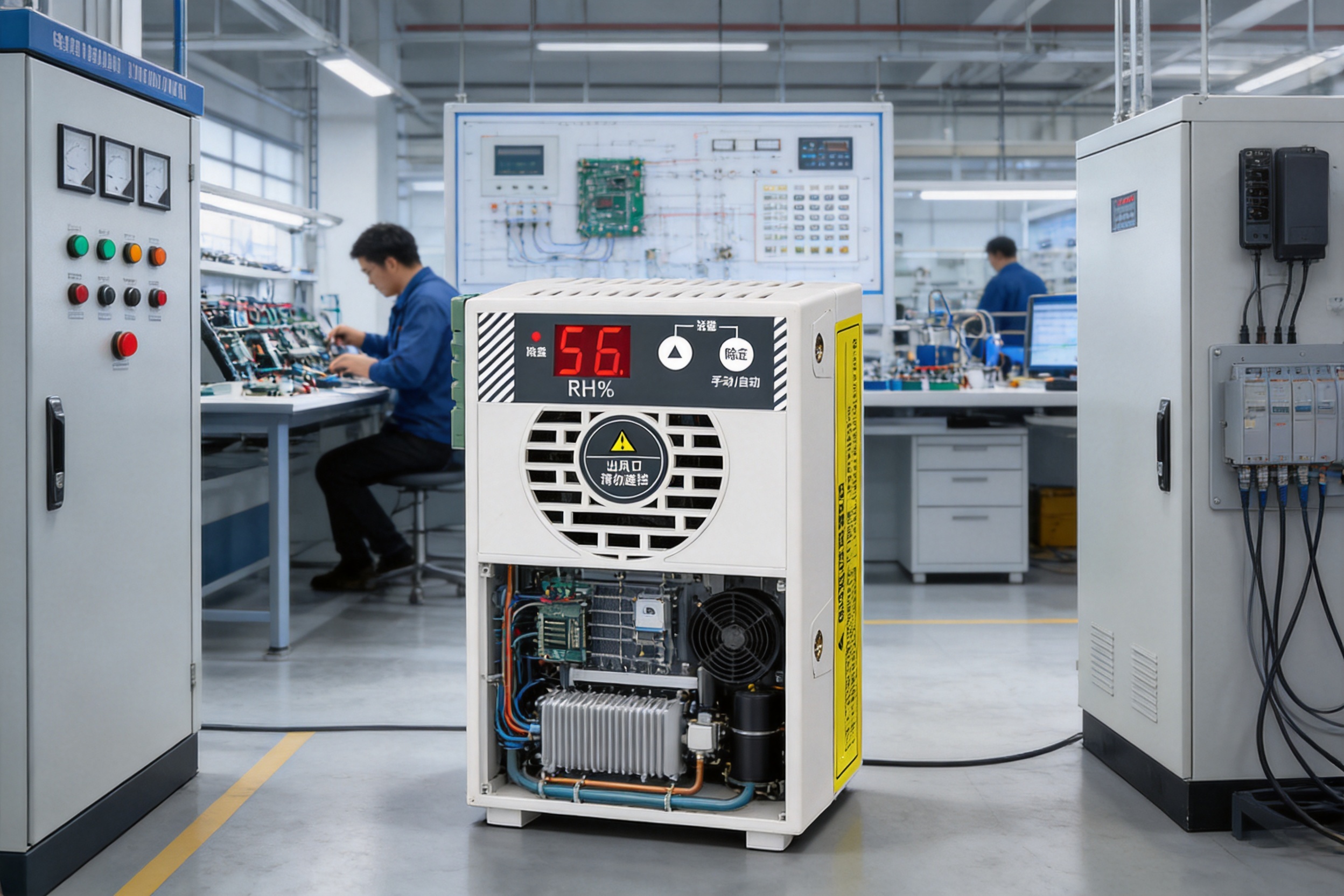
Customization and Project Support
Industrial customers frequently require more than a standard catalog unit. They may need a specific mounting arrangement, wiring configuration, enclosure interface, label format, control-panel integration, documentation package, or coordinated supply with other monitoring products. The feasibility of customization depends on the project requirements and should be evaluated with the manufacturer before ordering.
A supplier with in-house product development and industrial manufacturing experience can help review application conditions and identify potential design conflicts. For example, the correct solution may depend on whether the unit is installed inside a sealed cabinet, in a ventilated compartment, near a heat source, or in a location where corrosive contaminants are present. Technical consultation before production can reduce installation changes later.
Project support may also include model confirmation, parameter recommendations, sample evaluation, production scheduling, inspection coordination, packaging requirements, and after-sales technical communication. These services are particularly important for original equipment manufacturers, system integrators, panel builders, and international distributors.
Customers should provide accurate application information when requesting support. Useful details include enclosure dimensions, expected humidity, temperature range, power supply, airflow conditions, drainage arrangement, installation orientation, duty cycle, surrounding contaminants, and the required control behavior. Clear information allows the manufacturer to determine whether the standard KL-CS15W is appropriate or whether an alternative arrangement should be considered.
Commercial Value for Equipment Builders
For control-panel builders and equipment manufacturers, standardized auxiliary products can simplify engineering and reduce procurement complexity. A compact dehumidifier with a broad input range can be designed into different cabinet models without maintaining multiple voltage-specific versions. The one-channel input structure and defined control behavior also make it easier to document the environmental-control function.
The 15 W starting consumption may help equipment builders manage the total power budget of a cabinet. This is useful when the cabinet already contains controllers, communication devices, fans, heaters, transmitters, and other auxiliary loads. A lower-power dehumidification option can preserve capacity for the primary equipment and reduce the size of the supporting power system, subject to the complete design calculation.
There can also be lifecycle benefits. Preventing moisture-related corrosion and intermittent faults may reduce emergency maintenance, replacement of electronic parts, and unplanned downtime. The financial value depends on the equipment being protected, but in many industrial applications the cost of one failure can exceed the cost of a suitable environmental-control device by a wide margin.
For distributors, the product fits within the growing demand for smart environmental-control components. It can be presented to customers in automation, energy management, telecommunications, manufacturing, instrumentation, and industrial maintenance. Its use case is clear: compact, active, automatically controlled humidity reduction for suitable enclosed spaces.
Recommended Selection Process
A responsible selection process should begin by identifying the moisture risk. Is the problem condensation, high relative humidity, corrosion, storage protection, or a combination of these issues? The answer determines whether a dehumidifier is required and how it should be integrated with sealing, heating, ventilation, filtration, or insulation.
The next step is to evaluate the enclosure and environment. Users should review internal volume, construction materials, opening frequency, cable entry points, ambient temperature, external humidity, internal heat generation, and exposure to contaminants. The stated 0–50°C working environment and non-corrosive requirement should be treated as basic selection boundaries.
Power availability should then be confirmed. The product accepts AC/DC 85–260 V, but the project designer must still verify the actual electrical system and protection method. A suitable supply does not replace correct wiring or safe installation.
Control requirements should be defined clearly. If unattended operation is required, automatic mode with an appropriate humidity setting and hysteresis should be used. If the unit must operate continuously during a specific procedure, manual mode may be useful. The selected parameters should be documented and reviewed as part of commissioning.
Finally, drainage and maintenance should be planned before the unit is installed. The product removes moisture by condensation, so water must have a reliable path out of the cabinet or protected area. Maintenance personnel should be able to inspect the air path, sensor, drain, and electrical terminals without unnecessary disassembly.
Frequently Asked Questions
What type of product is the KL-CS15W?
The KL-CS15W is a compact smart dehumidifier designed for localized humidity control. It uses semiconductor refrigeration dehumidification and includes a one-channel temperature and humidity input module for environmental measurement and automatic control.
How does the dehumidification process work?
A fan draws humid air into the dehumidification duct. Moisture condenses into water when the air passes through the semiconductor refrigeration mechanism. The condensed water is then discharged from the cabinet through a water pipe.
Does the product operate automatically?
Yes. When the automatic dehumidification function is active, the device starts when ambient humidity rises above the maximum humidity value and stops when humidity falls below the minimum humidity value. These values are based on the configured humidity setting and hysteresis.
Can the unit be operated manually?
Yes. When the dehumidification function is manually turned on, the unit continues dehumidifying until the function is manually turned off. Manual mode is useful for commissioning, maintenance, troubleshooting, and temporary high-humidity conditions.
What is humidity hysteresis?
Humidity hysteresis is the separation between the activation threshold and the deactivation threshold. The maximum value is the humidity setting plus hysteresis, while the minimum value is the humidity setting minus hysteresis. This prevents the device from changing state too frequently when humidity fluctuates near the target.
What power supply does the KL-CS15W use?
The stated working power supply is AC/DC 85–260 V. The actual installation must still be checked by qualified personnel to ensure that the supply, wiring, protective devices, grounding, and local electrical requirements are appropriate.
How much power does the dehumidifier consume?
The supplied technical information states that the dehumidifier consumes 15 W when it starts. Actual energy use over time depends on how frequently and how long the unit operates.
What humidity range can the product measure?
The listed humidity measurement range is 5%RH to 95%RH. Humidity resolution is 1%RH. The stated basic error is ±3%RH from 10%RH to 90%RH and ±5%RH across the wider 0%RH to 99%RH range.
What temperature range is specified?
The temperature measurement range is listed as -9 to +80°C, with a temperature resolution of 1°C. The recommended working environment for the complete product is 0–50°C.
Where can this dehumidifier be used?
Potential applications include electrical cabinets, automation panels, communication enclosures, instrumentation compartments, remote equipment boxes, industrial control systems, and small storage spaces. The final application must meet the stated environmental conditions and provide appropriate airflow and drainage.
Is this product suitable for a whole room?
The KL-CS15W is designed for compact, localized humidity control rather than whole-room dehumidification. A room-scale application may require a higher-capacity system with a different design.
Why choose semiconductor refrigeration instead of a compressor?
Semiconductor refrigeration can provide a compact structure suitable for small enclosures. It avoids the larger mechanical arrangement associated with compressor systems and can be appropriate when the required moisture removal capacity is moderate and localized.
Does the product replace cabinet sealing or heating?
No. It should be considered part of a complete environmental-control strategy. Proper enclosure sealing, suitable ventilation or heating, correct cable entry protection, and appropriate maintenance may all be necessary depending on the application.
What should be done with the condensed water?
The condensed water should be discharged through the designated water pipe and routed safely away from electrical components. The drain should be protected from blockage, sharp bends, backflow, and leakage.
What does the manufacturer specialize in?
ASY Electronics develops industrial products related to data sensing, intelligent connectivity, smart-factory applications, broadband power line communication, wireless temperature monitoring, transmitters, thermal gas mass flow meters, and automatic door controllers. This product range supports applications involving industrial measurement, communication, and control.
What information should customers provide before ordering?
Customers should provide the enclosure size, expected temperature and humidity, power supply, installation location, airflow conditions, drainage plan, operating mode, duty cycle, and any exposure to dust, chemicals, or corrosive gases. These details help determine whether the standard product meets the application requirements.
Conclusion
The KL-CS15W Mini Dehumidifier provides a focused approach to humidity management in industrial and equipment-level environments. Its semiconductor refrigeration process actively removes moisture, while the fan-driven air path promotes circulation through the dehumidification duct. The product’s automatic control logic uses a humidity setting and hysteresis range to start and stop operation in a stable manner, and its manual mode provides additional flexibility for service and commissioning.
Its 15 W starting consumption, AC/DC 85–260 V input, temperature and humidity monitoring, 5%RH–95%RH humidity measurement range, and compact application focus make it a practical option for cabinets, control systems, communication enclosures, instrumentation, and other enclosed spaces. Compared with passive absorbers, timer-only fans, oversized room dehumidifiers, and compressor systems designed for larger areas, it offers a more targeted balance of active control, compact integration, and low power demand.
The product’s effectiveness depends on correct application engineering. Users should select an appropriate installation location, maintain adequate airflow, position the sensor carefully, provide reliable condensate drainage, and operate the product within the stated environmental conditions. When combined with proper enclosure design and maintenance, localized dehumidification can help reduce moisture-related failures and support longer equipment service life.
Backed by a company active in industrial sensing, connectivity, automation, and smart-factory solutions, the KL-CS15W can also be considered as part of a wider equipment-protection and industrial-data strategy. For manufacturers, integrators, and facility operators seeking a compact humidity-control component, it offers a practical foundation for building more reliable, efficient, and maintainable industrial systems.
References
1. Product technical information for the KL-CS15W Mini Dehumidifier, including operating principle, control behavior, electrical input, measurement range, accuracy, power consumption, and working environment.
2. Industrial humidity-control design principles for electrical cabinets, communication enclosures, instrumentation systems, and automation panels.
3. General engineering guidance on semiconductor refrigeration, thermoelectric heat transfer, air circulation, and condensate management.
4. General practices for industrial sensor installation, humidity measurement, control hysteresis, and environmental monitoring.
5. Smart-factory application concepts involving equipment condition monitoring, energy management, industrial communication, and production-process optimization.
6. Industrial electrical installation and maintenance principles for low-voltage equipment, control cabinets, sensors, and auxiliary environmental-control devices.