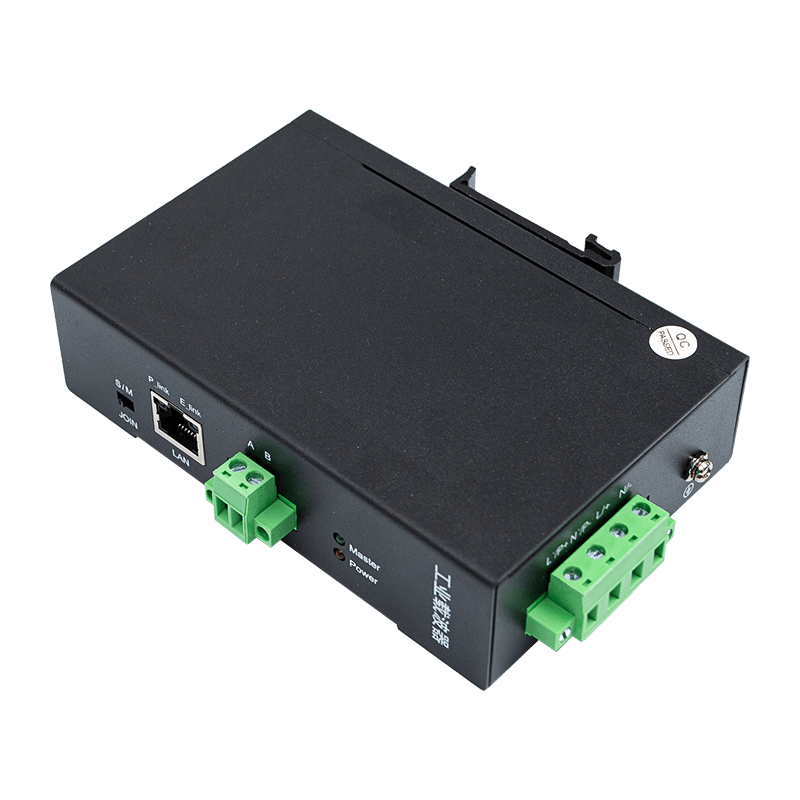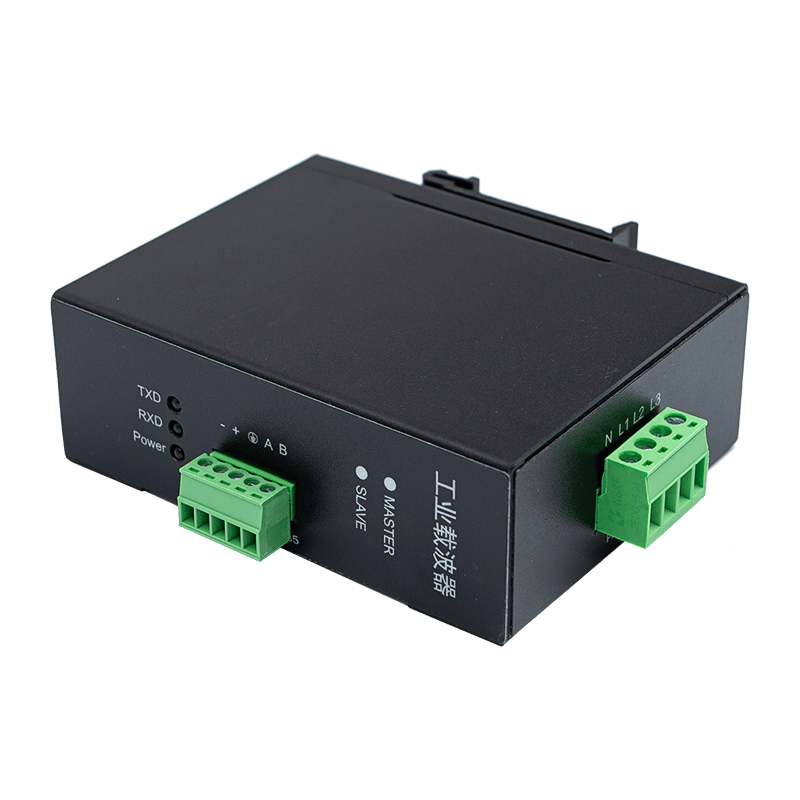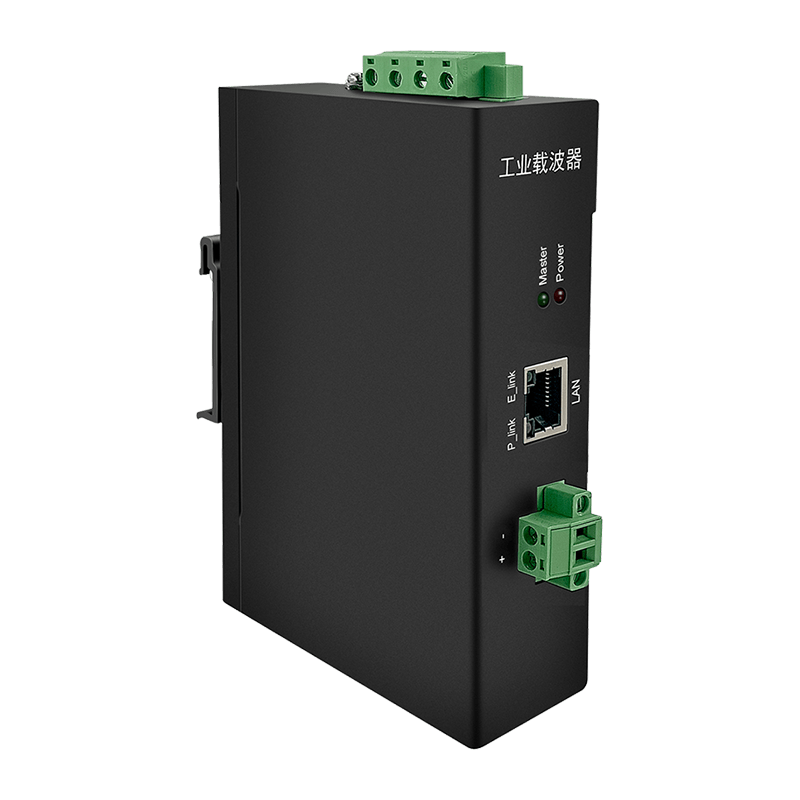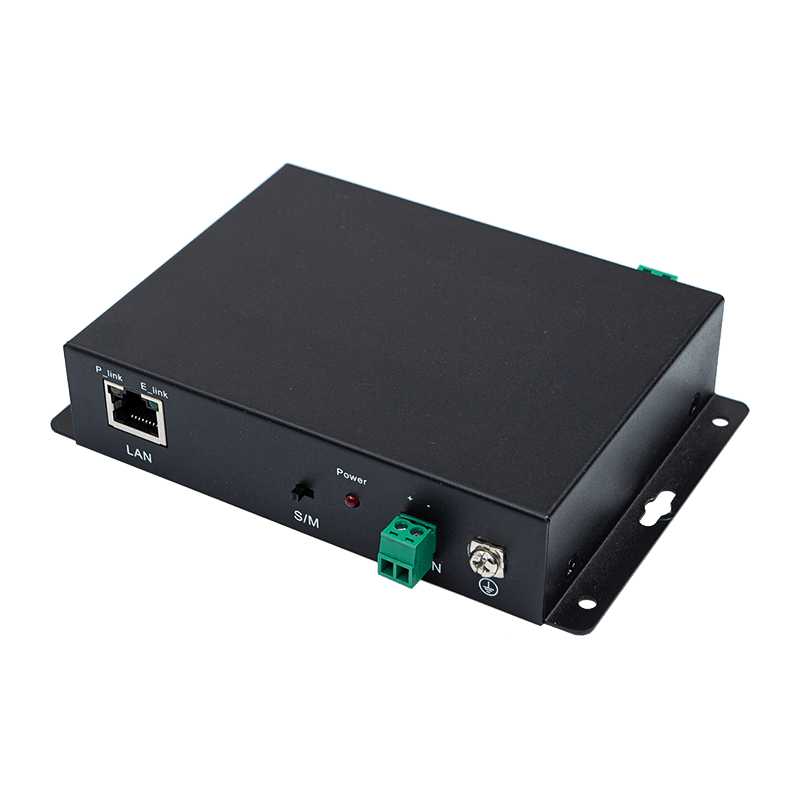


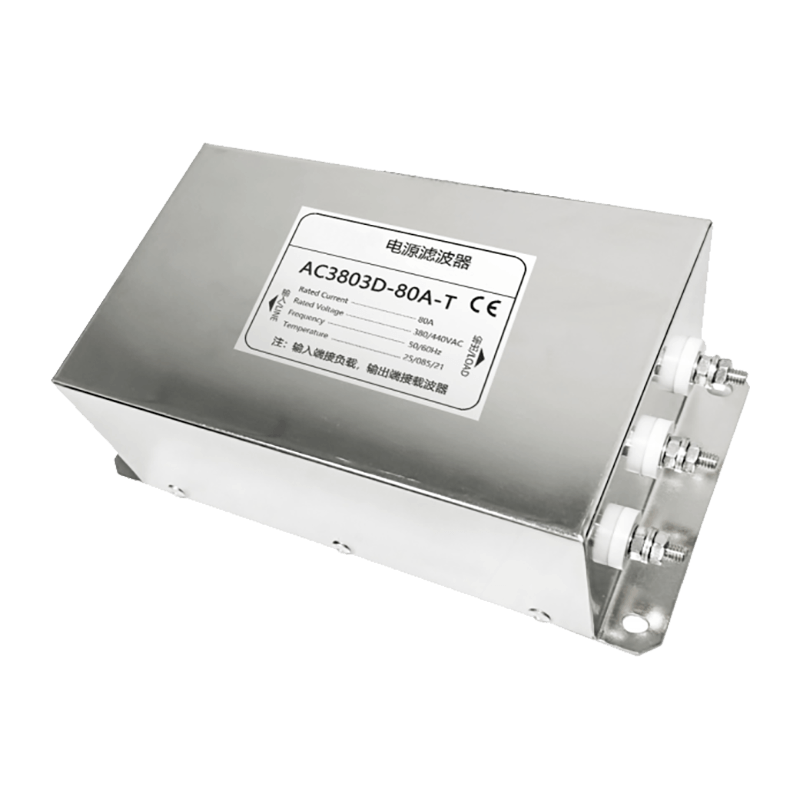
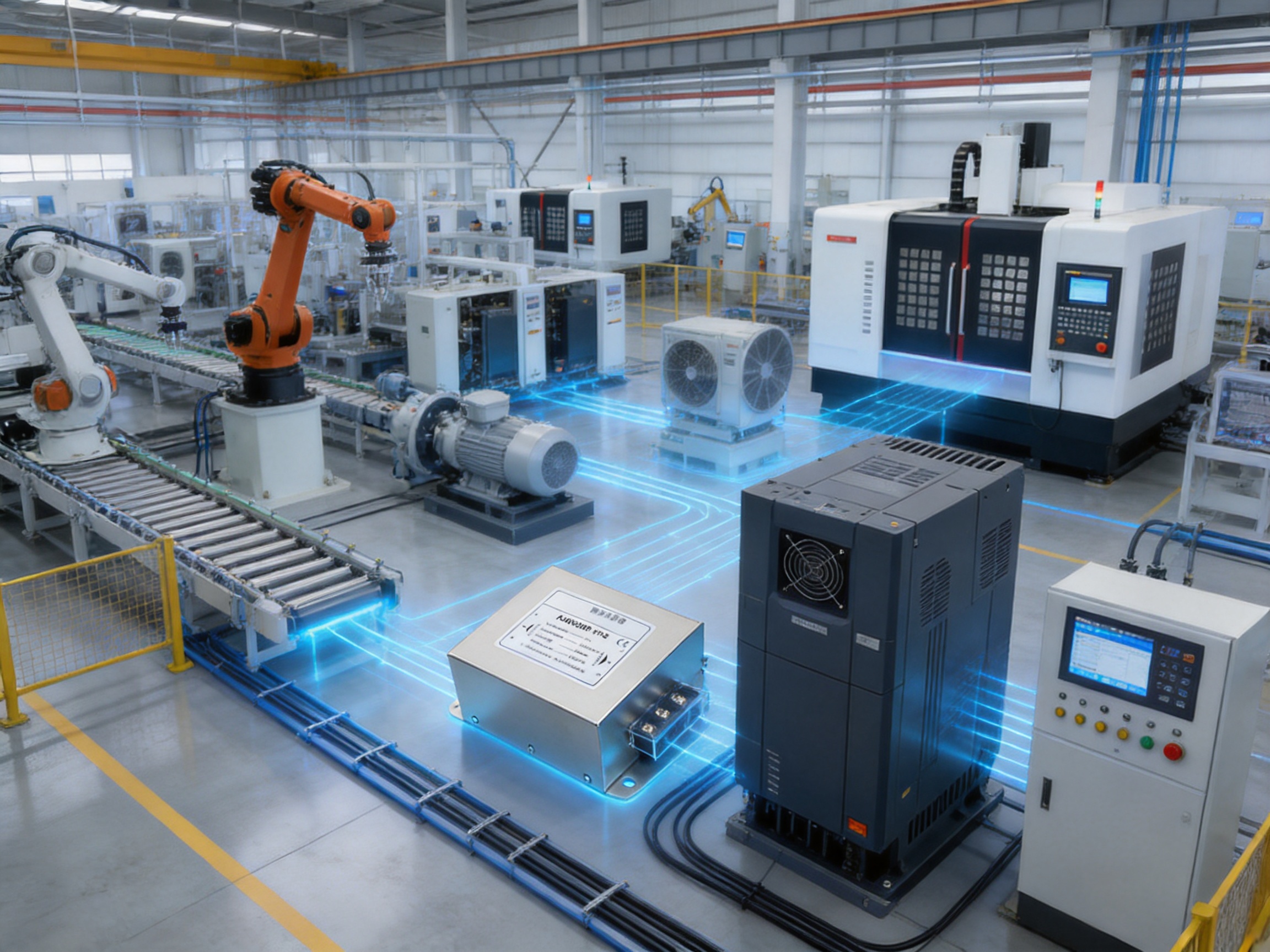
Modern factories depend on frequency converters, inverters, servo systems, and large industrial drives to control motors, pumps, fans, compressors, conveyors, machine tools, and automated production equipment. These technologies improve energy efficiency and process control, but they also create a difficult electrical environment. High-frequency switching, harmonics, surges, rapid voltage transitions, and conducted electromagnetic interference can travel through the same power network used by industrial communication systems.
Power-line carrier communication is especially sensitive to this environment. A power carrier uses the electrical distribution network as a communication path, so the same conductors that carry useful data can also carry unwanted noise. If a frequency converter or servo drive injects excessive interference into the line, communication may become unstable, slow, intermittent, or completely unavailable. In some applications, the interference can also contribute to over-voltage, over-current, heating, drive malfunction, false alarms, and equipment rejection.
The AC3803BP dedicated isolation filter is designed to address this challenge. It is a three-phase power filter intended for frequency converters, inverters, servo systems, large industrial drives, and three-phase three-wire power-line carrier applications. Its purpose is not simply to reduce noise. It is engineered to filter interference, isolate disruptive equipment from the carrier network, and provide a secondary filtering effect that supports more stable industrial communication.
With rated current options from 5 A to 250 A, a rated voltage of 380/440 VAC, an operating frequency of 50/60 Hz, and a filter range of 10 kHz to 30 MHz, the product is suitable for a broad range of industrial installations. Its overload capability, high-potential test performance, multiple wiring configurations, climatic rating, and compatibility with domestic and international drive brands make it a practical solution for system integrators, electrical engineers, machine builders, and factory automation specialists.
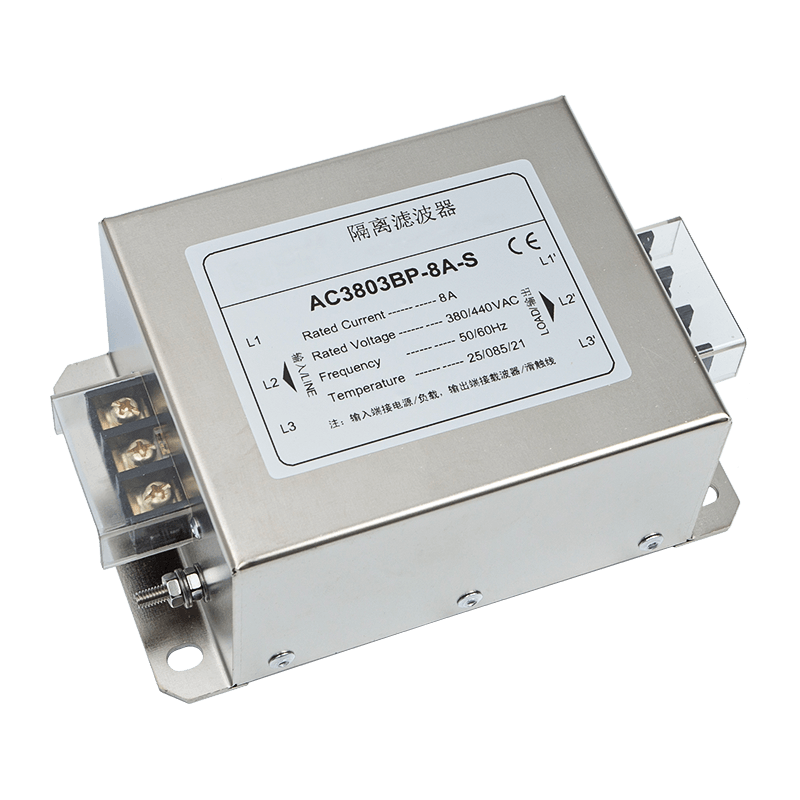
Dedicated Isolation Filter for Frequency Converters
1. The Industrial Communication Problem Behind Drive-System Interference
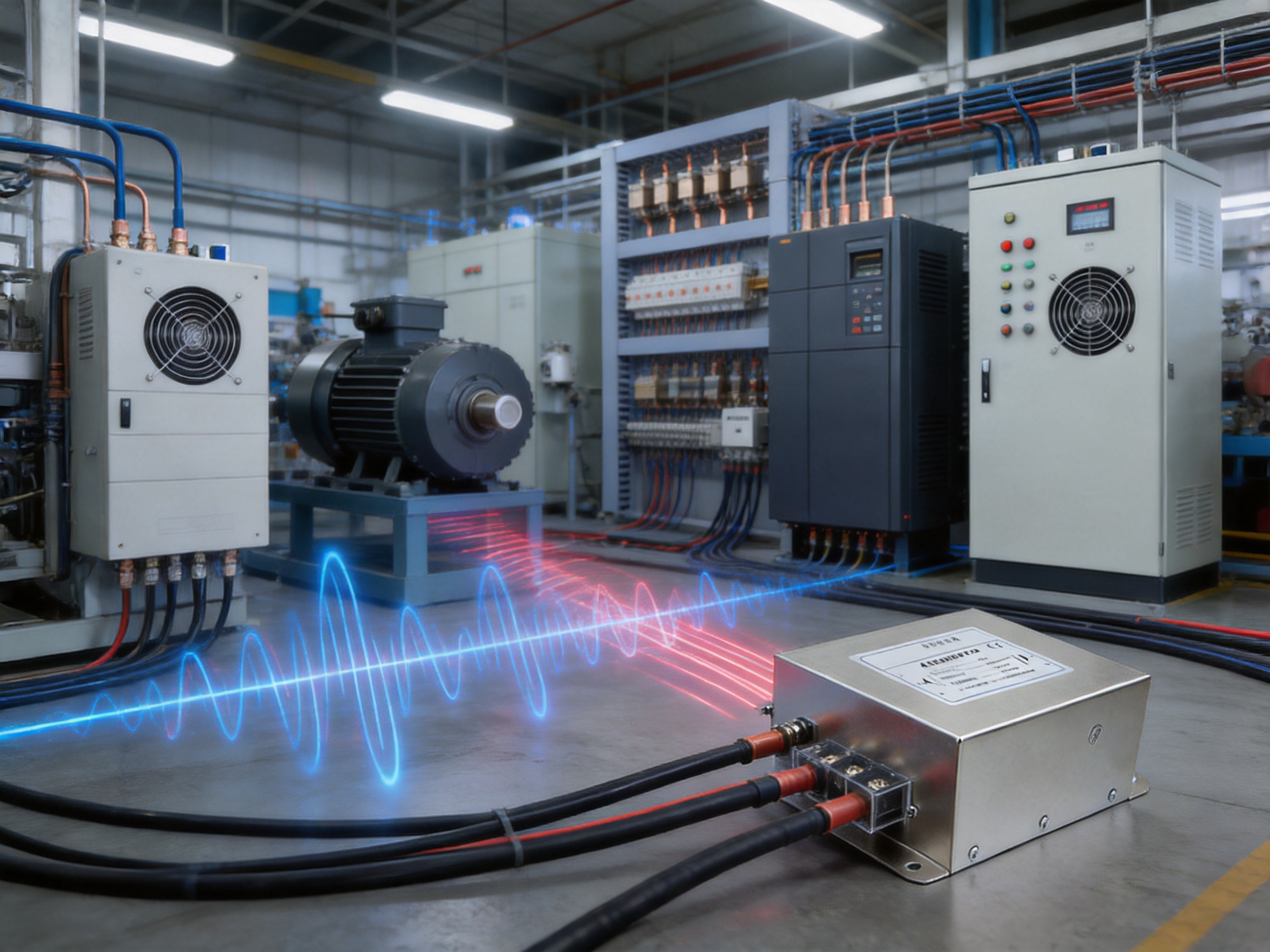
Frequency converters regulate motor speed by switching power electronics at high speed. This switching process is fundamental to variable-frequency drive operation, but it can generate common-mode and differential-mode disturbances. The disturbances may appear as high-frequency voltage components, current pulses, harmonics, rapid transients, and electromagnetic noise conducted through the power supply.
In a conventional motor-control installation, these disturbances may affect radio equipment, sensors, programmable controllers, safety circuits, or neighboring electrical devices. In a power-line carrier installation, the problem is more direct. The communication signal is intentionally coupled onto the power line, which means the signal must share the conductors with the electrical noise generated by connected loads.
Several symptoms can indicate that drive interference is affecting a power-line communication system. Data packets may be lost, communication may become slower, nodes may disconnect, and network commissioning may become difficult. A system that appears stable during light-load operation may fail when a motor accelerates, decelerates, or reaches a high-load condition. Communication quality can also vary according to motor speed, switching frequency, cable length, grounding conditions, and the number of connected drives.
Interference can also travel in the opposite direction. A power carrier signal may enter a drive system or other load and cause unwanted interaction. Depending on the equipment and network design, this may contribute to false triggering, abnormal feedback, control instability, or improper drive behavior. The electrical distribution line therefore requires a controlled interface between the carrier network and the high-noise equipment.
An isolation filter provides that interface. Installed in series with the relevant power circuit, it allows the required power-frequency energy to pass while attenuating unwanted high-frequency components. At the same time, it helps isolate the carrier signal from a drive or load that would otherwise absorb, distort, or reflect the signal.
2. Product Overview
The AC3803BP is a dedicated isolation filter for frequency converters and related industrial drive systems. It is designed for three-phase three-wire power applications in which a power-line carrier must coexist with equipment that can generate severe electromagnetic interference.
Product designation | AC3803BP |
Product category | Isolation filter |
Primary application | Frequency converters, inverters, servo systems, industrial drives, and three-phase power-line carrier systems |
Rated voltage | 380/440 VAC |
Operating frequency | 50/60 Hz |
Rated current range | 5 A to 250 A |
Filter range | 10 kHz to 30 MHz |
Climatic category | 25/085/21, corresponding to -25°C to +85°C operation |
High-potential test | 2250 VDC for 2 seconds line-to-line; 2700 VDC for 2 seconds line-to-ground |
Overload capability | Four times rated current at switch-on; 1.5 times rated current for one minute, once per hour |
Design references | UL 1283, CSA 22.2 No. 8 1986, and IEC/EN 60939 |
The product is intended to be connected in series where isolation from a noisy load is required. It can be installed outside the carrier equipment or at the interface between the power-line carrier network and the frequency converter, servo drive, inverter, or large driver. The correct installation point depends on the system architecture, power distribution arrangement, current rating, and communication topology.
Because the current range extends from 5 A to 250 A, the same product family can support small and medium control panels as well as substantially larger industrial drive circuits. This range simplifies product selection for integrators that work with multiple machine sizes or different motor capacities.
3. How the Isolation Filter Supports Power-Line Carrier Communication
The AC3803BP performs several complementary functions within an industrial power network. Its first function is attenuation. The filter reduces unwanted high-frequency interference generated by connected equipment. Its stated filter range of 10 kHz to 30 MHz covers a broad portion of the conducted-noise spectrum that can affect industrial communication and control equipment.
Its second function is isolation. A drive system can present a difficult electrical impedance to a carrier signal. Without an isolation barrier, the signal may be absorbed by the drive input, diverted into other branches, or distorted by the drive’s internal power electronics. By placing the filter in series, the carrier network receives a more controlled electrical boundary.
Its third function is secondary filtering. In a complete power-line carrier installation, the communication equipment may already include internal filtering. The external AC3803BP adds another stage at the power interface. This layered approach can be useful in severe-interference environments because noise reduction is distributed between the carrier device and the external isolation component.
The filter is therefore more than a general-purpose mains filter. It is designed around the practical relationship between high-power switching equipment and power-line communication. That focus is important for industrial applications in which conventional noise suppression may not provide sufficient carrier isolation.
3.1 Differential-mode and common-mode considerations
Electrical interference can be described in different ways. Differential-mode noise appears between phase conductors, while common-mode noise appears between conductors and ground or across multiple conductors relative to a reference potential. Frequency converters can generate both forms of disturbance, and the actual balance depends on the converter design, motor cable arrangement, grounding system, load condition, and installation geometry.
A suitable filter must be integrated into the complete system rather than treated as an isolated component. Wiring length, conductor routing, enclosure layout, grounding, cable shielding, and the separation of power and communication circuits all influence the final performance. The AC3803BP provides the filtering and isolation element, while the installer must follow appropriate electrical design and safety practices.
3.2 Why external filtering may be necessary
Many frequency converters include built-in electromagnetic compatibility measures. However, built-in filtering is generally optimized for the converter’s own operating requirements and may not be sufficient for a power-line carrier network that uses the same distribution conductors. Different drives also have different internal architectures, input impedances, switching behaviors, and EMC characteristics.
An external dedicated filter gives the system designer an additional method of controlling the interface. It can be selected according to the current rating and placed where it provides the greatest separation between the carrier branch and the interfering load. This is especially valuable when adding communication capability to an existing factory, where replacing drives or redesigning the entire distribution system would be expensive and disruptive.
4. Main Product Advantages Over Basic Filtering Approaches
The most important advantage of the AC3803BP is its application-specific design. A basic power filter may reduce some conducted noise, but it may not be designed with power-line carrier isolation in mind. The AC3803BP is intended specifically for the interaction between carrier communication and frequency-conversion equipment.
4.1 Dedicated design for severe interference
Industrial drives operate in environments where interference levels can be considerably higher than those found in ordinary commercial electrical systems. The product is designed for frequency inverters and especially for applications described as having severe interference. This makes it suitable for demanding industrial networks in which communication stability is a priority.
Rather than selecting a filter solely by voltage and current, the system designer can consider the communication function as part of the filtering requirement. This helps avoid a common mistake in which a component is electrically adequate for powering a drive but does not provide sufficient separation for a carrier signal.
4.2 Broad current coverage
The 5 A to 250 A rated-current range supports a wide selection of applications. Small machine modules, control cabinets, servo branches, pumps, fans, production lines, and larger industrial drive systems can be addressed within one product family. This can reduce engineering effort and simplify procurement for integrators that need consistent filtering technology across different projects.
The maximum rating of 250 A also makes the product relevant to high-power industrial applications. It is important, however, that the selected rating be based on the continuous operating current, starting characteristics, ambient temperature, overload conditions, conductor size, enclosure ventilation, and applicable electrical codes.
4.3 Wide frequency filtering range
The 10 kHz to 30 MHz filter range is another practical advantage. Drive-related disturbances are not limited to one narrow frequency. Switching events and fast voltage transitions can generate energy across a wide spectrum. A broad filtering range gives the system a better opportunity to reduce the frequencies that interfere with communication, although actual attenuation depends on installation conditions and the electrical characteristics of the complete network.
4.4 Support for multiple drive brands
The product directly matches various brands of frequency converters, inverters, servo systems, and industrial drive systems. This compatibility is valuable for retrofit applications. Industrial facilities often contain equipment from multiple generations and suppliers. A filter that can be used with different brands gives integrators greater freedom when designing upgrades or addressing communication problems on existing machinery.
Brand-independent compatibility also reduces the need to redesign the control architecture around a single drive supplier. The filter can serve as a standardized interface component within a mixed-equipment environment.
4.5 Multiple wiring options
Different installations require different connection methods. The AC3803BP is available with various wiring options, including bolt connections, copper connections, and terminal blocks. This flexibility helps the product adapt to panel construction, current level, conductor arrangement, maintenance practices, and available installation space.
For high-current systems, a robust bolt or copper connection may be preferred. For compact control cabinets or lower-current circuits, a terminal-block configuration may simplify assembly and servicing. The specific option should be selected according to the current rating, conductor cross-section, tightening requirements, thermal design, and applicable safety standards.
4.6 Electrical withstand performance
The specified high-potential tests provide useful information about insulation withstand. The product is tested at 2250 VDC for 2 seconds line-to-line and 2700 VDC for 2 seconds line-to-ground. These values support the design objective of providing a reliable electrical boundary between the connected circuits.
High-potential test values do not replace the need for correct installation, grounding, insulation coordination, overcurrent protection, or enclosure safety. They do, however, demonstrate that the component is designed with significant dielectric-strength requirements in mind.
4.7 Overload capability
Drive systems may experience temporary current conditions during startup, acceleration, deceleration, switching, or abnormal mechanical loading. The AC3803BP is specified to withstand four times rated current at switch-on and 1.5 times rated current for one minute, once per hour. This overload capability gives the filter additional operating margin for common industrial transient conditions.
Overload capability should not be interpreted as permission to operate continuously above the rated current. The installation must still be designed around continuous current, thermal dissipation, protective devices, and the actual load profile.
5. Application Scenarios
5.1 Power-line carrier networks in smart factories
Power-line carrier communication can be useful in factories where installing new communication cables is difficult, expensive, or disruptive. Existing power conductors can provide a communication path between equipment, sensors, gateways, and control points. However, factory power systems often contain many variable-speed drives and switching loads.
The AC3803BP can be installed at the interface between a carrier network and a drive branch to reduce the risk that the drive will disturb communication. This supports more stable connectivity for equipment monitoring, energy management, and industrial data collection.
5.2 Frequency converters for pumps and fans
Water-treatment facilities, HVAC plants, process lines, and manufacturing sites commonly use frequency converters to regulate pumps and fans. These systems may operate continuously and may be distributed across large facilities. When communication signals travel through shared power infrastructure, drive-generated noise can affect remote nodes.
An isolation filter can help separate the pump or fan drive from the carrier network while allowing the required three-phase power to reach the load. The current rating should be selected according to the motor and converter specifications, including starting and transient conditions.
5.3 Servo systems and precision machinery
Servo systems are widely used in packaging machines, assembly equipment, robotics, machine tools, and high-speed production systems. These applications may contain several coordinated drives, feedback devices, and control modules in a compact enclosure. High switching activity and tightly packed wiring can create challenging EMC conditions.
Installing the filter at the appropriate power interface can reduce the coupling of drive-related interference into a carrier communication circuit. This may be particularly useful when the machine is integrated into a larger industrial network that uses the facility power system for communication.
5.4 Retrofit projects
Retrofitting an existing plant often involves adding monitoring and communication features without replacing functioning drives. The AC3803BP can provide a practical way to address interference while preserving existing equipment. It can be selected for different current levels and used with different drive brands, which is beneficial in facilities with mixed electrical equipment.
A retrofit should begin with a site survey. Engineers should identify the power topology, drive locations, communication routes, grounding arrangements, motor cable lengths, and operating conditions. Measurements during drive startup and normal operation can help determine whether the filter should be installed at the drive input, carrier branch, or another defined interface point.
5.5 Large industrial drive systems
Large drivers and industrial drive systems can produce substantial current and severe conducted interference. Their size and power level may also limit the practical options for rewiring or replacing equipment. The AC3803BP current range extends to 250 A, allowing it to be considered for larger three-phase applications when the selected model and installation meet the system requirements.
High-current installations require particular attention to conductor routing, mechanical support, terminal temperature, short-circuit protection, ventilation, enclosure structure, and maintenance access. Professional electrical design is essential.
6. Manufacturing and Engineering Strengths
The performance of an isolation filter depends not only on its circuit concept but also on manufacturing consistency. A filter must maintain repeatable electrical characteristics, mechanical integrity, insulation quality, connection reliability, and thermal performance. ASY Electronics is a high-tech enterprise focused on smart-factory technologies, data sensing, intelligent connectivity, industrial communication, and related equipment.
This background is relevant to the AC3803BP because the company’s broader product portfolio includes broadband power-line carriers, wireless temperature monitoring systems, industrial transmitters, thermal gas mass flow meters, and automatic door controllers. These products serve industrial environments in which reliable sensing, communication, and equipment integration are important.
6.1 Manufacturing aligned with smart-factory principles
A smart factory depends on consistent production processes, equipment data, process control, traceability, and continuous improvement. These principles are directly applicable to the manufacture of electrical filters. Component selection, winding or magnetic assembly, insulation processing, enclosure construction, terminal installation, and final testing all benefit from controlled and documented workflows.
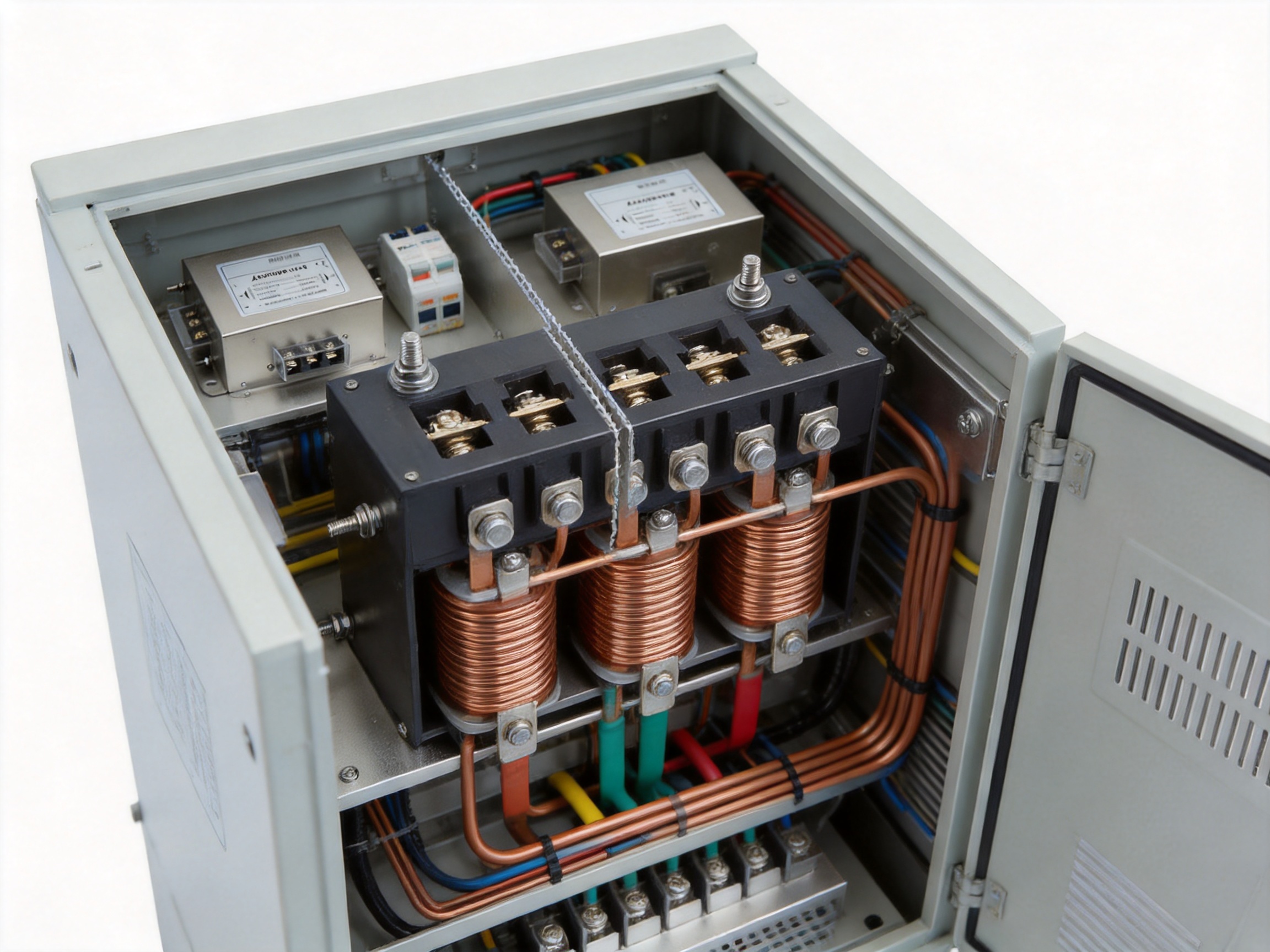
For an isolation filter, production quality must be considered at several levels. The electrical design must produce the intended filtering behavior. The magnetic and capacitive elements must be assembled consistently. Insulation distances must be maintained. Connections must withstand current and vibration. The finished unit must pass electrical safety checks and meet the declared operating conditions.
6.2 Integration of hardware and industrial data
The company’s focus on self-developed edge-layer hardware and industrial data integration reflects an understanding of how physical equipment becomes part of a connected production environment. This is important for filter applications because the component is often installed as part of a larger system rather than used alone.
Industrial customers increasingly expect suppliers to understand the complete operating context: drive systems, power networks, communication equipment, sensors, energy-management platforms, and machine-control systems. Experience across these product categories can support more practical application guidance and more integrated engineering discussions.
6.3 Attention to application-specific design
A general-purpose component may be technically functional but difficult to integrate. Application-specific products are typically easier to specify because their intended use, electrical ratings, installation context, and performance objectives are clearer. The AC3803BP is positioned specifically for frequency converters, inverters, servo systems, industrial drives, and power-line carrier applications.
This application focus can help engineers evaluate the filter according to the real problem: protecting communication and isolating a noisy load. It also supports more efficient troubleshooting because the component is selected for a known relationship between industrial drives and carrier networks.
6.4 Quality and certification orientation
The product design corresponds to UL 1283, CSA 22.2 No. 8 1986, and IEC/EN 60939 references. These standards are associated with safety and performance considerations for electromagnetic interference filters and related equipment. Standards-based design gives system integrators a clearer technical basis for evaluation and documentation.
Certification and standards alignment should always be verified for the specific model, configuration, market, and installation. Customers may also require additional documentation, inspection records, test reports, or project-specific approvals.
7. Installation Planning and Best Practices
Correct installation is essential for achieving the intended isolation effect. The filter should be installed in series with the circuit where separation from the interfering equipment is required. The installer must identify the line side and load side according to the product documentation and system design.
7.1 Select the correct electrical rating
The rated voltage must be suitable for the three-phase supply. The rated current must be selected based on the expected continuous current and the application’s transient profile. A filter should not be selected solely by the nominal motor power because converter input current, efficiency, power factor, overload behavior, and duty cycle also affect the requirement.
When the operating environment has a high ambient temperature, limited ventilation, or a compact enclosure, thermal derating may need to be considered. The filter’s climatic category covers -25°C to +85°C, but the complete assembly may have a lower practical temperature limit due to neighboring components and enclosure conditions.
7.2 Keep high-noise wiring controlled
Power conductors on the noisy side of the filter should be routed carefully and kept separate from the carrier or communication wiring where possible. Long parallel runs between input and output conductors can create unwanted coupling and reduce the benefit of the filter. The physical arrangement should prevent filtered and unfiltered conductors from being unnecessarily close.
Cabinet layout is therefore part of the filtering solution. The filter should be mounted in a position that supports short, direct connections, clear separation between line and load sides, adequate cooling, and safe access for inspection.
7.3 Use suitable grounding and bonding
Grounding and bonding must follow the requirements of the electrical system and applicable regulations. A filter cannot compensate for poor grounding, loose connections, incorrect protective bonding, or excessive parasitic coupling. The enclosure, drive, carrier equipment, cable shields, and protective conductors should be evaluated as one system.
Ground connections should be mechanically secure and electrically appropriate. High-frequency behavior can be affected by conductor length and routing, so the installation should avoid unnecessary loops and long inductive connections.
7.4 Check connections and torque
Loose terminals can increase resistance, create heating, produce voltage drops, and generate additional interference. Bolt, copper, and terminal-block connections should be assembled according to the specified conductor size and tightening requirements. Periodic inspection may be appropriate in systems exposed to vibration, thermal cycling, or high current.
7.5 Verify communication under real operating conditions
Testing should not be limited to a no-load condition. The carrier network should be evaluated during drive startup, acceleration, deceleration, steady operation, and normal production loading. Engineers should observe packet loss, communication retries, node availability, response time, and any correlation between communication events and drive activity.
Testing under real conditions provides a more reliable indication of whether the filter has been installed at the correct location and whether additional measures are needed.
8. System-Level Benefits
The value of a dedicated isolation filter is measured by the performance of the complete industrial system. By reducing interference and isolating disruptive equipment, the AC3803BP can help improve communication reliability, reduce commissioning difficulty, and support more predictable operation of power-line carrier networks.
Stable communication is important for industrial data collection. If carrier nodes repeatedly disconnect, the resulting data may be incomplete or delayed. This can affect equipment condition monitoring, energy analysis, production reporting, and maintenance planning. A cleaner communication environment supports more dependable information flow from the factory floor to edge devices and management systems.
The filter can also help reduce troubleshooting time. Without a defined isolation point, engineers may need to investigate every branch of a power system to determine where interference is entering the network. A dedicated filter creates a deliberate boundary between a known noise source and the carrier network, making the system architecture easier to analyze.
Another benefit is flexibility during system expansion. When additional drives or machines are added, the electrical environment changes. Using a standardized filter family with several current ratings allows engineers to apply a consistent interference-control approach to new branches.
For machine builders, the filter can be incorporated into a repeatable cabinet design. For factory operators, it can provide a retrofit option. For system integrators, compatibility with different drive brands and wiring configurations can simplify project execution.
9. Comparison with Alternative Approaches
Several approaches may be used to address interference in industrial systems. Each has a role, but the AC3803BP offers a focused solution when the primary problem is the interaction between a drive and a power-line carrier network.
9.1 Relying only on the drive’s internal filter
An internal drive filter may reduce emissions from the converter, but it may not provide the level of carrier isolation required by a communication system. Internal filtering also varies among drive brands and models. An external dedicated filter provides an additional and more consistent interface that can be evaluated independently of the drive manufacturer.
9.2 Using only cable shielding
Shielded motor and communication cables can reduce radiated coupling, but they do not necessarily prevent conducted interference from traveling through the power conductors. Cable shielding and correct grounding remain important, but they address a different part of the EMC problem. The AC3803BP directly addresses the conducted path at the power interface.
9.3 Separating communication onto new cables
Installing dedicated communication cables or fiber-optic links may reduce dependence on the power network, but new cabling can be expensive and difficult in an operating factory. It may require new cable trays, machine modifications, production downtime, and additional installation work. A power-line carrier system with suitable isolation can be more practical where existing power infrastructure is advantageous.
9.4 Using a general-purpose EMI filter
A general-purpose filter may be designed for equipment emissions or immunity, but not specifically for carrier-signal isolation. The AC3803BP is differentiated by its intended use with three-phase three-wire power carriers and severe interference from inverters, servo drives, and large drivers.
10. Selection Guide for Engineers and Integrators
Before selecting a model, engineers should collect the following information:
● The phase configuration and whether the system is three-phase three-wire.
● The nominal line voltage and operating frequency.
● The drive input current, motor power, and expected load profile.
● The maximum startup, acceleration, and overload current.
● The location of the carrier equipment and the branch where isolation is needed.
● The presence of multiple drives, servo systems, or large switching loads.
● Ambient temperature, enclosure size, cooling method, and installation altitude if relevant.
● The required wiring option, conductor cross-section, and maintenance access.
● Applicable safety, EMC, and certification requirements for the destination market.
● The communication performance before and after installation.
A properly selected filter should have sufficient continuous-current capacity without excessive thermal stress. It should also be physically compatible with the cabinet and provide connection methods suitable for the conductor size. For high-current systems, engineering review should include fault-current conditions and protective coordination.
11. Maintenance and Troubleshooting
Isolation filters are generally passive components, but they should still be included in preventive maintenance programs. Visual inspection can identify discoloration, loose hardware, damaged insulation, unusual odor, corrosion, or signs of overheating. Thermal inspection may help detect abnormal connection resistance or excessive current concentration.
If communication problems occur after installation, engineers should verify that the filter is connected in the correct series position and that line-side and load-side conductors are not routed together in a way that bypasses the intended isolation. They should also check whether another power branch is coupling interference into the carrier network.
Drive parameters can influence interference. Switching frequency, acceleration time, carrier frequency, motor cable length, braking operation, and common-mode current behavior may all change the electrical environment. A filter can significantly improve conditions, but it should be evaluated together with drive settings, grounding, cable management, and network topology.
Communication failures that occur only during motor acceleration may indicate transient coupling. Failures that occur at all times may point to incorrect wiring, insufficient current rating, poor grounding, carrier impedance problems, or an installation point that does not isolate the actual noise path.
12. Role in Industrial IoT and Smart-Factory Development
Industrial IoT systems depend on dependable communication between physical assets and digital platforms. Sensors, transmitters, drives, controllers, gateways, and data-management systems must exchange information with predictable performance. Power-line carrier communication can be an efficient part of this architecture, particularly in facilities where existing power infrastructure can support data connectivity.
The AC3803BP contributes at the physical-layer level. It does not replace a carrier modem, controller, gateway, or software platform. Instead, it helps create a more suitable electrical environment for those technologies to operate. This type of hardware foundation is important because higher-level analytics cannot compensate for missing, corrupted, or unstable field data.
Reliable connectivity supports applications such as equipment condition monitoring, refined energy management, production process optimization, and predictive maintenance. When data from machines is available consistently, factory operators can identify abnormal energy consumption, detect changes in equipment behavior, and make better decisions about maintenance and production scheduling.
In this context, a dedicated isolation filter may be a small component in physical size but a significant part of system reliability. It helps connect the electrical infrastructure of the factory with the information infrastructure of the smart factory.
13. Frequently Asked Questions
Q1: What is the primary purpose of the AC3803BP?
The primary purpose is to filter interference and isolate frequency converters, inverters, servo systems, and large industrial drives from three-phase three-wire power-line carrier networks. It helps prevent drive-generated noise from disturbing carrier communication and helps prevent carrier signals from being improperly absorbed or distorted by the connected load.
Q2: What voltage and frequency does the filter support?
The rated voltage is 380/440 VAC, and the operating frequency is 50/60 Hz. The complete electrical system must be checked to confirm that the selected configuration is suitable for the installation.
Q3: What current ratings are available?
The rated-current range is 5 A to 250 A. The correct rating should be selected according to continuous current, starting conditions, transient loading, ambient temperature, enclosure design, and applicable electrical requirements.
Q4: Can the filter be used with different inverter brands?
Yes. The product is designed to directly match various domestic and international brands of frequency converters, inverters, servo systems, and industrial drive systems. Compatibility should still be confirmed for the specific installation and wiring configuration.
Q5: Is the AC3803BP a replacement for a drive’s internal EMC filter?
It should not be viewed automatically as a replacement for internal drive filtering. It is an external dedicated isolation filter that adds filtering and separation at the power interface. It can complement the drive’s built-in measures when power-line carrier communication requires additional protection.
Q6: Where should the filter be installed?
It should be installed in series at the power interface where isolation from the noisy load is required. The exact position depends on the carrier topology, drive branch arrangement, power distribution system, and intended direction of isolation. A qualified electrical engineer should determine the final installation location.
Q7: What is the filter frequency range?
The specified filter range is 10 kHz to 30 MHz. This broad range is intended to address a wide portion of conducted interference that may affect power-line carrier communication and related industrial equipment.
Q8: What wiring options are available?
Various wiring options are available, including bolt, copper, and terminal-block configurations. The appropriate option depends on current level, conductor size, panel construction, and maintenance requirements.
Q9: Can the product handle temporary overloads?
The stated overload capability is four times rated current at switch-on and 1.5 times rated current for one minute, once per hour. These specifications describe temporary conditions and do not authorize continuous operation above the rated current.
Q10: What environmental temperature range is specified?
The climatic category is 25/085/21, corresponding to an operating range of -25°C to +85°C. The complete assembly must also be evaluated for enclosure temperature, ventilation, nearby heat sources, and actual operating conditions.
Q11: Can the filter solve every communication problem?
No. It is designed to address conducted interference and carrier isolation, but communication performance also depends on grounding, cable routing, network topology, carrier equipment, drive parameters, power-system impedance, and other loads. A system-level evaluation is recommended.
Q12: What safety tests are specified?
The high-potential test specifications are 2250 VDC for 2 seconds line-to-line and 2700 VDC for 2 seconds line-to-ground. Customers should request the applicable technical and compliance documentation for the selected model and project.
Q13: Is the product suitable for retrofit projects?
Yes. Its broad current range and compatibility with different drive brands make it suitable for many retrofit situations. A site survey should be completed before installation to identify the actual source and path of interference.
Q14: Why is external isolation important in a smart factory?
Smart-factory applications depend on reliable field data. If drive interference causes carrier nodes to disconnect or lose packets, condition monitoring, energy management, and production optimization can be affected. External isolation helps provide a more stable physical communication environment.
14. Recommended Engineering Workflow
A reliable deployment should begin with problem definition. The engineering team should determine whether the issue is conducted interference, radiated interference, carrier signal attenuation, incorrect topology, or a combination of factors. Baseline measurements during different drive operating states can provide valuable evidence.
The next step is to identify the affected branch. If a particular inverter, servo system, or large driver causes communication failures, the filter should be evaluated at the boundary between that equipment and the carrier network. If several loads contribute to the problem, a broader distribution strategy may be necessary.
After selecting the voltage and current rating, the team should review the mechanical installation. Connection method, conductor routing, thermal dissipation, enclosure space, and access for inspection should be confirmed before procurement.
Following installation, the network should be tested under representative production conditions. Results should be documented, including communication availability, error rate, drive state, load level, and environmental conditions. This creates a reference for future maintenance and expansion.
15. Why This Product Is a Practical Industrial Choice
The AC3803BP combines a focused application purpose with a broad electrical range. It is designed for the real-world problem of connecting power-line carrier communication to equipment that generates substantial interference. Its rated voltage supports common 380/440 VAC industrial systems, while its 5 A to 250 A range covers applications from smaller machine circuits to large drive branches.
Its filter range of 10 kHz to 30 MHz addresses a broad spectrum of conducted noise. Its isolation function provides more than basic attenuation by creating a controlled interface between carrier equipment and disruptive loads. Its overload capability adds margin for temporary operating conditions, while its high-potential test specifications support insulation design and safety evaluation.
The availability of bolt, copper, and terminal-block wiring options improves installation flexibility. Compatibility with different inverter, servo, and industrial drive brands is valuable for both new machine construction and retrofit work. Standards-oriented design references also help engineers prepare technical documentation and project approvals.
Behind the product is a company whose wider capabilities include industrial communication, sensing, transmitters, flow measurement, wireless temperature monitoring, automatic door control, edge-layer hardware, and industrial data integration. This combination suggests an understanding of both the electrical equipment and the connected-factory applications in which the filter operates.
For manufacturers and integrators, the most important benefit is not simply noise reduction. It is the opportunity to build a more stable, maintainable, and scalable industrial communication system without replacing every existing drive or installing entirely new communication infrastructure.
Conclusion
Frequency converters, inverters, servo systems, and large industrial drives are essential to efficient automation, but their switching behavior can create severe interference on shared power networks. When a power-line carrier system uses those networks for communication, filtering and isolation become critical design requirements.
The AC3803BP dedicated isolation filter is developed for this specific challenge. It supports 380/440 VAC three-phase applications, rated currents from 5 A to 250 A, and a 10 kHz to 30 MHz filtering range. It is intended to reduce conducted interference, isolate carrier signals from noisy drive equipment, and provide a secondary filtering stage in demanding industrial environments.
Its application-specific design, broad current coverage, compatibility with different drive brands, flexible wiring options, electrical withstand performance, overload capability, and standards-oriented design references distinguish it from a basic general-purpose filter. When combined with correct grounding, cable routing, drive configuration, protective coordination, and system testing, it can become an important part of a reliable power-line communication architecture.
As factories continue to adopt industrial IoT, condition monitoring, energy management, and connected production systems, the quality of the physical communication layer will remain essential. A dedicated isolation filter helps bridge the gap between high-power automation equipment and dependable industrial data connectivity.
References
1. AC3803BP Product Technical Data, Dedicated Isolation Filter for Frequency Converters.
2. IEC/EN 60939, Passive Filter Units for Electromagnetic Interference Suppression.
3. UL 1283, Electromagnetic Interference Filters.
4. CSA 22.2 No. 8 1986, Electromagnetic Interference Filters.
5. Industrial Power-Line Carrier Communication Engineering Principles.
6. Variable-Frequency Drive Installation and Electromagnetic Compatibility Practices.
7. Industrial IoT Architecture, Edge Connectivity, and Smart-Factory Data Integration.