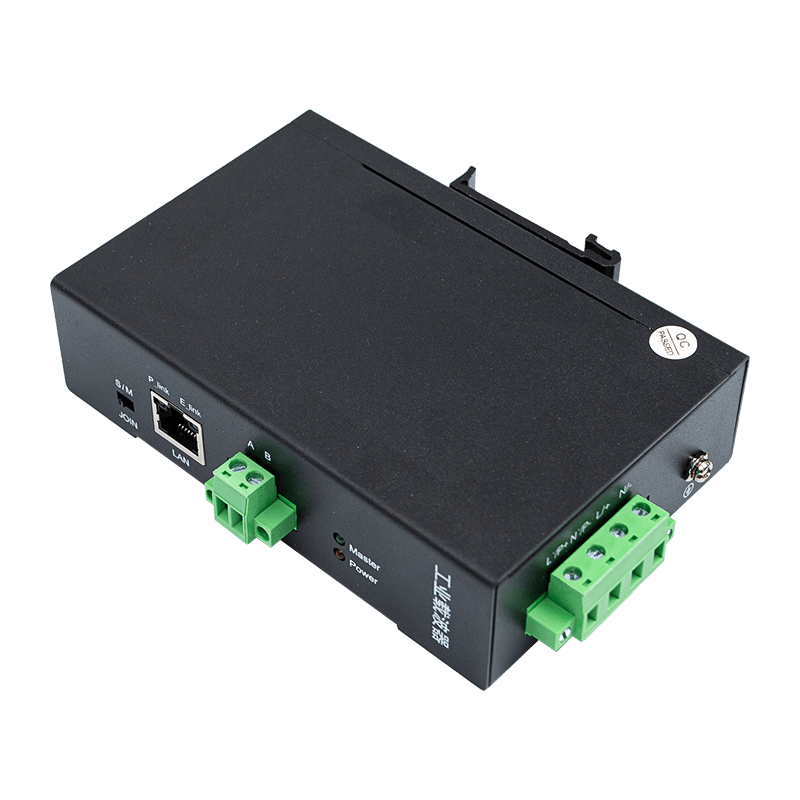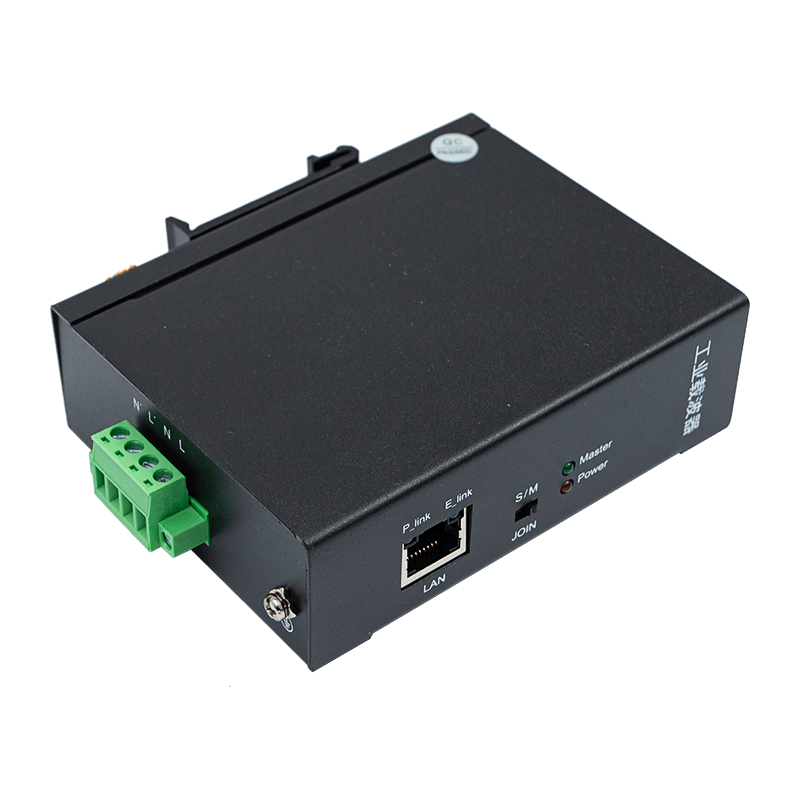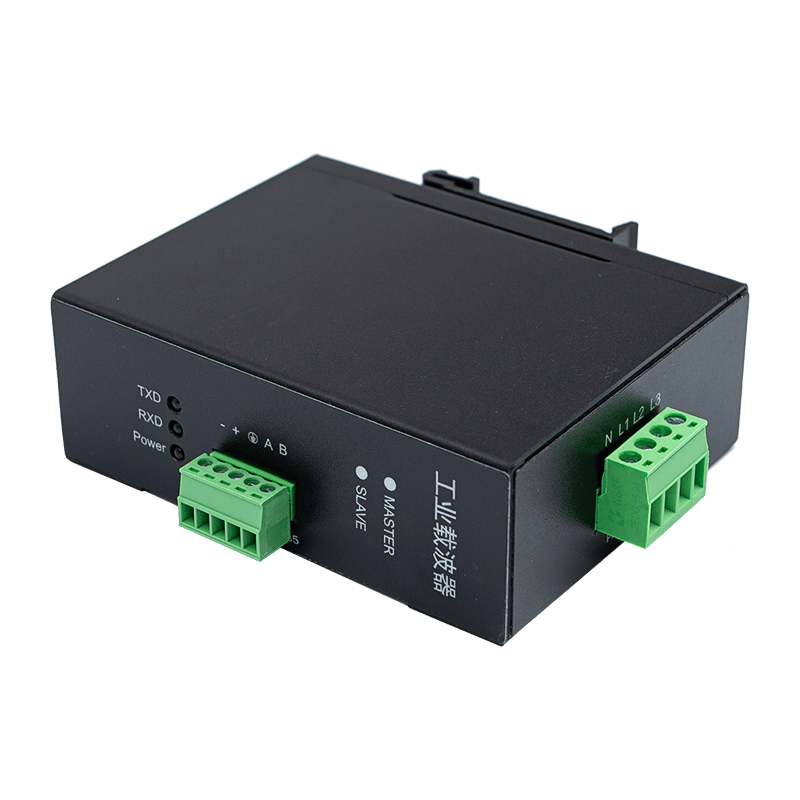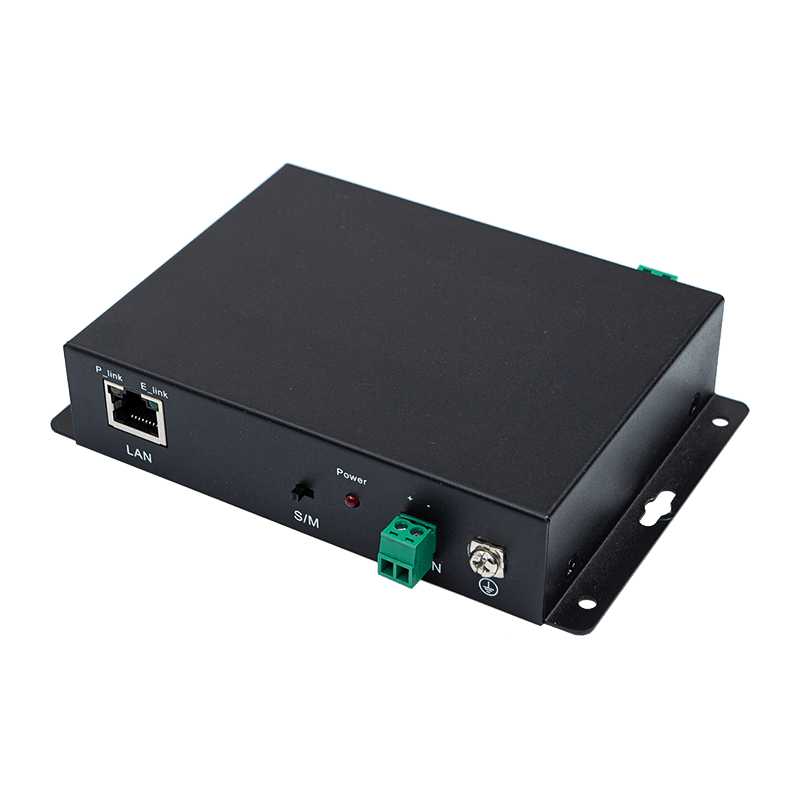


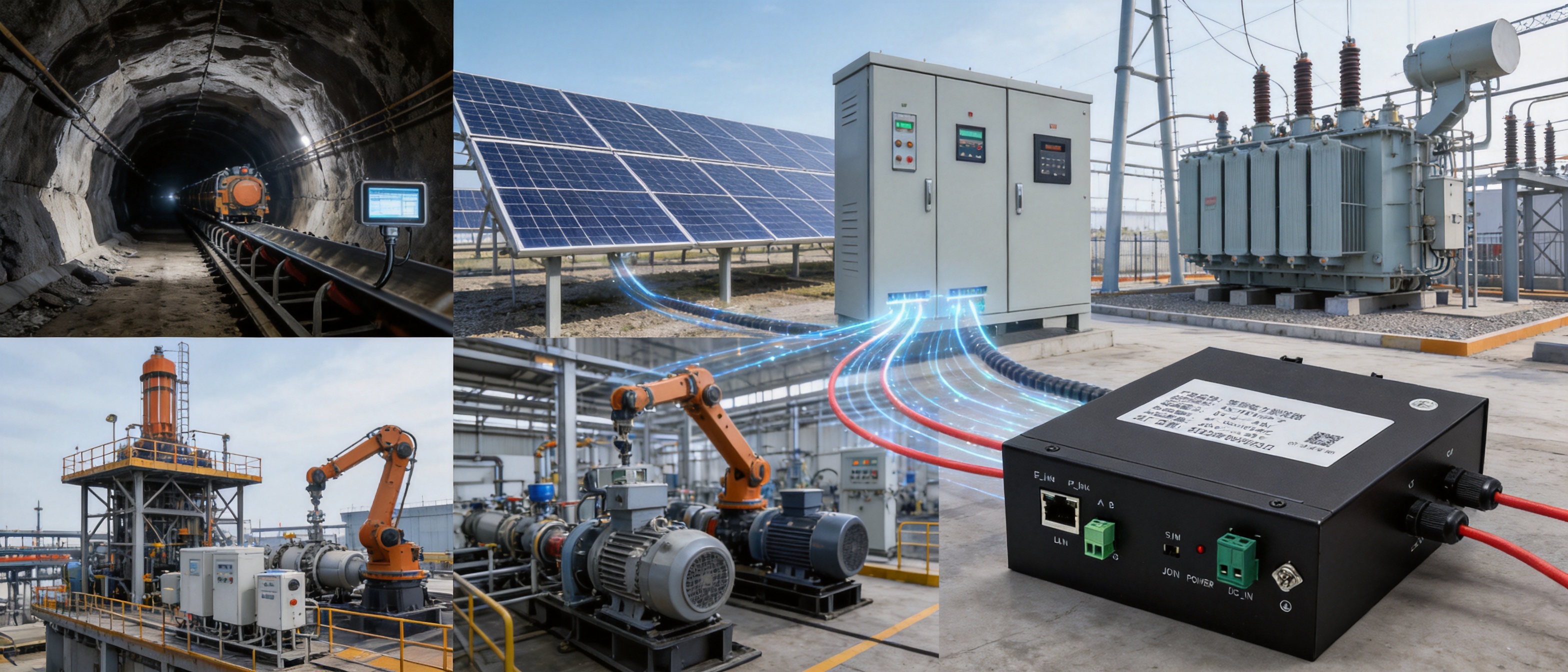
Industrial communication networks are increasingly required to operate in places where conventional Ethernet cabling, wireless links, and fiber-optic installations are difficult to deploy. Mines, substations, photovoltaic facilities, oilfield platforms, elevator systems, production lines, and mobile industrial machinery often contain existing power conductors that already reach the locations where data must be collected. A high-voltage broadband power line transceiver can use this infrastructure to transmit industrial data without requiring a completely new communication cable installation.
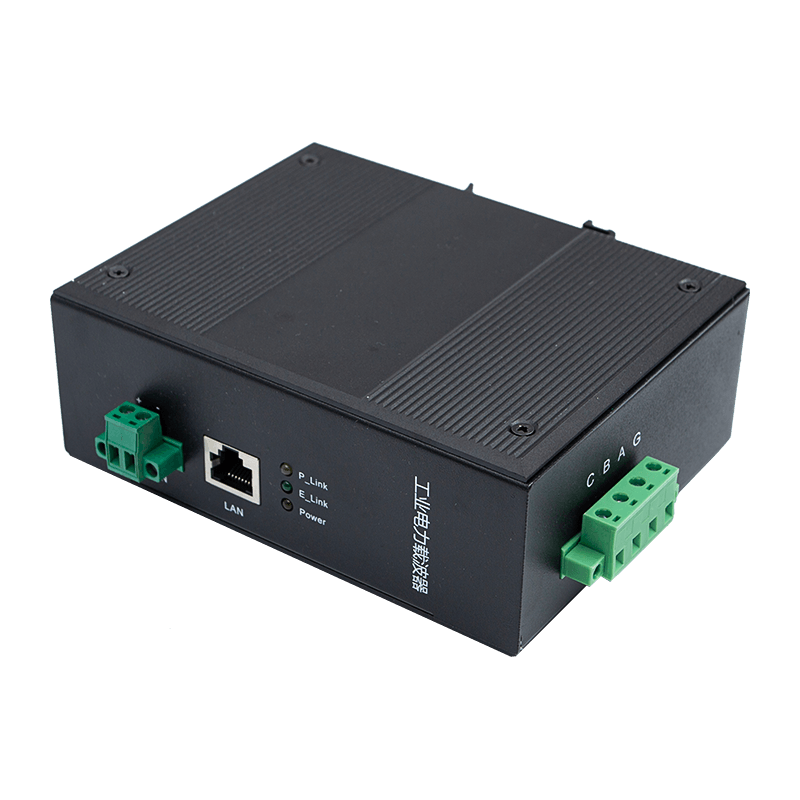
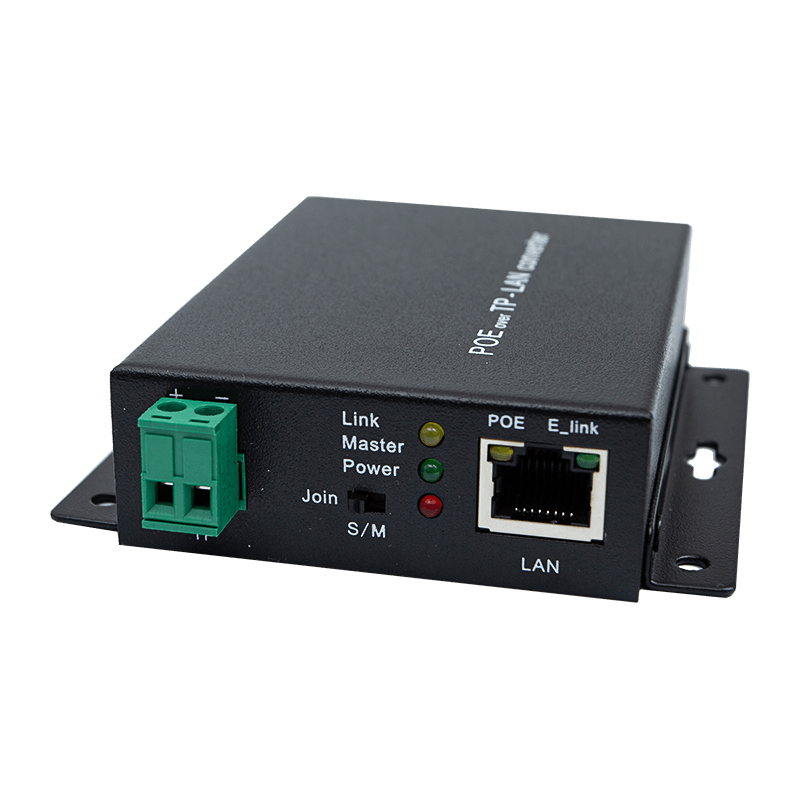
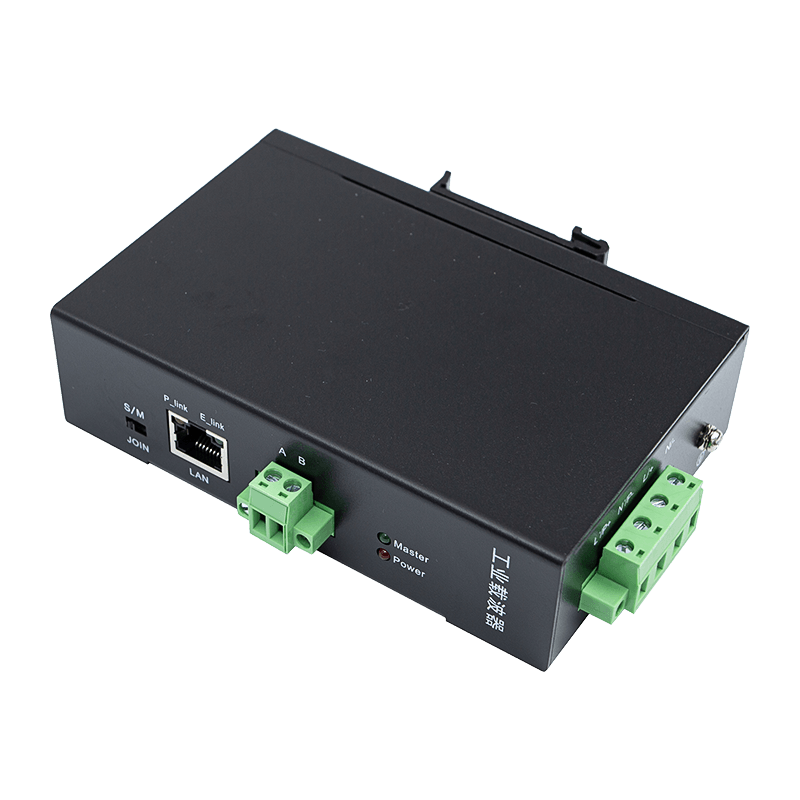
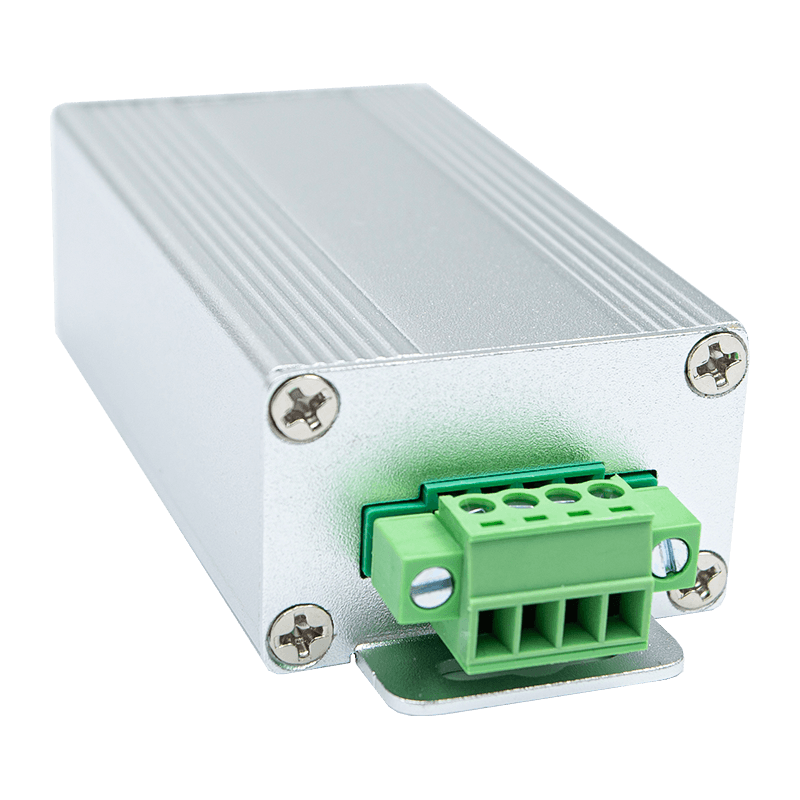
The KS700M4P is an industrial high-voltage broadband power line communication device designed for data transmission over many types of two-core conductors. It supports Ethernet and RS485 communication, works with AC or DC power lines and specialized conductors such as slip-touch cords and slip-ring cables, and is designed for communication environments involving line voltages up to 1200 V. Its industrial operating temperature range, surge protection, integrated coupling circuit, routing capability, and flexible network architecture make it suitable for demanding applications where communication reliability and installation efficiency are essential.
Rather than treating the power line as only an energy delivery path, the device enables the same pair of conductors to carry digital information. This approach can significantly simplify industrial networking projects. It can reduce the need for additional communication cabling, shorten installation time, and make it easier to connect moving or remote equipment. When combined with the engineering and manufacturing capabilities of ASY Electronics, the transceiver provides a practical foundation for industrial IoT communication solutions, smart-grid projects, equipment monitoring systems, and power-line carrier networks.
Understanding the Need for High-Voltage Industrial Communication
Many industrial sites are not designed around the requirements of modern data networks. Power cables may already be installed inside shafts, along gantries, through production facilities, across mobile machinery, or between remote electrical cabinets. Installing a separate Ethernet cable or fiber-optic link may require new conduits, additional protection, machinery shutdowns, or costly structural modifications.
Wireless communication can solve some of these problems, but it is not always dependable in industrial environments. Metal structures, motors, high-current equipment, electromagnetic interference, enclosed spaces, and moving machinery can weaken or interrupt wireless signals. In mines and substations, safety requirements and physical conditions may also limit the use of standard wireless devices. Fiber optic cable provides excellent noise immunity, but it may be difficult to install in systems containing moving sections, slip rings, or existing high-voltage conductors.
Power line communication provides another approach. It places a high-frequency data signal on an existing two-core cable while the cable continues to perform its normal electrical function. The communication device must, however, be engineered carefully. It must separate the data signal from the power signal, protect its internal circuits from surges, maintain reliable signal quality, and support communication protocols used by industrial equipment.
The KS700M4P addresses these requirements through an integrated design intended for high-voltage power line communication. Its PLC signal port can be used with any two-core cable carrying voltages from 0 to 1200 V, subject to correct installation and system safety procedures. This creates opportunities for data communication in areas where ordinary networking hardware would be difficult or unsuitable.
Product Overview
The KS700M4P is an industrial-grade broadband power line transceiver with a DC12–36V power supply. It is designed to transmit digital information over power lines, twisted pairs, coaxial cables, parallel lines, elevator cables, slip-touch cords, slip-ring cables, and other suitable two-core conductors. Its primary communication interfaces are Ethernet and RS485, allowing it to connect with computers, industrial controllers, sensors, meters, PLCs, gateways, and Modbus devices.
The device uses OFDM modulation across a carrier-frequency range of 2–28 MHz. Orthogonal frequency-division multiplexing helps the communication system use multiple subcarriers and adapt more effectively to the changing characteristics of industrial conductors. This is important because power lines are not normally designed as data cables. Their impedance, noise level, attenuation, and interference characteristics can vary depending on connected equipment and operating conditions.
The transceiver supports automatic networking and transparent data transmission. It includes a self-contained routing algorithm, enabling connected devices to form a communication network without requiring complicated manual routing configuration. A plug-and-play approach can reduce commissioning time, especially in projects where multiple transceivers must be deployed across a large facility.
Its Ethernet interface supports 10M/100Mbps auto-negotiation, while the RS485 interface supports Modbus RTU with adjustable baud rates from 1200 to 115200 bps. The device also supports commonly used industrial and network standards, including TCP/IP, UDP, Profinet, Modbus-TCP, IEEE802.3, IEEE802.3u, IEEE802.3ab, IEEE1905.1, IEEE1900, and IEEE1901. AES-128-bit encryption is available for protecting transmitted information, and IGMP multicast support allows communication with up to 128 nodes.
The combination of physical interfaces and communication protocols makes the product suitable for both newly designed networks and modernization projects. A facility can connect traditional Modbus RTU equipment through RS485 while also using Ethernet for supervisory systems, industrial computers, or edge gateways.
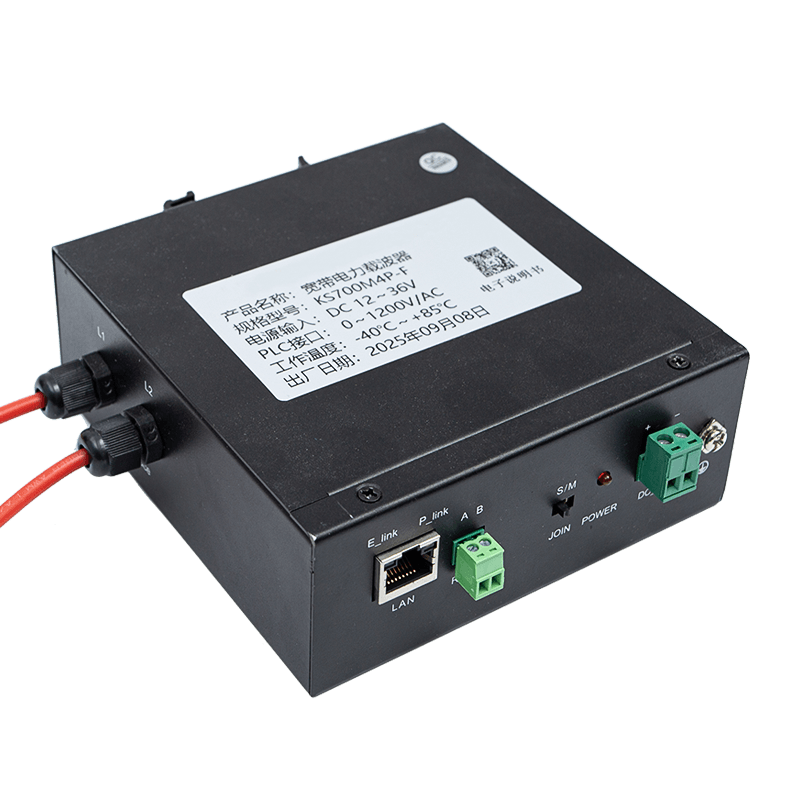
High-Voltage Broadband Powerline Transceiver
Key Technical Specifications
Item |
Specification |
Product type |
Industrial high-voltage broadband power line transceiver |
Model |
KS700M4P |
Power supply |
DC12–36V |
PLC signal line |
Any suitable two-core cable, including power lines and slip-touch cords |
Supported line voltage |
0–1200V on the PLC signal port |
Modulation |
OFDM |
Carrier frequency |
2–28MHz |
Ethernet |
10M/100Mbps auto-negotiation |
RS485 |
Modbus RTU; 1200–115200bps adjustable baud rate |
Point-to-point distance |
Up to approximately 500 meters according to the listed technical data |
Relay capability |
Up to 10 relay levels; relay configurations may reach approximately 3–5 kilometers |
Typical data delay |
Within 10ms |
Packet loss probability |
Less than 0.1‰ under stated conditions |
Power consumption |
3W or less |
Security |
AES-128-bit encryption |
Operating temperature |
−40°C to 85°C |
Operating humidity |
20%–95%, non-condensing |
Mounting |
TS35/TS35 rail installation |
Dimensions |
129 × 126 × 50mm |
Weight |
Approximately 610g |
Designed for High-Voltage Power Line Environments
A central advantage of the KS700M4P is its ability to support power line communication in applications involving high-voltage conductors. The product incorporates a coupled circuit and surge protection, and its design is intended to meet the relevant 1140V safety certification specification described in the product information. It is suitable for power line carrier communication up to AC1200V when installed according to appropriate electrical safety requirements.
This capability distinguishes the device from ordinary consumer power line adapters. Consumer products are generally developed for low-voltage residential electrical systems and controlled indoor conditions. They are not intended for mines, substations, industrial switchgear areas, photovoltaic installations, or specialized moving conductors. A high-voltage industrial transceiver must address a broader set of challenges, including electrical transients, thermal stress, vibration, electromagnetic noise, grounding conditions, and continuous operation.
The stated surge resistance of ±4kV provides an additional level of protection against shock and interference. Surge performance does not eliminate the need for external protection, correct grounding, isolation procedures, or a professional electrical design. It does, however, demonstrate that the product is intended for environments in which electrical disturbances are a normal engineering consideration rather than an exceptional event.
The integrated coupling circuit is also important. Coupling high-frequency communication signals onto a power conductor requires controlled signal injection and separation. Integrating this function into the transceiver can simplify system design and reduce the number of external components required. It can also help ensure that the communication path and protection system are designed as a coordinated unit.
Communication Performance and Network Flexibility
The device provides a maximum communication speed of up to 1000Mbps in the product introduction, while the listed Ethernet interface specification identifies 10M/100Mbps auto-adaptive Ethernet. These figures describe different parts of the system: the broadband PLC link may support a higher internal communication capacity, while the available Ethernet interface is specified for 10M/100Mbps connection speeds. System designers should select the appropriate figure for their network architecture and confirm performance under the actual cable, noise, distance, and topology conditions.
Point-to-point communication can reach up to approximately 500 meters according to the technical data. In relay configurations, the product supports up to 10 relay levels, with a maximum overall transmission distance of approximately 3–5 kilometers under suitable conditions. Relay networking allows the system to extend communication beyond the practical reach of a single link. It is particularly useful in long industrial corridors, mine galleries, conveyor routes, oilfield installations, and large energy facilities.
The product supports bus, star, tree, and hybrid network topologies. This flexibility allows system designers to match the network to the physical layout of the facility. A bus topology may be appropriate for a linear production line or tunnel. A star topology can simplify connections around a central control cabinet. A tree structure can serve multiple branches, while a hybrid arrangement can combine these approaches across different areas of a site.
Master-slave DIP switches provide a simple method for identifying host and extension units. The M-side serves as the host and the S-side as the slave. One host can communicate with one slave or multiple slaves. This physical configuration method is useful in industrial environments because it reduces dependence on software discovery during initial setup. It also makes the role of each unit easier to verify during maintenance.
Automatic networking and transparent data transmission further improve deployment efficiency. When the PLC layer carries Ethernet or serial data transparently, existing applications can often communicate without major changes. The transceiver acts as a communication bridge rather than forcing the user to redesign the application layer.
Ethernet and RS485 in One Industrial Platform
Many industrial sites use a mixture of modern Ethernet equipment and legacy serial equipment. Replacing every existing controller, meter, sensor, or actuator can be expensive and disruptive. The KS700M4P supports both Ethernet and RS485, allowing these different generations of equipment to share a power line communication infrastructure.
The Ethernet interface can connect industrial computers, programmable logic controllers, remote I/O modules, video or monitoring systems, edge gateways, and supervisory control platforms. Support for TCP/IP, UDP, Profinet, and Modbus-TCP helps it fit into a range of automation and Industrial IoT architectures.
The RS485 interface supports Modbus RTU, one of the most widely used protocols for industrial meters, transmitters, sensors, and controllers. Its adjustable baud rate from 1200 to 115200bps accommodates different equipment requirements. A temperature monitoring sensor, flow meter, energy meter, or industrial transmitter can therefore send data through the power line network without requiring a separate long-distance serial cable installation.
This mixed-interface capability is a practical advantage over products designed only for Ethernet or only for serial communication. It enables a gradual transition from traditional automation to connected industrial systems. Existing devices can remain in service while the communication backbone is expanded and connected to cloud platforms, local servers, data historians, or energy-management software.
Advantages Compared with Conventional Alternatives
Compared with New Dedicated Cabling
Installing dedicated communication cable can deliver reliable performance, but the installation may require cable trays, conduits, protective tubing, new junction boxes, and access to difficult areas. In an operating plant, these activities can involve shutdowns and safety permits. Power line communication makes use of conductors that may already be present, potentially reducing material use and installation labor.
This advantage is especially valuable when data must be transmitted to moving equipment or locations where cable replacement is difficult. Slip-touch cords and slip-ring cables can be used in applications where conventional network cables may experience mechanical stress. The suitability of each conductor must be evaluated carefully, but the ability to use existing two-core infrastructure creates design options that conventional Ethernet cabling does not always provide.
Compared with Wireless Communication
Wireless networks are convenient, but industrial radio performance can be affected by metal obstructions, electrical noise, distance, interference, and changing equipment layouts. A power line communication link remains physically associated with the conductor, which can provide a more predictable route in enclosed or heavily obstructed areas.
The KS700M4P can be particularly useful where wireless coverage is inconsistent, where radio spectrum is crowded, or where a site owner prefers a wired communication path for critical monitoring data. It can also complement wireless sensors by providing a reliable backhaul connection from a local gateway to the control system.
Compared with Fiber Optic Networks
Fiber optics offer excellent bandwidth and immunity to electromagnetic interference, but they require fiber installation, termination, splicing, and mechanical protection. Fiber is also less convenient in some moving equipment applications. The KS700M4P does not replace fiber in every high-bandwidth backbone application, but it can be a more practical option for short and medium-distance industrial links where existing power conductors are available.
Using power line communication can reduce the complexity of connecting remote equipment, particularly when a new fiber route would be expensive or physically impractical. It can also serve as an economical access network connected to a fiber backbone at a higher level.
Compared with Consumer-Grade PLC Equipment
Consumer PLC adapters are generally optimized for residential low-voltage environments, moderate temperatures, and ordinary indoor use. Industrial projects need stronger environmental performance and more specialized interfaces. The KS700M4P offers an operating temperature range of −40°C to 85°C, supports RS485 Modbus RTU, provides surge protection, supports rail mounting, and is designed for continuous industrial operation.
Its 7-by-24-hour working capability, low power consumption of 3W or less, and industrial-grade construction make it more suitable for control cabinets, energy facilities, and remote equipment than typical home networking products.
Industrial Environmental Reliability
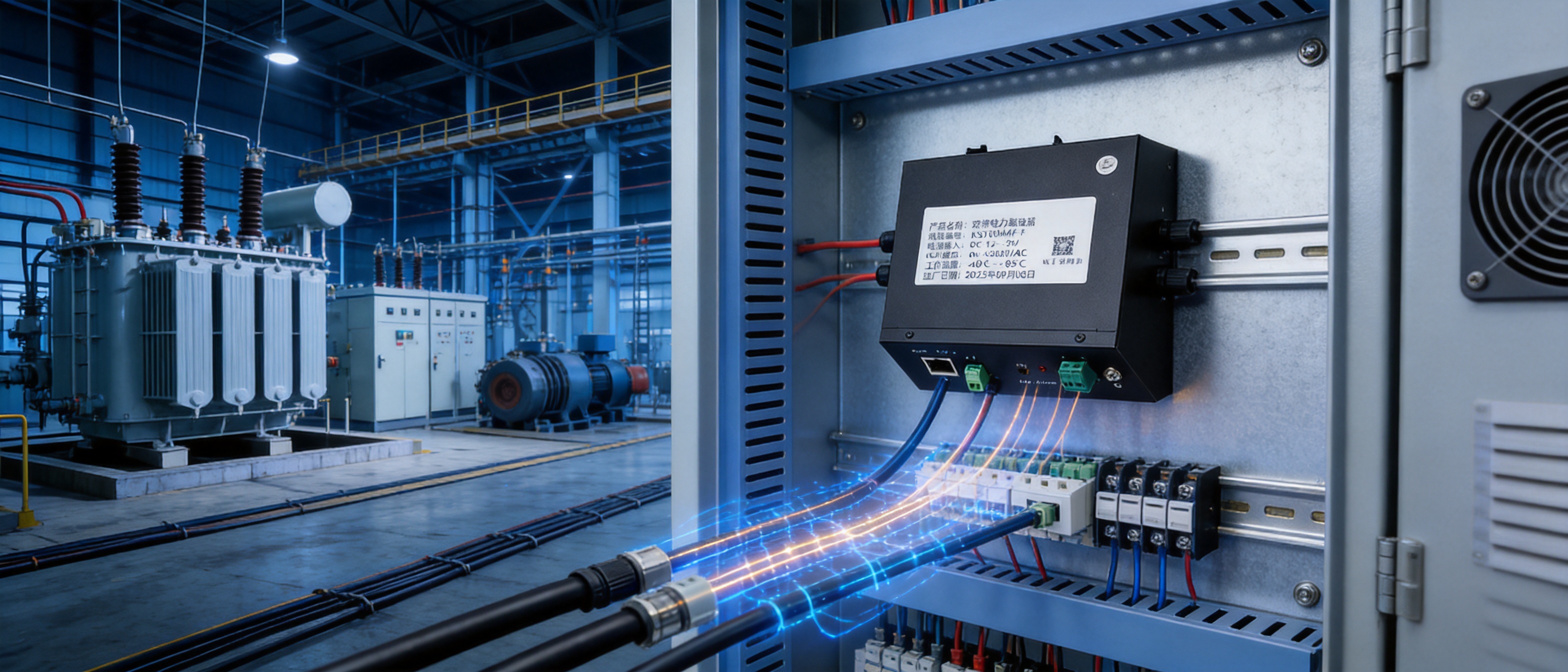
Industrial installations may experience temperature changes, condensation risks, dust, vibration, electrical noise, and voltage disturbances. The KS700M4P is specified for operation from −40°C to 85°C and storage from −40°C to 85°C. This broad range supports deployment in outdoor cabinets, unheated industrial buildings, mines, substations, photovoltaic sites, and other locations where commercial office equipment may not be suitable.
The specified humidity range is 20%–95% without condensation. Correct enclosure selection, ventilation, drainage, and environmental control remain necessary, particularly in areas with rapid temperature changes. The device should be mounted and wired in accordance with the applicable electrical, EMC, and safety requirements of the installation.
Rail mounting through a TS35/TS35 guide rail provides a familiar installation method for industrial control cabinets. The 129 × 126 × 50mm form factor allows the unit to be integrated into many standard cabinet layouts while leaving room for terminal wiring and maintenance access. A weight of approximately 610g reflects a solid industrial product construction while remaining manageable during installation.
Reliability also depends on communication behavior. The listed data delay is within 10ms, and the packet loss probability is less than 0.1‰ under stated conditions. These characteristics can support monitoring, control, and data acquisition applications where predictable communication is more important than consumer-oriented peak throughput.
Application Areas
Mining Communication Systems
Mines often contain long tunnels, moving machinery, electrical equipment, and areas where wireless coverage can be difficult. Existing power lines or specialized cables may already reach conveyors, pumps, ventilation equipment, and monitoring points. A high-voltage PLC system can carry data between underground equipment and surface control systems, subject to the mine’s safety certification and installation requirements.
RS485-connected gas sensors, temperature sensors, pressure transmitters, and equipment monitors can transmit data through the same communication system. Ethernet-connected industrial computers and gateways can collect this information for centralized supervision. Relay networking can extend the link along long routes without requiring a new communication cable for every section.
Oilfield Collection Platforms
Oilfield platforms and remote collection stations may contain distributed meters, controllers, pumps, and monitoring instruments. The distance between equipment and the communication cabinet can make dedicated cabling expensive. Power line carrier communication can help connect field devices across existing electrical infrastructure while reducing the number of independent cable routes.
The product’s wide temperature range and low power consumption are useful for remote cabinets. Its support for Modbus RTU allows flow meters, transmitters, and energy instruments to communicate with a central data system.
Substations and Smart Grid Systems
Substations require dependable communication between monitoring equipment, control cabinets, protection-related systems, and supervisory platforms. Electrical environments may include high transient energy and strong electromagnetic fields. The KS700M4P’s high-voltage signal-line design, surge protection, and industrial temperature range make it a candidate for selected power carrier communication tasks.
It can support smart-grid projects involving equipment condition monitoring, energy data acquisition, and remote status reporting. Application engineers must determine whether the product is appropriate for a specific protection or control function and must complete all required safety and electromagnetic compatibility assessments before deployment.
Photovoltaic and Renewable Energy Facilities
Photovoltaic sites often cover large areas and include distributed inverters, combiner boxes, environmental sensors, energy meters, and monitoring gateways. Existing DC or AC conductors may offer useful communication paths between field equipment and collection points. The KS700M4P can help connect distributed devices while reducing the need for additional communication cable routes.
Its support for Ethernet and Modbus makes it suitable for integrating inverter data, meter readings, temperature information, and equipment status into an energy management platform. Relay networking can support long rows of equipment when a single point-to-point connection is insufficient.
Elevator and Moving Equipment Systems
Elevators and other moving machines often rely on traveling cables, slip rings, or slip-touch cords. These conductors may already be available for power delivery, but adding a separate high-speed data cable can be mechanically challenging. The product is designed to support communication over elevator cables and slip-touch cords, creating a way to transmit data over the existing moving connection.
This approach may support condition monitoring, service diagnostics, controller communication, and equipment status reporting. The cable type, movement cycle, electrical noise, and safety architecture must be reviewed for each installation.
Industrial Production Lines
Production facilities contain motors, drives, sensors, controllers, robots, and inspection equipment. The network may need to connect both older serial instruments and newer Ethernet-based systems. Power line communication can provide a flexible extension method for remote stations, especially where installing new cable trays would interrupt production.
The device’s support for bus, star, tree, and hybrid topologies allows the communication design to follow the production layout. Its low power consumption also helps reduce thermal loading inside control cabinets containing many network devices.
Advanced Manufacturing and Engineering Strengths
Industrial communication products require more than a communication chipset. They must combine high-frequency signal design, power isolation, surge protection, mechanical construction, firmware, interface compatibility, environmental reliability, and application engineering. ASY Electronics has developed its product portfolio around self-developed edge-layer hardware and industrial data integration solutions, creating a foundation for this type of integrated product development.
The company’s focus on smart factories and intelligent connectivity connects the transceiver to real industrial use cases rather than treating it as a general-purpose networking accessory. Its broader product portfolio includes broadband power line carriers, wireless temperature monitoring systems, industrial transmitters, thermal gas mass flow meters, and automatic door controllers. This product combination supports projects that require sensing, measurement, communication, and control as part of one industrial IoT architecture.
Self-developed hardware can provide several practical advantages. Product functions can be adapted to industrial application requirements, communication interfaces can be selected for compatibility with existing equipment, and firmware features such as automatic networking, relay operation, and transparent transmission can be integrated into the hardware platform. This can simplify coordination between the communication device and other industrial products supplied for the same project.
The manufacturing strength of an industrial electronics provider is also reflected in its ability to maintain consistent product specifications, manage component sourcing, assemble electronic and mechanical systems, and support quality control across product batches. For customers deploying many transceivers, consistency is important. Network commissioning becomes easier when every unit follows the same interface layout, configuration method, operating range, and communication behavior.
Engineering support is another important strength. High-voltage PLC performance depends on the conductor, electrical load, distance, topology, and noise environment. A capable provider can assist with application evaluation, device selection, network planning, relay placement, interface matching, and commissioning. This project-level support is often more valuable than a nominal speed specification considered in isolation.
Integrated Product Development
The KS700M4P integrates the PLC communication function, coupled circuit, surge protection, Ethernet interface, RS485 interface, routing logic, and industrial enclosure into one device. This integrated architecture reduces the number of separate modules required in a control cabinet. Fewer modules can mean fewer connectors, fewer points of failure, simpler wiring, and easier maintenance.
Integration also allows the hardware and software to be developed around the same application requirements. Automatic networking, master-slave configuration, transparent data transmission, multicast support, and encryption are not isolated features; together they form a practical communication platform for industrial systems.
Industrial-Oriented Testing Considerations
Although the supplied product information does not list every factory test procedure, the stated design targets indicate the importance of industrial validation. A product intended for −40°C to 85°C operation should be evaluated for thermal startup, continuous operation, and performance across temperature changes. A device with surge protection should be assessed for response to specified transient conditions. Communication performance should be checked under different cable lengths, loads, and interference conditions.
Manufacturing quality is strengthened when electrical inspection, firmware verification, interface testing, mechanical inspection, and final functional testing are treated as connected stages. For high-voltage PLC products, production discipline is particularly important because the communication interface is associated with conductors that may carry substantial electrical energy. Professional installation, insulation verification, and safe test procedures are essential parts of the complete product solution.
Security and Network Management
Industrial networks increasingly connect to enterprise systems, remote monitoring platforms, and cloud applications. Data security therefore needs to be considered alongside physical communication reliability. The KS700M4P supports AES-128-bit encryption, helping protect information transmitted over the PLC network.
Security should be implemented as part of a broader defense-in-depth strategy. Network segmentation, controlled access, secure configuration, software maintenance, password management, and monitoring should be applied according to the risk level of the installation. Encryption helps protect data in transit, but it does not replace access control or secure system architecture.
IGMP multicast support allows the device to handle multicast communication, with a maximum number of nodes specified as 128. This can be useful in applications where multiple monitoring or control endpoints need to receive the same data stream. Proper network planning is necessary to prevent unnecessary traffic and to ensure that the connected switches, controllers, and gateways support the required multicast behavior.
Deployment and Engineering Guidelines
Before installation, engineers should survey the electrical network and identify the conductors that will carry the PLC signal. The cable type, length, voltage, branching structure, connected loads, grounding arrangement, and expected interference sources should be documented. The communication design should then be tested under representative operating conditions.
The DC12–36V power supply should be stable and correctly protected. The PLC signal connection must be installed only by qualified personnel who understand the voltage present on the line. Isolation, clearance, creepage, fusing, grounding, enclosure protection, and lockout procedures should comply with applicable local standards and site rules.
Network topology should be selected according to the physical layout. A point-to-point link may be sufficient for a single remote cabinet. A bus can connect multiple stations along a corridor, while a tree or hybrid network may be more appropriate for a large facility. Relay units should be placed where the signal path requires additional range, and the number of relay levels should be planned to maintain the required performance.
RS485 networks should follow good wiring practice. Correct polarity, termination, biasing, grounding strategy, baud rate, and Modbus addressing are important for stable operation. Ethernet equipment should be configured with compatible network parameters, and the overall application should be tested for latency, packet loss, multicast behavior, and recovery after power interruption.
Commissioning should include a baseline communication test before the network is placed into full service. Engineers can record throughput, delay, packet loss, temperature, and error behavior at different operating loads. These records provide useful reference information for future maintenance and help distinguish a communication issue from a problem in the connected industrial equipment.
How the Product Supports Industrial IoT Architecture
An Industrial IoT system normally includes several layers. Sensors and meters generate data at the field layer. Controllers and gateways process information at the edge layer. Network infrastructure transports the information. Supervisory software, analytics platforms, and enterprise applications use the data at higher levels.
The KS700M4P operates as a communication foundation between these layers. An RS485 temperature sensor or flow meter can send measurements through the PLC link to an industrial gateway. Ethernet equipment can communicate with a supervisory computer through the same physical power line path. This allows a facility to connect field data without redesigning every part of its existing electrical infrastructure.
For equipment condition monitoring, the system can transport temperature, vibration-related status, pressure, flow, current, and alarm information. For energy management, it can connect meters and controllers that report consumption, voltage, current, operating status, and production-related energy data. For process optimization, it can provide a reliable link between distributed instruments and the software used to analyze production conditions.
The communication platform also supports future expansion. A project can begin with a small point-to-point connection and later add relay units, additional slaves, RS485 instruments, or Ethernet gateways. This scalability is important for factories that modernize in stages rather than replacing all infrastructure at once.
Why Choose an Industrial Specialist
Choosing a high-voltage PLC supplier involves more than comparing communication speed. Customers should consider whether the supplier understands industrial applications, can support custom requirements, offers compatible sensing and measurement products, and can provide consistent manufacturing and technical service.
ASY Electronics is positioned as an industrial IoT communication solutions provider and manufacturer. Its focus on smart factories, equipment condition monitoring, refined energy management, and production process optimization aligns with the main applications of industrial power line communication. The company’s product range combines broadband power line carriers with wireless temperature monitoring sensors, industrial transmitters, thermal gas mass flow meters, and automatic door controllers.
This broader capability can simplify project coordination. A customer may need to connect temperature monitoring, gas flow measurement, industrial transmission, and automatic access control within one facility. Working with a provider that understands both the field devices and the communication layer can reduce integration effort and improve the consistency of the final solution.
Custom development is another potential advantage for industrial projects. Different sites may require alternative interfaces, relay configurations, mechanical arrangements, firmware behavior, or communication protocols. A manufacturer with internal product development and application experience is better positioned to evaluate these requirements than a supplier focused only on standardized consumer networking products.
Maintenance and Lifecycle Benefits
Industrial equipment is expected to operate for long periods, often under continuous duty. The KS700M4P is specified for 7-by-24-hour all-weather operation, supporting applications where communication cannot be limited to office hours. Its low power consumption helps reduce heat generation and operating costs, which is useful when many units are installed inside a cabinet or remote enclosure.
Rail mounting simplifies replacement and maintenance. A technician can identify the unit, verify the master-slave setting, check the DC supply, inspect the signal connection, and replace the device without redesigning the entire cabinet. Transparent communication also helps reduce changes to the application software when a network segment is expanded or repaired.
Lifecycle planning should include spare units, configuration records, cable documentation, firmware information, and periodic inspection of surge protection and electrical connections. Industrial reliability is achieved not only through product design but also through proper installation, preventive maintenance, environmental control, and trained personnel.
Frequently Asked Questions
What is a high-voltage broadband power line transceiver?
It is a communication device that transmits digital data over a two-core conductor that may also carry electrical power. The device adds a high-frequency communication signal to the conductor and separates the data from the power signal at the receiving end. The KS700M4P is designed for industrial use and supports PLC communication on suitable lines up to 1200V.
Can the KS700M4P transmit data over AC and DC lines?
The PLC signal port is specified for any suitable two-core cable, including power lines, and the product information identifies both AC and DC wire applications. The exact suitability depends on the cable, voltage, load, noise environment, and installation design. A professional site evaluation should be completed before deployment.
Does the device provide both Ethernet and RS485?
Yes. It supports a 10M/100Mbps auto-adaptive Ethernet interface and RS485 with Modbus RTU support. The RS485 baud rate can be adjusted from 1200 to 115200bps.
What communication protocols are supported?
The listed standards and protocols include TCP/IP, UDP, Profinet, HomePlug, Modbus-TCP, IEEE802.3, IEEE802.3u, IEEE802.3ab, IEEE1905.1, IEEE1900, and IEEE1901. RS485 supports Modbus RTU.
How far can the communication signal travel?
The listed technical data identifies a point-to-point distance of up to approximately 500 meters. The relay version supports up to 10 relay levels, and the overall transmission distance may reach approximately 3–5 kilometers under suitable conditions. Actual performance depends on cable characteristics, electrical loads, interference, topology, and installation quality.
Can the device work in extreme temperatures?
Its specified operating temperature range is −40°C to 85°C. Storage is also specified from −40°C to 85°C. Humidity is specified at 20%–95% without condensation.
Is the product suitable for mines and substations?
The product information identifies mine communication systems, oilfield collection platforms, substations, and photovoltaic energy facilities as application areas. Suitability for a particular installation depends on the site’s safety certification, electrical design, regulatory requirements, and environmental conditions. The product should be installed and commissioned by qualified professionals.
How is the host and slave relationship configured?
The M-side is the host and the S-side is the slave. Master-slave DIP switches provide one-touch setup. A host can communicate with one slave or multiple slaves, depending on the planned network arrangement.
What network topologies are available?
The product supports bus, star, tree, and hybrid network topologies. The appropriate topology depends on the physical arrangement of the equipment, the required distance, the number of nodes, and the locations where relay units may be installed.
Does the transceiver provide data security?
Yes. AES-128-bit encryption is listed as a supported security feature. It should be combined with network segmentation, access control, secure configuration, and appropriate industrial cybersecurity procedures.
What mounting method does it use?
The device is designed for TS35/TS35 guide rail installation, making it suitable for many industrial control cabinets and electrical enclosures.
Can it be used with industrial sensors and meters?
Yes. Its RS485 Modbus RTU interface can connect compatible temperature sensors, flow meters, transmitters, energy meters, and other industrial instruments. Ethernet-based sensors and gateways can use the Ethernet interface.
Does using PLC eliminate the need for all other communication networks?
No. Power line communication is an additional networking option. Fiber, Ethernet cabling, wireless links, and other technologies may remain appropriate for parts of the same project. The best architecture may combine several communication methods according to distance, bandwidth, safety, mobility, and environmental requirements.
Conclusion
The KS700M4P is designed to solve a specific industrial communication challenge: transmitting high-speed digital information over existing two-core conductors in demanding electrical environments. Its support for lines up to 1200V, integrated coupling circuit, surge protection, wide temperature range, low power consumption, Ethernet and RS485 interfaces, Modbus compatibility, automatic networking, relay capability, and flexible topology options make it a strong platform for industrial IoT connectivity.
Compared with installing new communication cables, it can reduce infrastructure changes. Compared with wireless links, it can provide a physically guided communication path in difficult environments. Compared with consumer PLC equipment, it offers industrial interfaces, environmental specifications, and high-voltage application positioning. Compared with single-interface devices, it supports both Ethernet and RS485, helping facilities connect modern and legacy equipment in one network.
The product’s value is strengthened by ASY Electronics’ focus on self-developed industrial hardware, intelligent connectivity, data sensing, and smart-factory applications. Its wider portfolio of communication, sensing, measurement, and control products provides a basis for integrated solutions rather than isolated devices. For mines, substations, photovoltaic facilities, oilfield platforms, elevators, production lines, and other industrial sites, the transceiver offers a practical way to extend reliable data communication through infrastructure that may already be installed.
Successful deployment still requires careful engineering. Cable conditions, voltage levels, electrical safety, interference, network topology, relay placement, and application requirements must be evaluated for every project. When properly designed and installed, a high-voltage broadband power line transceiver can become a cost-effective and scalable communication layer for equipment monitoring, energy management, process optimization, and industrial digital transformation.
References
1. Product technical information for the KS700M4P high-voltage broadband power line transceiver, including interface, environmental, communication, and mechanical specifications.
2. Industrial Ethernet and Modbus communication principles for automation, monitoring, and distributed control systems.
3. General engineering practices for power line communication, OFDM-based data transmission, surge protection, and industrial electromagnetic compatibility.
4. Smart-grid and Industrial IoT architecture principles for equipment condition monitoring, energy management, and production process optimization.
5. General safety and installation practices for industrial control cabinets, high-voltage conductors, guide-rail equipment, and professional electrical commissioning.