

Industrial enterprises are under constant pressure to connect more equipment, collect more data, reduce wiring complexity, and maintain stable communication in locations where conventional network construction is expensive or impractical. General Gigabit Power Line Communication is designed for exactly this challenge: it enables high-speed Ethernet data transmission through existing power lines, allowing industrial devices to communicate without the need to install separate communication cables across every machine, rail line, warehouse zone, tunnel, parking system, or mobile platform.
The product discussed in this article is an industrial-grade broadband power line communication device with a physical-layer carrier rate up to 1000 Mbps and Ethernet adaptation at 10 Mbps, 100 Mbps, and 1000 Mbps. It is built on IEEE P1901 power line communication principles and OFDM modulation and demodulation technology, while also supporting communication standards and industrial protocols used in modern automation environments. Its practical data throughput can reach up to 480 Mbps depending on site conditions, making it suitable for many real-time industrial communication requirements, including monitoring, control, video, diagnostics, equipment networking, and industrial Internet of Things data collection.
Unlike many traditional narrowband power line carrier products that are designed mainly for low-rate metering or basic status reporting, this broadband solution is intended for high-speed, bidirectional, real-time Ethernet communication. It is compact, rail-mountable, low in power consumption, and able to operate across a wide temperature range from -40°C to 85°C. With a separate DC 12–48 V power supply and a PLC signal port compatible with AC 0–380 V or DC 0–560 V lines, it offers strong adaptability for industrial sites where electrical architectures vary widely.
ASY Electronics (JiaXing) Co., Ltd. develops and supplies industrial communication and data acquisition products for smart factories, smart grids, energy management, equipment monitoring, and automation. The company’s broader product portfolio includes broadband power line carriers, wireless temperature monitoring systems, industrial transmitters, thermal gas mass flow meters, and automatic door controllers. This background gives the company a practical understanding of sensing, transmission, field installation, and industrial reliability, all of which are reflected in the design of its gigabit power line communication solution.
General Gigabit Power Line Communication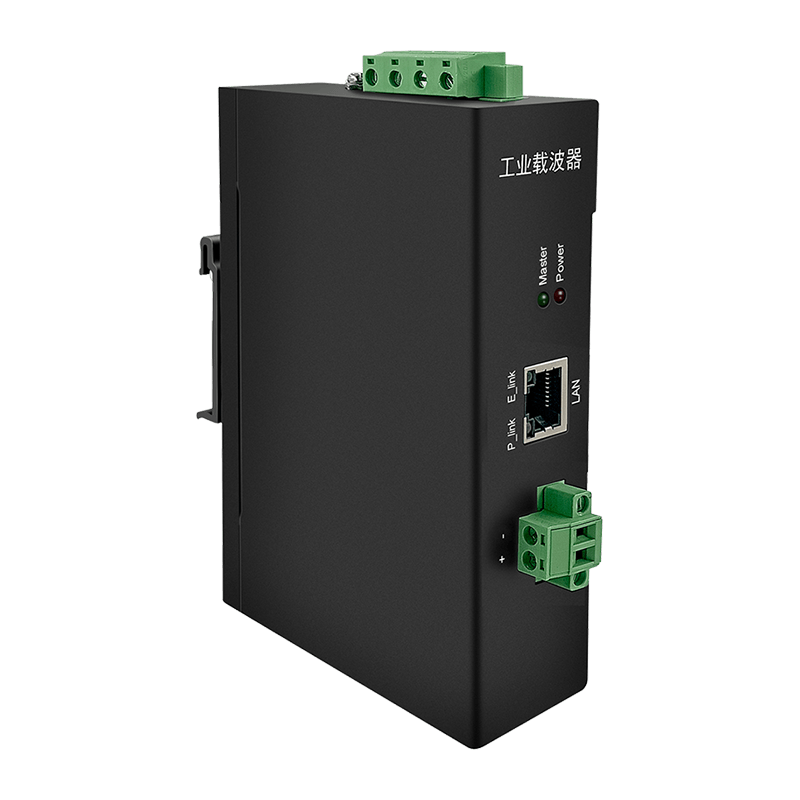
Product Overview
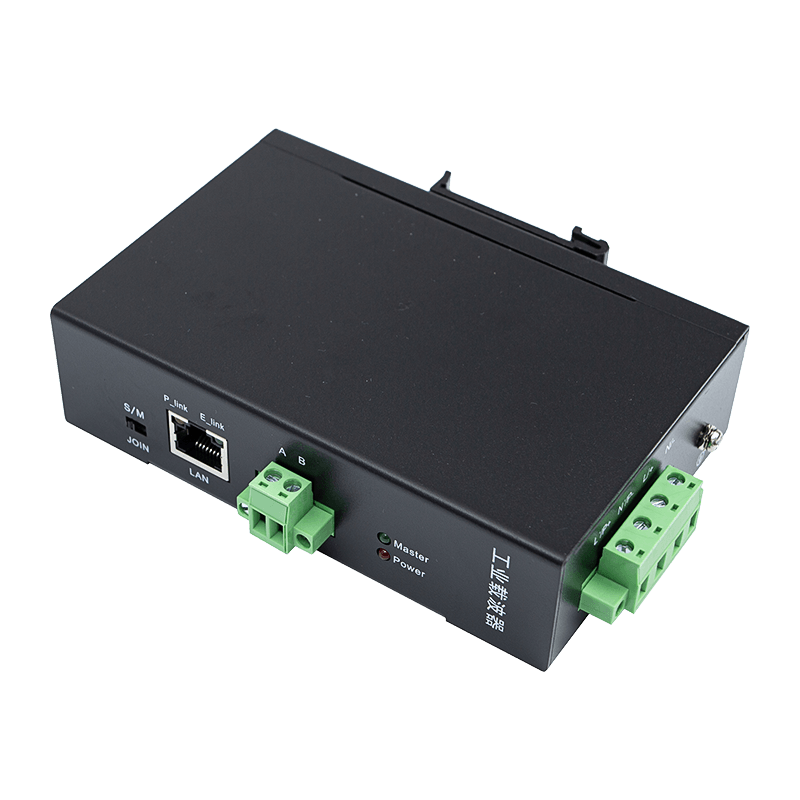
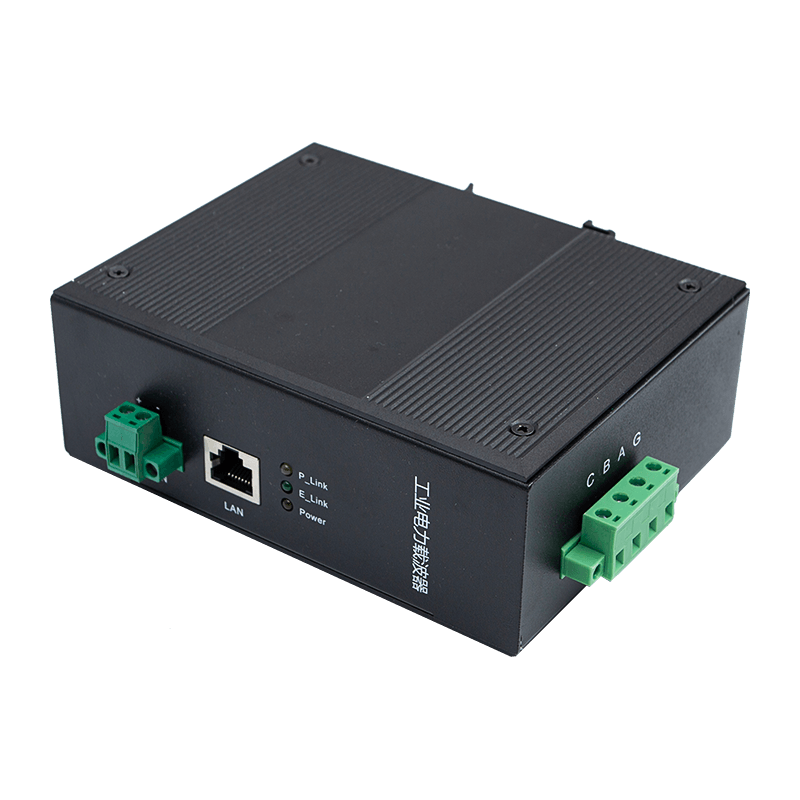
The General Gigabit Power Line Communication device is a broadband carrier communication unit used to transmit Ethernet data over power lines or suitable cables. By using the existing electrical line as the communication medium, it reduces the need for new network cabling and simplifies retrofits in complex industrial environments. The device supports plug-and-play operation, automatic networking, self-routing, AES-128 bit encryption, and multiple network topologies such as bus, star, tree, and hybrid structures.
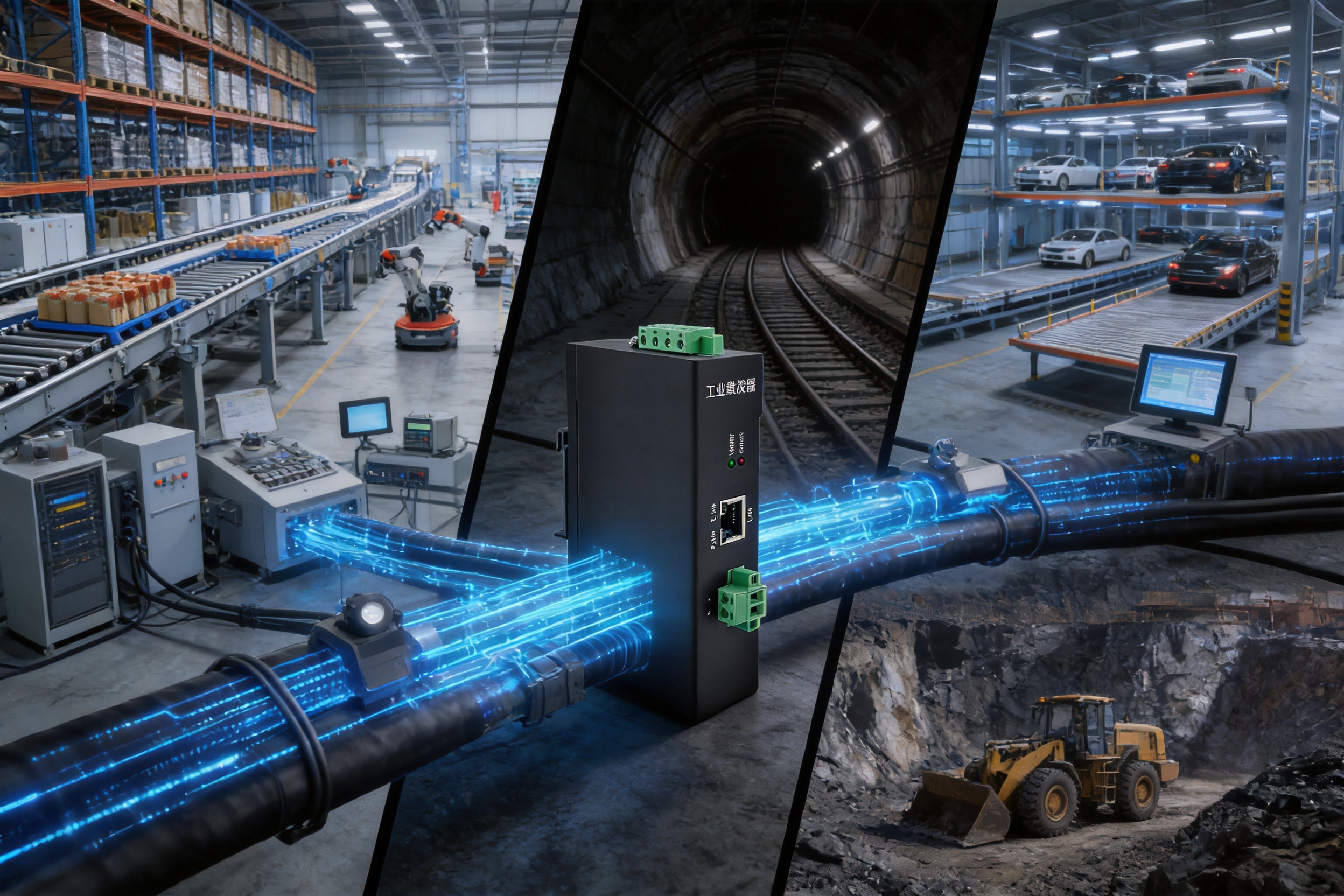
The product is especially valuable where the physical environment makes new Ethernet wiring difficult. Examples include underwater robots, mines, oilfields, automated warehouses, logistics sorting systems, three-dimensional parking garages, railways, subway communication systems, moving machinery, slip contact power rails, and industrial automation equipment. In these environments, the cost, risk, and downtime associated with new data cabling can be substantial. Power line communication allows users to reuse the electrical path that already exists for equipment power and add data communication on top of it.
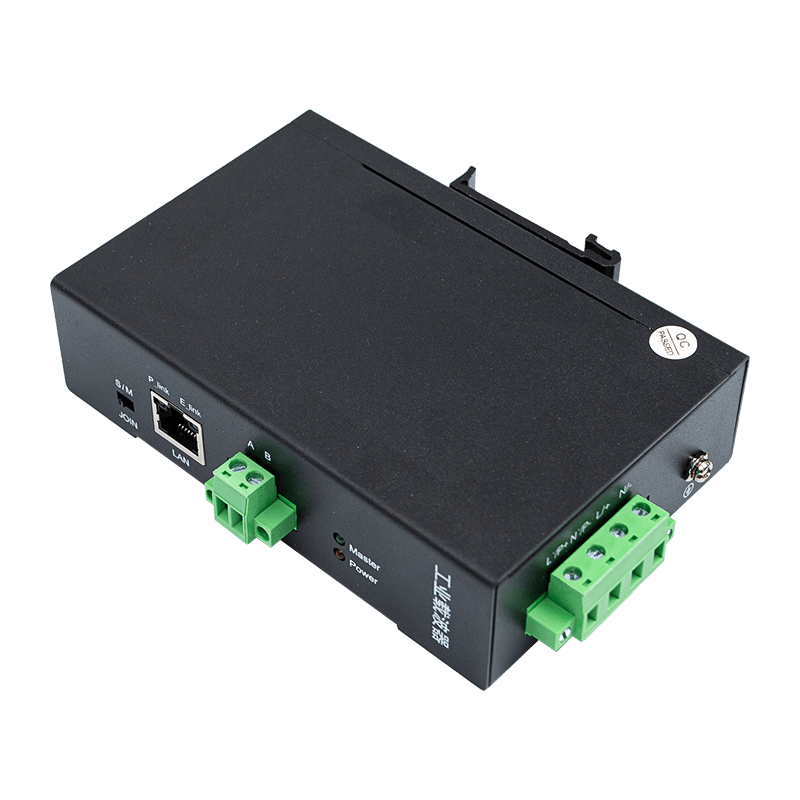
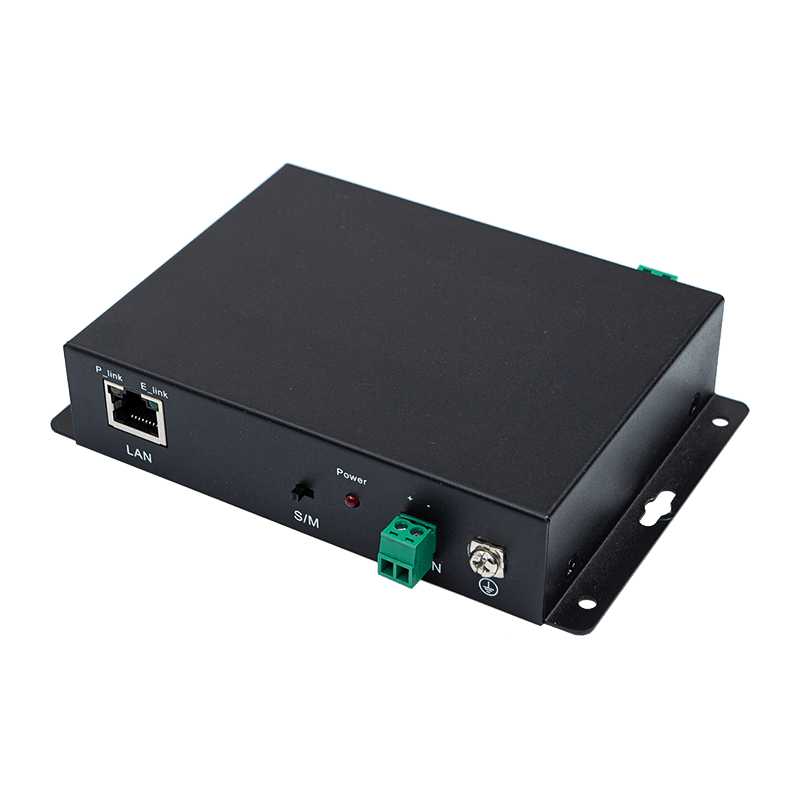
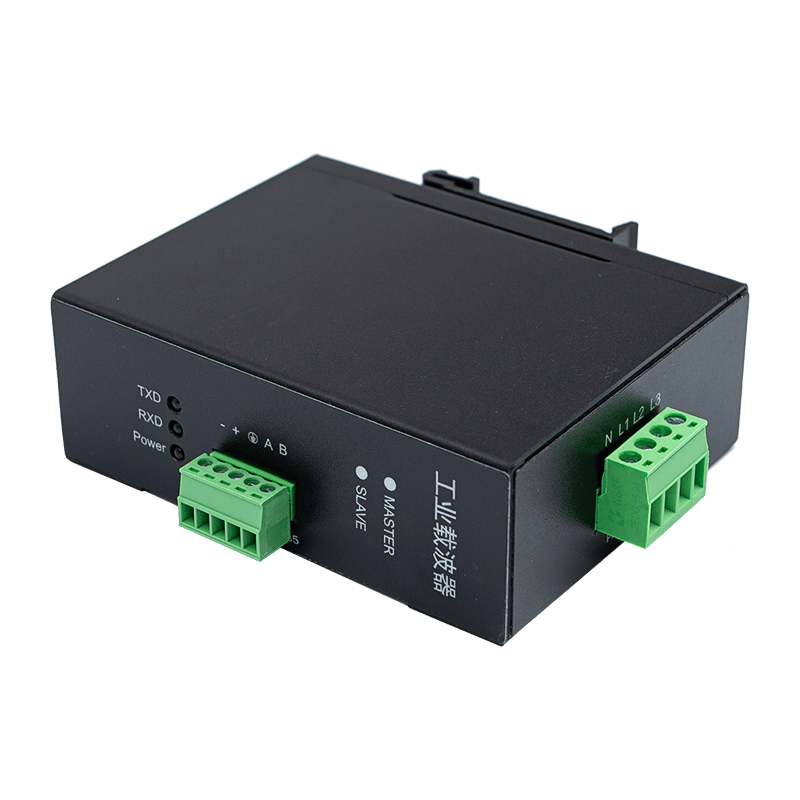
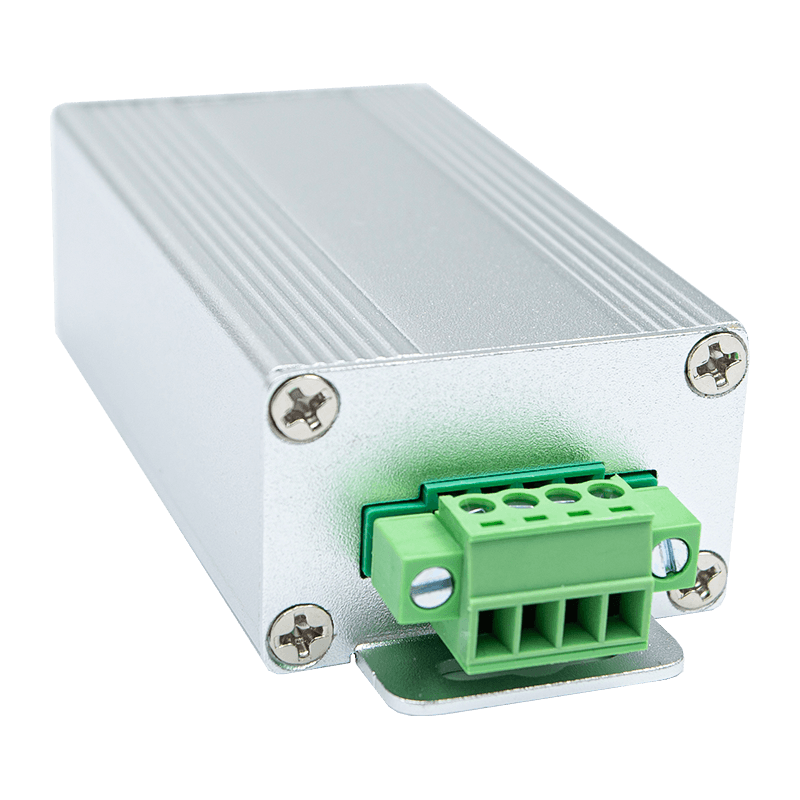
At the device level, the product is designed as an industrial module with dimensions of approximately 90 mm by 35 mm by 130 mm and a weight of about 400 g. It supports TS35 guide rail installation, making it suitable for control cabinets, electrical panels, machinery enclosures, and distributed industrial nodes. Overall power consumption is no more than 3 W, which is important for systems where multiple communication nodes must operate continuously with minimal thermal load.
One key advantage of the device is its ability to communicate without requiring phase-sequence distinction or polarity distinction at the PLC channel port. This reduces installation complexity, limits wiring errors, and improves deployment speed. In field service conditions, especially where technicians must install multiple units across large sites, a forgiving electrical interface can significantly reduce commissioning time.
Why Power Line Communication Matters in Modern Industry
Industrial digitization depends on connectivity. Sensors, controllers, drives, cameras, energy meters, human-machine interfaces, robots, and supervisory systems all need reliable data exchange. However, many factories and infrastructure sites were not originally designed with dense industrial Ethernet networks. Retrofitting these sites with new communication cable can require trenching, conduit installation, cable trays, shutdown planning, electrical isolation work, and extensive labor. In moving systems, rotating equipment, long rails, tunnels, and underground spaces, adding new data lines may be technically difficult or unreliable.
Power line communication solves a practical problem by transmitting data over the same wires already used for electrical power. In narrowband forms, PLC has long been used for metering and utility applications, but narrowband rates are not enough for many modern industrial needs. Broadband PLC changes the situation by supporting high-speed Ethernet-style communication suitable for richer data traffic, including equipment diagnostics, distributed monitoring, industrial protocol exchange, and even video in appropriate conditions.
The General Gigabit Power Line Communication device uses OFDM technology, which divides the transmission channel into many subcarriers. This helps it adapt to the complex impedance, noise, and attenuation conditions often present on power lines. Industrial power wiring is rarely as clean as a dedicated data cable; motors, inverters, relays, switching power supplies, welders, and long cable runs can all introduce interference. OFDM-based broadband PLC improves resilience by distributing data across multiple frequencies and using modulation schemes suited to changing line conditions.
Compared with wireless solutions, power line communication can be more stable in shielded, underground, metallic, or electromagnetically complex environments. Compared with new Ethernet wiring, it can be faster to install and more economical in retrofit projects. Compared with traditional narrowband PLC, it offers much higher bandwidth and supports richer industrial data. Compared with consumer-grade power line adapters, an industrial broadband carrier provides wider temperature tolerance, robust installation, DC industrial power input, protocol compatibility, and more suitable mechanical design.
Core Technical Characteristics
The product combines high-speed data transmission, wide electrical compatibility, and industrial environmental tolerance. Its broadband carrier capability supports a physical-layer bandwidth up to 1000 Mbps, with practical Ethernet bandwidth adaptation at 10 Mbps, 100 Mbps, and 1000 Mbps. The listed application bandwidth can reach up to 480 Mbps, depending on the electrical line quality, distance, coupling conditions, and noise environment. For many industrial applications, this performance is far beyond what is required for sensor data and also sufficient for multi-device communication and higher-volume information streams.
The device uses an independent DC power supply of 12–48 V. This range matches many industrial control cabinet standards and allows the communication unit to be powered from common DC supply systems. At the same time, the PLC signal port can operate over AC 0–380 V or DC 0–560 V power lines, allowing data to be carried across many different power distribution architectures. This separation of device power and communication line compatibility is an important engineering advantage because it allows the module to be integrated into systems without forcing a single voltage architecture.
The carrier frequency range of 2–68 MHz provides broadband transmission capability while remaining aligned with power line communication design principles. The product supports OFDM modulation and a range of modulation modes, including QAM, QPSK, BPSK, ROBO, HS-ROBO, and Mini-ROBO. These modes help balance speed and robustness depending on channel conditions. In practical terms, the device can communicate at higher rates when line conditions are strong and maintain more stable communication modes when interference or attenuation increases.
The transmission distance is specified as up to 800 meters for point-to-point power line communication. This range is highly relevant in industrial sites such as logistics corridors, parking systems, railway communication paths, mining tunnels, and large workshops. Traditional copper Ethernet normally has a 100-meter segment limitation without repeaters or switches. A broadband PLC link over existing power lines can reduce intermediate network infrastructure and simplify long-distance deployment.
Latency is another important parameter. The product specifies data delay within 10 ms, which makes it suitable for many real-time monitoring and control communication tasks. While the most demanding motion-control loops may still require dedicated deterministic networks, a sub-10 ms communication delay is strong for condition monitoring, control supervision, data acquisition, remote diagnostics, distributed gateways, and many industrial IoT applications. Packet loss probability is listed as less than 0.1 per mille, supporting stable operation for continuous data exchange.
Item |
Specification |
Industrial Value |
Device power supply |
DC 12–48 V |
Compatible with common industrial control power systems |
PLC signal port |
AC 0–380 V or DC 0–560 V |
Adaptable to diverse power line environments |
Modulation |
OFDM |
Improves communication robustness on noisy power lines |
Carrier frequency |
2–68 MHz |
Supports broadband carrier transmission |
Ethernet bandwidth |
10/100/1000 Mbps adaptive |
Works with many industrial Ethernet devices |
Practical bandwidth |
Up to 480 Mbps |
Suitable for high-volume industrial data |
Transmission distance |
Up to 800 m point to point |
Reduces reliance on extra repeaters or communication cables |
Data delay |
Within 10 ms |
Supports real-time monitoring and responsive communication |
Packet loss probability |
Less than 0.1‰ |
Supports stable industrial data exchange |
Encryption |
AES-128 bit |
Improves data security across shared electrical media |
Operating temperature |
-40°C to 85°C |
Suitable for harsh industrial environments |
Installation |
TS35 guide rail |
Convenient for control cabinets and machinery panels |
Advantages Over Conventional Narrowband Power Line Communication
Traditional narrowband PLC is useful for low-rate communication, but it is limited when industrial users need high data capacity, fast response, or multiple device connections. Narrowband systems are often sufficient for reading meters, sending commands at low frequency, or transferring small status packets. However, modern industrial systems increasingly require detailed equipment data, frequent sampling, distributed diagnostics, edge gateways, remote firmware management, and sometimes video or high-volume logs. These applications need more bandwidth and lower latency.
The gigabit broadband power line device provides a significant improvement by using high-speed OFDM broadband transmission. With a physical-layer carrier rate up to 1000 Mbps and practical bandwidth up to 480 Mbps, it delivers much greater data capacity than narrowband products. This means that one communication link can support multiple types of industrial traffic rather than being limited to a single low-rate purpose.
Another advantage is networking flexibility. Narrowband PLC systems often follow simpler master-slave communication structures. In contrast, this broadband device includes built-in algorithms that do not require users to manually configure a master-slave structure. It supports self-routing and automatic networking, which simplifies deployment when nodes are added, moved, or reconfigured. This is especially useful in modular production lines, logistics systems, and dynamic automation projects where equipment layouts may change.
Encryption and protocol compatibility are also important differentiators. AES-128 bit encryption helps protect data transmission, while support for Ethernet communication and industrial protocols such as TCP/IP, UDP, Profinet, and Modbus-TCP enables integration with modern controllers, gateways, SCADA systems, and industrial computers. As factories move toward integrated data platforms, communication devices must do more than send small packets; they must participate in industrial Ethernet ecosystems.
Advantages Over New Dedicated Ethernet Cabling
Dedicated Ethernet cable remains an excellent communication medium where it can be installed easily and where cable length, movement, and environmental limitations are manageable. However, many industrial retrofits are not ideal for new Ethernet construction. Long cable routes may pass through high-temperature areas, moving sections, underground channels, rotating devices, or existing conduits that are already full. Production downtime may be required to install network lines safely. Cable trays, shielding, connectors, switches, and maintenance points can add cost and complexity.
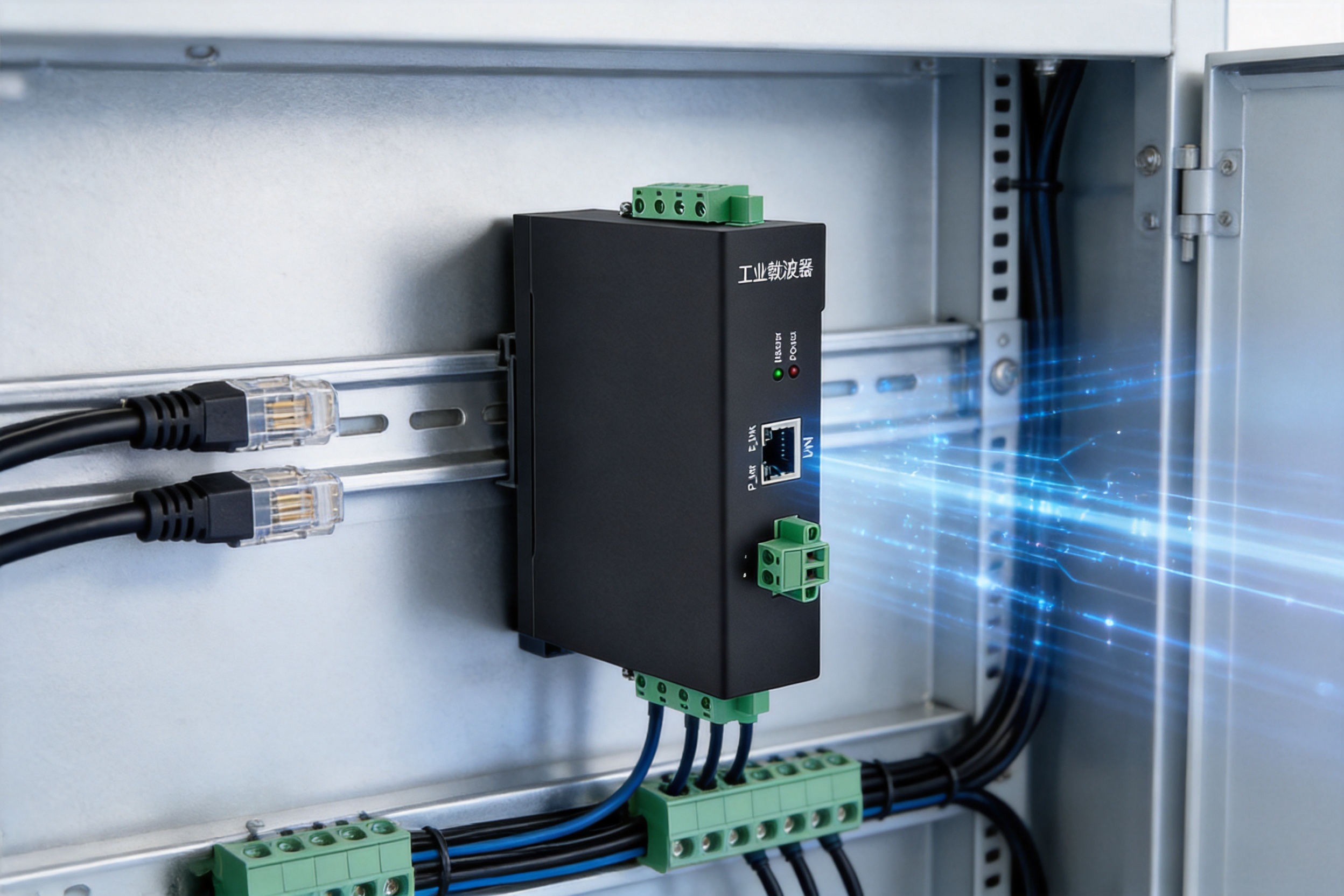
Power line communication changes the economic equation by using power wiring already present in the system. In many applications, equipment already has power but lacks data connectivity. By adding broadband carrier modules at each communication endpoint, users can extend Ethernet communication without pulling a parallel data cable. This can reduce installation time, reduce material consumption, and preserve existing plant infrastructure.
The specified point-to-point transmission distance of up to 800 meters is another advantage over standard copper Ethernet, which usually requires switches or repeaters beyond 100 meters. In long corridors, rail-mounted systems, parking towers, and large industrial halls, fewer intermediate devices can mean lower maintenance effort and fewer failure points. The device’s low power consumption of no more than 3 W also supports distributed deployment without imposing a major energy burden.
For moving equipment, slip contact cords, or power rails, dedicated Ethernet can be particularly problematic. Cable bending, twisting, dragging, and connector wear can lead to network failure. A broadband PLC solution can communicate through existing power feed paths, which may already be designed for motion or sliding contact. While every site must be evaluated for electrical noise and coupling quality, the ability to use the power path for data is a major practical advantage in dynamic industrial systems.
Advantages Over Wireless Communication
Wireless communication is convenient, but it is not always reliable in industrial environments. Factories may contain metal structures, moving vehicles, high-power motors, electromagnetic interference, shielding walls, underground spaces, and strict cybersecurity policies. Wireless spectrum congestion can also be a problem in large facilities where many Wi-Fi, Bluetooth, cellular, and proprietary radio devices operate simultaneously. In critical applications, fluctuating signal quality can lead to unstable communication.
Broadband power line communication offers an alternative by using the physical electrical connection rather than relying on radio propagation. This is useful in mines, tunnels, warehouses with dense shelving, enclosed machinery, underground systems, and metallic structures where wireless signals may be blocked or reflected. Because the communication path is defined by wiring, coverage planning can be more predictable than wireless coverage in difficult spaces.
Security is another consideration. Wireless networks broadcast signals through the air, which requires strong authentication and encryption to prevent unauthorized access. Power line communication still requires proper security practices, but the communication medium is physically associated with the electrical network. The product’s built-in AES-128 bit encryption helps protect data transmission and supports more secure operation in industrial environments.
Wireless systems can still be valuable, and in many projects a hybrid approach is best. However, for equipment that already has stable power wiring and requires consistent industrial data exchange, broadband PLC can provide a robust and installation-friendly alternative. It is particularly effective when the goal is to connect fixed or moving industrial nodes without adding separate signal cable or depending on uncertain radio conditions.
Industrial Protocol Support and Network Integration
Industrial users need communication products that integrate with existing systems rather than forcing a complete redesign. The General Gigabit Power Line Communication device supports Ethernet communication and a range of standards and protocols associated with industrial networking. Its compatibility includes IEEE 1901-related PLC communication, IEEE 802.3 Ethernet principles, HomePlug AV and HomePlug AV2 standards, TCP/IP, UDP, Profinet, and Modbus-TCP. This breadth of support makes it easier to deploy in automation networks that already use programmable logic controllers, industrial PCs, gateways, network switches, remote I/O, and supervisory software.
Modbus-TCP remains common in industrial data acquisition because it is simple, open, and widely supported. Profinet is used in many automation systems requiring more structured industrial Ethernet communication. TCP/IP and UDP support allows integration with general networking devices, data platforms, and custom industrial software. By carrying Ethernet data through the power line, the product acts as a communication bridge rather than a specialized closed system.
The device also supports IGMP multicast protocols with a maximum number of nodes listed as 64. Multicast support can be useful where data must be distributed efficiently to multiple devices without unnecessary duplication. In industrial systems, multicast can support discovery, monitoring, synchronized information distribution, and communication patterns used by some Ethernet-based protocols.
Automatic networking and self-routing reduce engineering workload. In many industrial projects, communication topology is not a simple point-to-point link. Equipment may be arranged in lines, branches, distributed stations, or mixed topologies. The product supports bus, star, tree, and hybrid network structures, enabling design flexibility. This is important for production systems where the electrical layout may not match a standard Ethernet topology.
Security Through Built-In AES-128 Bit Encryption
As industrial networks become more connected, cybersecurity becomes increasingly important. Power line communication may use existing electrical infrastructure, but data must still be protected from unauthorized access and unintended exposure. The device includes AES-128 bit encryption, a widely recognized encryption method used to protect digital communication. This feature helps ensure that data transmitted through the power line channel is not simply open traffic.
Encryption is especially important when PLC communication is used across shared electrical segments, distributed buildings, large equipment systems, or infrastructure environments. A secure communication layer reduces risk and supports compliance with internal information security policies. While encryption alone does not replace network segmentation, authentication, access control, and industrial cybersecurity management, it forms a strong foundation for safer data transmission.
The security value is enhanced by the device’s plug-and-play capability. Industrial teams often prefer solutions that are secure but not difficult to deploy. If security configuration is too complicated, users may misconfigure systems or avoid using protective features. Built-in encryption helps provide a balance between usability and protection.
Rugged Design for Harsh Environments
Industrial communication equipment must continue working in conditions that can be far more demanding than commercial or residential environments. Temperature extremes, humidity, vibration, electrical noise, cabinet heat, dust, and continuous operation all affect long-term reliability. The broadband carrier device is designed for operation from -40°C to 85°C and storage across the same temperature range. It also supports operating humidity from 20% to 95% non-condensing, making it suitable for many industrial environments where climate conditions vary.
Continuous operation is a key requirement. The product is specified for industrial-grade 7-day, 24-hour all-weather work. In automated systems, communication failure can stop production, delay logistics, or interrupt monitoring. A communication module must not be treated as a temporary accessory; it is a critical part of the industrial data infrastructure. Low power consumption, compact design, and industrial temperature tolerance all contribute to stable operation.
The TS35 guide rail mounting format allows the device to be installed in standard industrial electrical panels. Rail installation improves serviceability, keeps wiring organized, and supports repeatable deployment across multiple cabinets. The compact 90 mm by 35 mm by 130 mm size helps conserve cabinet space, which is often limited in retrofit projects.
Because power line communication devices are installed near electrical lines, robust electrical design is essential. The PLC signal port’s broad compatibility with AC and DC voltage ranges gives engineers flexibility, while the absence of phase sequence or polarity requirements simplifies wiring. These practical design details reduce installation errors and improve field reliability.
Manufacturing Strengths Behind the Product
A high-performance industrial communication product depends not only on its circuit design but also on the quality of its manufacturing process. ASY Electronics (JiaXing) Co., Ltd. positions itself as a high-tech enterprise focused on smart factory infrastructure, industrial data sensing, and intelligent connectivity. This orientation influences how products are engineered, manufactured, tested, and prepared for long-term industrial use.
Advanced manufacturing for broadband power line communication devices begins with component selection. Industrial-grade communication modules require stable power components, reliable connectors, high-quality printed circuit boards, and parts suitable for temperature variation and electrical stress. Component consistency affects communication performance, thermal stability, and long-term reliability. A manufacturer with experience in industrial transmitters, wireless temperature monitoring, flow measurement, and control equipment understands that field devices must be designed for real operating conditions rather than laboratory-only performance.
Printed circuit board assembly is another critical stage. High-frequency PLC communication requires careful layout, impedance management, grounding strategy, isolation design, and noise control. Manufacturing must maintain assembly consistency because variations in soldering, component placement, or board cleanliness can affect signal integrity. Automated surface-mount technology, controlled soldering processes, and inspection procedures help maintain repeatability across production batches.
Quality control should include visual inspection, electrical testing, functional communication testing, and environmental stress screening where appropriate. For a broadband power line carrier, testing should verify power input operation, PLC signal coupling, Ethernet interface stability, data throughput, networking behavior, encryption function, and communication performance under representative line conditions. Burn-in or extended operation testing can help identify early failures before products reach customers.
Manufacturing traceability is also important. Industrial users may deploy many units across large systems and need confidence that each unit meets consistent standards. Serial tracking, production records, test reports, and controlled assembly procedures support accountability and after-sales service. In projects such as mines, oilfields, railways, and automated warehouses, reliable technical support and repeatable product quality are as valuable as the product specification itself.
ASY Electronics’ broader mission of enabling efficient, reliable, and green smart factories aligns with the product’s value. By reducing unnecessary communication cabling and enabling data transmission over existing electrical infrastructure, broadband PLC can reduce installation material, lower retrofit complexity, and support more efficient industrial digitalization. The company’s combination of edge-layer hardware development and industrial data integration solutions provides a foundation for practical product design rather than isolated component supply.
Engineering Design Philosophy
The design philosophy behind the General Gigabit Power Line Communication device can be summarized as high speed, easy deployment, industrial durability, and flexible integration. Each of these principles addresses a real pain point in industrial communication projects.
High speed is necessary because modern industrial data is no longer limited to basic on-off signals. Users may need equipment status, energy data, alarm records, diagnostic information, control commands, production data, and image streams. A high-bandwidth PLC device gives users headroom for future expansion. Even if an application begins with simple monitoring, the same network can later support richer functions.
Easy deployment is reflected in plug-and-play operation, automatic networking, no master-slave setup, support for multiple topologies, and no need to distinguish phase sequence or polarity at the PLC channel port. These features reduce engineering time and make the product practical for both new installations and retrofit projects. Industrial users often need communication upgrades without extensive downtime; installation simplicity directly supports that goal.
Industrial durability is reflected in the wide temperature range, low power consumption, compact rail-mounted enclosure, and 24-hour continuous operation capability. Many communication products perform well in controlled office environments but fail in hot cabinets, cold outdoor locations, or electrically noisy industrial sites. An industrial-grade device must be designed from the beginning for harsher conditions.
Flexible integration is reflected in Ethernet adaptation and support for common industrial protocols. The product does not require users to abandon their existing controllers or software. Instead, it provides a communication layer that can carry the Ethernet traffic industrial systems already use. This makes adoption easier and reduces integration risk.
Application Scenario: Underwater Robots and Mobile Platforms
Underwater robots and mobile industrial platforms often face serious communication challenges. Wireless radio signals do not travel well through water, and long tether cables may already be required for power. Adding separate communication channels can increase tether complexity, size, weight, and failure risk. Broadband power line communication allows data to be transmitted through the power line within the tether, simplifying the cable structure while supporting high-speed communication.
In such applications, low latency and high bandwidth can support telemetry, sensor feedback, control commands, and potentially video or sonar-related data depending on system design. The independent DC power input and broad PLC voltage compatibility help engineers integrate the module into custom power architectures. The compact form factor is also valuable because mobile platforms have limited internal space.
Application Scenario: Mines, Oilfields, and Harsh Industrial Sites
Mines and oilfields are difficult environments for communication infrastructure. Long distances, dust, moisture, vibration, metallic structures, and safety constraints complicate new cable installation. Equipment may be distributed over large areas, and shutdown time can be costly. Broadband PLC can connect monitoring stations, control points, sensors, and communication gateways by using available power lines.
The -40°C to 85°C operating range is important for outdoor and underground temperature variation. AES-128 bit encryption supports safer data transmission, while the 800-meter point-to-point range can reduce intermediate equipment. In these environments, the ability to deploy communication without extensive new cabling is a major operational benefit.
Application Scenario: Warehousing, Logistics, and Sorting Systems
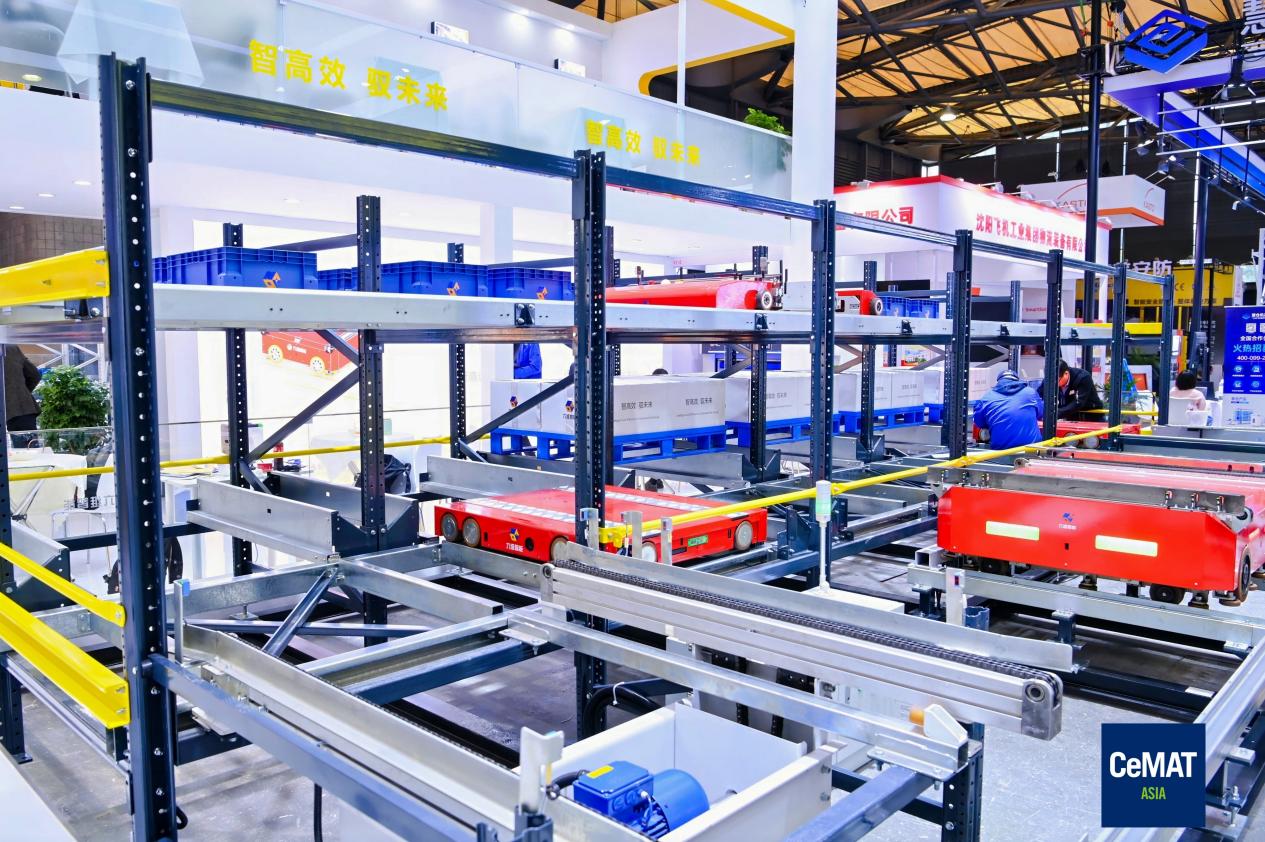
Automated warehouses and logistics sorting systems use conveyors, lifters, shuttles, stackers, sensors, scanners, controllers, and distributed drives. These systems often expand or change layout over time. Installing new communication cable across moving lines and large facilities can be disruptive. Power line communication provides a practical way to connect distributed equipment through existing electrical paths.
The product’s support for bus, star, tree, and hybrid networks is valuable in logistics environments because equipment arrangements are rarely uniform. Automatic networking and self-routing help reduce commissioning complexity. The high data rate allows the same communication infrastructure to support machine status, alarms, barcode or identification data, energy information, and maintenance diagnostics.
Application Scenario: Three-Dimensional Parking Garages
Three-dimensional parking garages contain moving platforms, lifts, sensors, control systems, drive units, and safety devices. Communication wiring can be challenging because mechanical movement and vertical structures increase cable stress. PLC communication through power lines or suitable slip contact systems can reduce the need for separate signal wiring and improve system maintainability.
In parking systems, real-time status and safety communication are important. The product’s data delay within 10 ms and low packet loss probability support responsive monitoring and control supervision. Its compact rail-mount design fits well in control cabinets distributed throughout parking equipment.
Application Scenario: Railway and Subway Communication
Railway and subway environments often involve long distances, harsh electrical conditions, vibration, tunnels, and strict reliability expectations. Communication links may be needed for monitoring, control, station equipment, tunnel systems, maintenance devices, and auxiliary infrastructure. Broadband PLC can use existing power lines or dedicated power cables to transmit data where new communication cable is difficult to install.
The 800-meter point-to-point distance, wide temperature tolerance, and industrial operating capability make the product relevant for these applications. Because tunnels and rail environments may limit wireless performance, wired power line communication can provide a more predictable path. The ability to support Ethernet and industrial protocols also helps integrate with supervisory control and monitoring platforms.
Application Scenario: Industrial Automation Equipment
In automation equipment, communication is often needed between cabinets, machine modules, sensors, control units, and remote interfaces. When machines are modular, mobile, or retrofitted, dedicated communication wiring may become complex. Broadband PLC allows engineers to create communication links through existing power lines, reducing cable count and simplifying machine design.
For machine builders, a compact rail-mounted PLC communication module can become a standard option for equipment networking. Because the device supports DC 12–48 V power input, it fits common control panel supply systems. The Ethernet adaptive interface helps connect to PLCs, industrial PCs, remote I/O, and gateways. The result is a flexible communication layer that can be applied across many machine types.
Installation and Deployment Considerations
Although broadband power line communication simplifies networking, proper engineering practice remains important. Power lines are not originally designed as data cables, so communication performance can be affected by cable length, branch structure, electrical noise, load changes, grounding, filters, transformers, and coupling methods. Before full deployment, users should evaluate the electrical environment and test communication performance under realistic operating conditions.
For best results, installation should consider separation from severe noise sources where possible, stable power connections, correct protective devices, and suitable cabinet grounding. If variable-frequency drives, large motors, welding equipment, or high-frequency switching devices are present, engineers may need to evaluate filtering or line routing. The product’s OFDM technology and robust modulation options help manage difficult line conditions, but system-level design still matters.
Network planning should also consider topology. The device supports bus, star, tree, and hybrid topologies, but line branching and impedance changes can affect PLC signal quality. In larger systems, engineers should map electrical distribution and plan node locations to maintain reliable communication. The maximum number of multicast nodes is listed as 64, which should be considered when designing larger networks.
Security planning should include AES-128 bit encryption along with broader industrial network protection. Users should segment networks where appropriate, manage access rights, protect control systems, and follow internal cybersecurity standards. PLC communication should be treated as part of the industrial network, not as an isolated accessory.
How the Product Supports Smart Factory Development
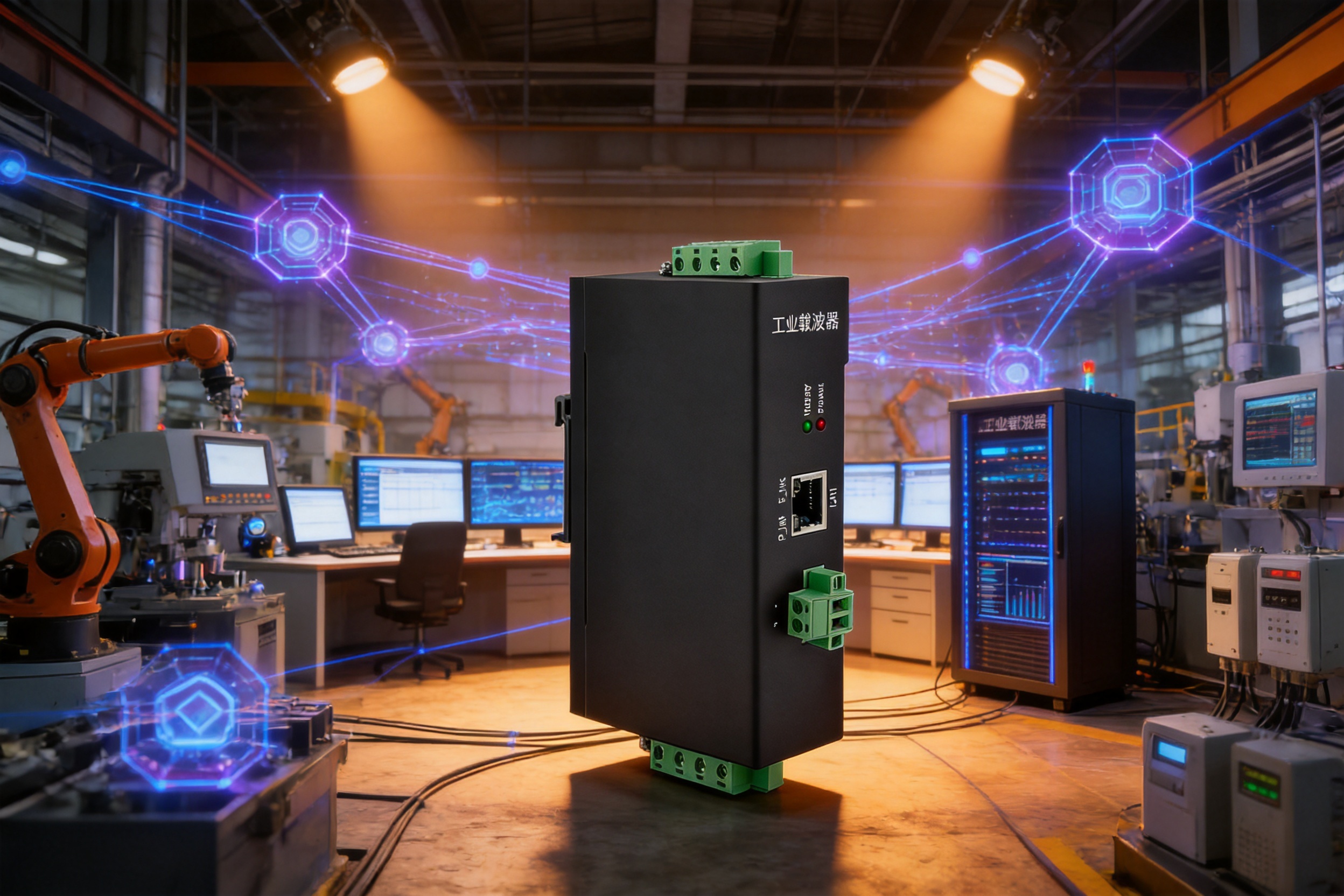
Smart factories depend on data. To improve production efficiency, reduce downtime, manage energy, and optimize processes, manufacturers must collect information from machines and production lines. However, the cost and complexity of connecting legacy equipment often slows digital transformation. Broadband power line communication provides an efficient path to industrial data connectivity by reducing the need for new communication cabling.
Equipment condition monitoring is one of the most important smart factory use cases. Motors, pumps, conveyors, compressors, drives, and production equipment can generate valuable operational data. When this data is transmitted reliably to edge systems or monitoring platforms, maintenance teams can detect abnormal conditions earlier and reduce unplanned downtime. PLC communication can help connect monitoring devices in areas where Ethernet cable is absent.
Energy management is another major use case. Smart factories need to measure, analyze, and optimize power consumption. Since energy devices are naturally connected to electrical infrastructure, power line communication can be a logical method for transmitting energy data. By enabling communication over power wiring, the product supports refined energy management and more sustainable operation.
Production process optimization also benefits from improved connectivity. When machines, controllers, sensors, and management systems exchange data more freely, factories can improve scheduling, quality control, and operational visibility. A high-speed broadband PLC device helps create the communication foundation for these improvements, especially in retrofit environments.
Comparison With Common Competing Solutions
Many competing communication options exist, but each has limitations. Narrowband PLC is low cost and long established, but its data rate is limited. Wireless is flexible, but signal quality can be unpredictable in metallic, underground, or interference-heavy environments. New Ethernet cable offers excellent performance, but installation can be expensive and disruptive. Consumer-grade power line adapters may be inexpensive, but they are typically not designed for industrial temperature ranges, DC power systems, rail mounting, protocol integration, or continuous operation in harsh sites.
The General Gigabit Power Line Communication device occupies a strong position between these alternatives. It provides high bandwidth without requiring new communication cable, physical-line stability without depending on wireless propagation, and industrial-grade construction beyond typical consumer products. Its DC 12–48 V independent power supply, AC/DC PLC signal compatibility, 800-meter point-to-point range, AES-128 bit encryption, plug-and-play networking, and -40°C to 85°C operating range create a balanced solution for industrial environments.
Another competitive advantage is the product’s ability to support multiple topologies and automatic networking. Some communication products require rigid network design or manual configuration, increasing engineering workload. This device is designed to be more flexible, allowing users to build bus, star, tree, or hybrid networks according to the actual power line layout. This can be especially valuable in retrofit projects where the existing electrical network cannot be easily changed.
Power consumption is also an advantage. With total power consumption no more than 3 W, the device can be deployed in multiple nodes without significant heat or energy impact. In industrial cabinets, every watt matters because heat accumulation affects equipment life. A low-power communication module supports reliability and energy efficiency.
Reliability, Maintenance, and Lifecycle Value
Industrial buyers evaluate communication products not only by purchase price but also by lifecycle value. A low-cost product that fails often, requires complex configuration, or causes downtime can become expensive. A reliable industrial communication module reduces maintenance burden, shortens commissioning time, and supports stable operation over many years.
The device’s rail-mounted compact design helps maintenance teams replace or inspect units efficiently. Standardized DC power input and Ethernet interfaces simplify troubleshooting. Automatic networking reduces configuration errors, while encryption improves secure operation. The wide operating temperature range gives users confidence that the product can function in cabinets exposed to heat, cold, and environmental variation.
Lifecycle value also comes from scalability. Because the product supports multiple topologies and up to 64 multicast nodes, users can begin with a small deployment and expand as needed. This is important for smart factory projects, which often begin with pilot installations before expanding across production lines or facilities.
Company Strengths and Customer Support Capability
ASY Electronics (JiaXing) Co., Ltd. is positioned as a provider of industrial IoT communication solutions and smart factory technology. Its company mission emphasizes efficient, reliable, and green smart factories, with key capabilities in data sensing and intelligent connectivity. This product is part of a larger ecosystem of industrial hardware and data integration solutions designed to help manufacturing enterprises improve equipment monitoring, energy management, and production optimization.
The company’s product range demonstrates cross-disciplinary industrial experience. Broadband power line carriers provide communication; wireless temperature monitoring sensors provide condition awareness; industrial transmitters and flow meters support process measurement; automatic door controllers support equipment automation. This combination allows the company to understand the full chain from field sensing to data transmission and control execution.
Manufacturing strength is also reflected in the ability to provide customized power line carrier solutions for industrial customers. Industrial sites vary widely, and communication systems often need adaptation to voltage conditions, wiring structures, enclosure requirements, interface needs, and protocol environments. A manufacturer with both product development and solution engineering capability can support customers more effectively than a supplier offering only standard off-the-shelf devices.
Customer support in power line communication is particularly important because site conditions strongly affect performance. Experienced engineers can help evaluate line conditions, select installation methods, recommend topology design, and troubleshoot interference. This practical support improves project success and strengthens the product’s value beyond its technical specifications.
Q&A Section
What is General Gigabit Power Line Communication?
General Gigabit Power Line Communication is a broadband communication solution that transmits Ethernet data through existing power lines or suitable electrical cables. It allows industrial equipment to exchange data without requiring separate dedicated communication cables.
What bandwidth can the device support?
The device supports a physical-layer carrier bandwidth up to 1000 Mbps and Ethernet adaptation at 10 Mbps, 100 Mbps, and 1000 Mbps. Practical bandwidth can reach up to 480 Mbps depending on the electrical environment, cable distance, noise level, and installation conditions.
What is the main advantage over narrowband PLC?
The main advantage is much higher communication speed. Narrowband PLC is usually suitable for low-rate data such as metering or simple commands, while this broadband solution supports richer Ethernet traffic, real-time monitoring, industrial protocols, and larger data volumes.
Can it replace Ethernet cable?
In many retrofit and long-distance applications, it can reduce or eliminate the need for separate Ethernet cable by using existing power lines. However, engineers should evaluate site conditions because power line quality, noise, and topology can affect performance.
What power supply does the device use?
The device uses an independent DC 12–48 V power supply, which is compatible with many industrial control cabinets and automation power systems.
What voltage range can the PLC signal port handle?
The PLC signal port is suitable for power line carrier communication on AC 0–380 V or DC 0–560 V lines. The port does not require phase-sequence distinction or positive-negative polarity distinction, which simplifies installation.
How far can it transmit data?
The specified point-to-point transmission distance over power line is up to 800 meters. Actual performance depends on cable condition, electrical noise, branch structure, and installation method.
Is the device suitable for harsh environments?
Yes. It is designed for industrial use with an operating temperature range from -40°C to 85°C, non-condensing operating humidity from 20% to 95%, and continuous 24-hour operation capability.
Does it support industrial protocols?
Yes. It supports Ethernet communication and common industrial networking protocols and standards including TCP/IP, UDP, Profinet, and Modbus-TCP, making it suitable for automation and industrial IoT integration.
Is the communication encrypted?
Yes. The product includes AES-128 bit encryption to help protect data transmitted through the power line communication channel.
What network topologies are supported?
The product supports bus, star, tree, and hybrid network topologies. It also supports automatic networking and self-routing, reducing manual configuration requirements.
Where is this product commonly used?
Typical applications include underwater robots, mines, oilfields, warehouses, logistics sorting systems, three-dimensional parking garages, railways, subway systems, industrial automation equipment, and other environments where existing power lines can be used for high-speed data transmission.
Conclusion
General Gigabit Power Line Communication provides a practical and powerful way to connect industrial equipment through existing power lines. By combining broadband OFDM technology, gigabit-class carrier capability, Ethernet protocol support, AES-128 bit encryption, flexible topology options, and industrial-grade environmental tolerance, it addresses many of the most difficult communication challenges in modern factories and infrastructure projects.
Its advantages over competing approaches are clear. Compared with narrowband PLC, it offers much higher bandwidth and richer data capability. Compared with new Ethernet cabling, it reduces installation complexity and retrofit cost. Compared with wireless communication, it can provide a more stable physical communication path in shielded, underground, metallic, or interference-heavy environments. Compared with consumer-grade power line adapters, it offers industrial voltage compatibility, rail mounting, wide temperature operation, low power consumption, and stronger suitability for continuous industrial use.
The product is also supported by a company focused on smart factory development, industrial sensing, intelligent connectivity, and practical data integration. ASY Electronics (JiaXing) Co., Ltd. brings manufacturing experience, product engineering capability, and industrial application understanding to the development of broadband power line communication solutions. For manufacturers, system integrators, and infrastructure operators seeking efficient, reliable, and scalable connectivity, this device offers a strong path toward industrial digitalization without unnecessary cabling complexity.
References
IEEE Standards Association. IEEE 1901 Standard for Broadband over Power Line Networks.
IEEE Standards Association. IEEE 802.3 Ethernet Working Group Standards.
European Committee for Electrotechnical Standardization. EN 50561 Power Line Communication Apparatus Used in Low-Voltage Installations.
HomePlug Powerline Alliance. HomePlug AV and HomePlug AV2 Technical Specifications.
National Institute of Standards and Technology. Guidelines for Industrial Control System Security.
International Electrotechnical Commission. Industrial Communication Networks and Fieldbus System References.
Industrial Ethernet Handbook. Principles of Ethernet-Based Automation Communication.