

Cold storage facilities depend on doors that open and close with precision, strength, and repeatability. A sliding door in a low-temperature warehouse is not simply a moving panel; it is part of a thermal barrier, a safety system, an energy-management strategy, and a logistics workflow. When that door is heavy, frequently operated, and exposed to frost, humidity, air pressure differences, and demanding personnel traffic, the controller behind the movement becomes a critical component. The Gear Motor Controller for Cold Storage Sliding Doors, model AIG-750L-03, is designed for this exact industrial environment. It provides controlled motion, configurable safety interfaces, heating and air curtain support, and network-ready operation for modern cold chain facilities.
This article explains the product’s technical value, practical advantages, system architecture, installation logic, performance strengths, and manufacturing background. It also discusses how a specialized controller can help operators reduce door-related downtime, improve insulation performance, enhance safety, and simplify commissioning when compared with conventional door-control solutions. The product is developed for facilities that require more than basic open-and-close operation. It is intended for heavy-duty sliding doors that must move smoothly, stop accurately, withstand low temperatures, and integrate with other warehouse equipment.
Gear Motor Controller for Cold Storage Sliding Doors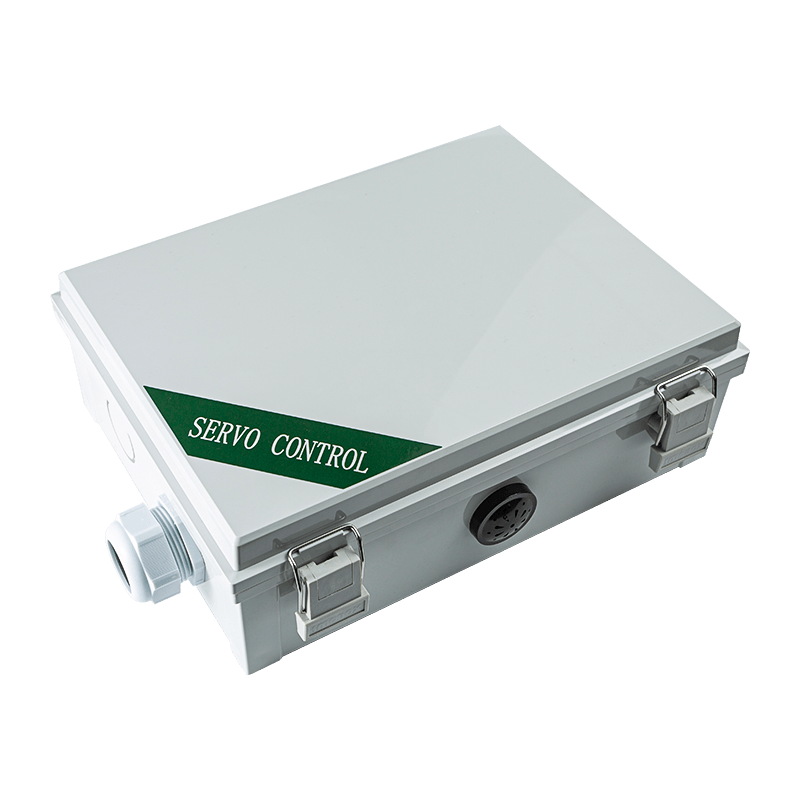
Product Overview
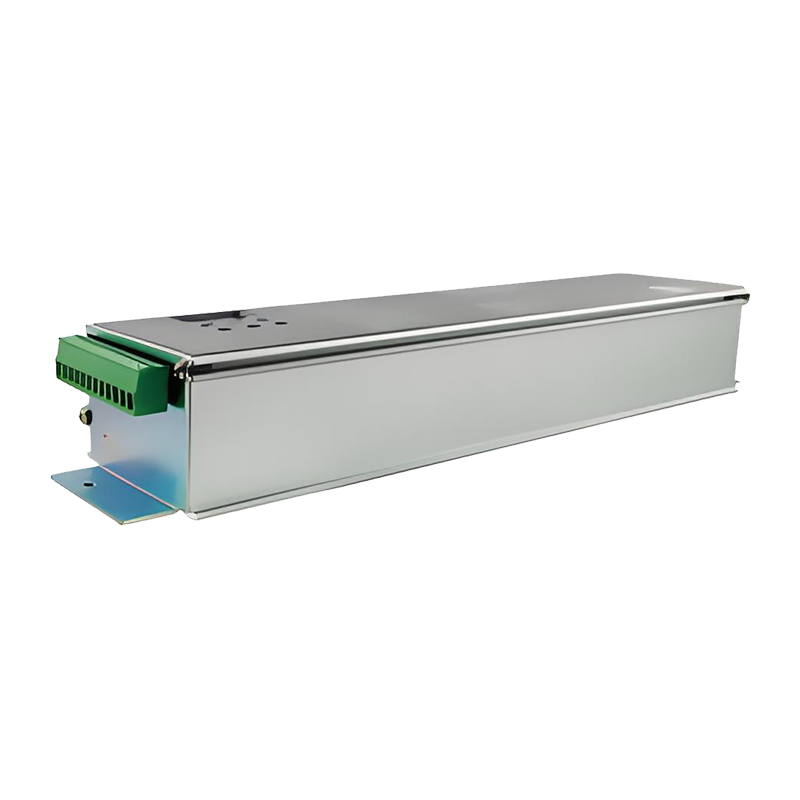
The AIG-750L-03 is a gear motor controller for cold storage sliding doors. It is built for applications where high torque, controlled acceleration, precise positioning, and dependable operation are essential. The controller is rated for 0.75 kW operation and uses a 220 V rated voltage platform. In its broader system configuration, it supports controllable high-voltage servo geared motor control with a maximum output power of 1500 W, enabling it to manage demanding door loads while maintaining smooth motion behavior.
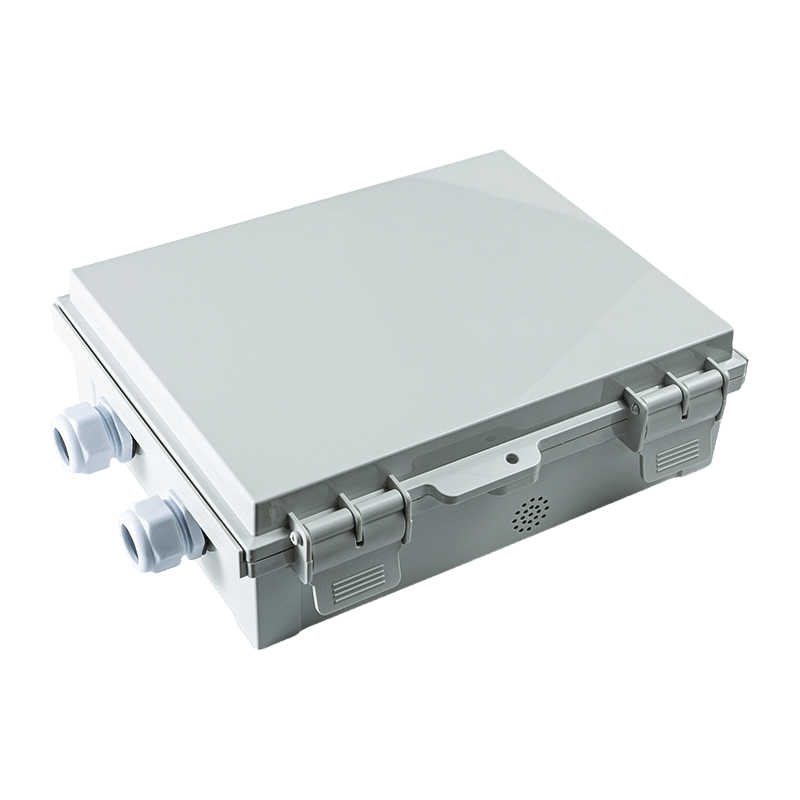
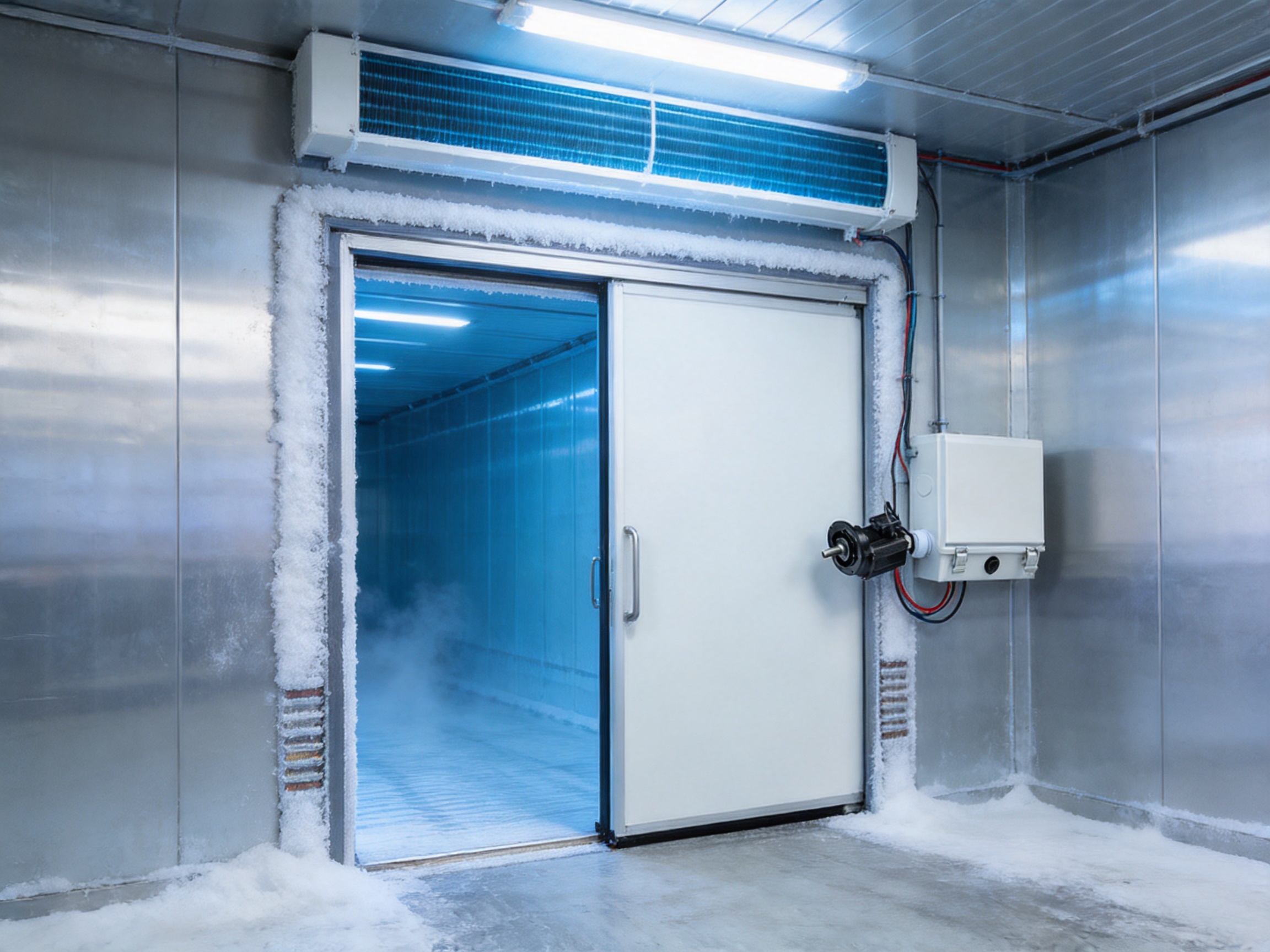
The controller is typically housed within the AIG-1500L-01J refrigerator door control box, providing an integrated enclosure solution for industrial door projects. It is compatible with the MT01-JS-45N, also identified as DLG-56S-45, a three-phase permanent magnet gear motor with a 45 N.m rated torque and a 1:6.45 reduction ratio. This motor-controller combination provides the torque foundation required for heavy cold storage sliding doors, especially where door seals create resistance and where ice or condensation may increase mechanical friction.
The product goes beyond basic motor driving. It includes outputs for external heating wires rated up to 1 kW at 220 V, helping prevent freezing around the door system. It also supports external air curtains rated up to 2.2 kW, helping maintain climate separation during door opening cycles. These peripheral-control functions are especially important in refrigerated and frozen storage environments, where thermal efficiency is a major operating cost factor.
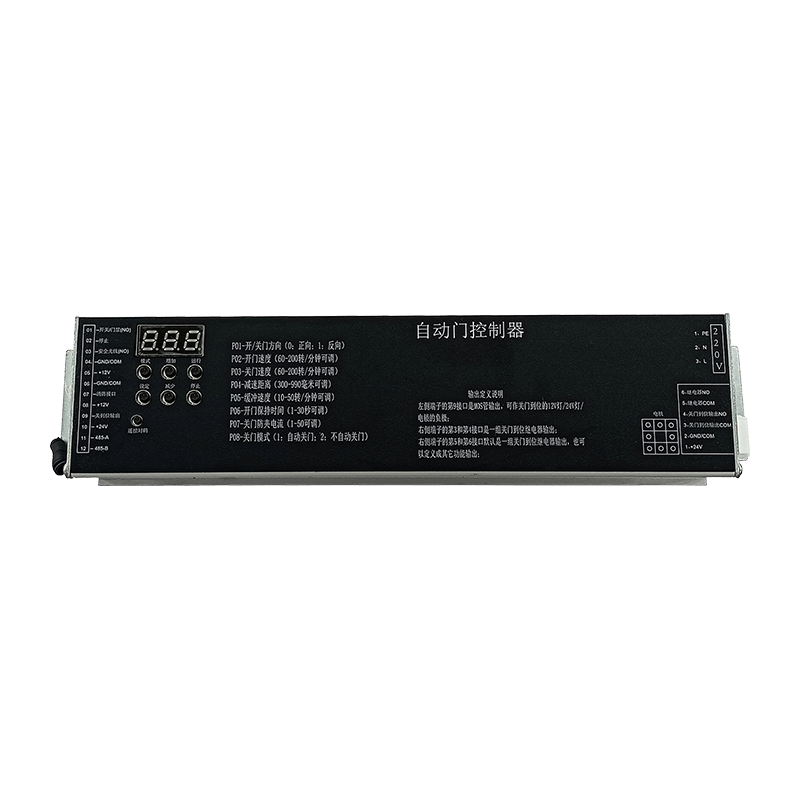
For external control and safety integration, the controller provides terminals for open, close, stop, anti-pinch or fire protection, door lock, radar, pull-cord, emergency stop, and other signals. It includes relay outputs that can be assigned to functions such as air curtain switching, occupied signals, alarm outputs, and position-related indications. One RS485 interface enables networked control, making the unit suitable for digitalized cold chain facilities that want to connect door assets into a supervisory system.
Why Cold Storage Sliding Doors Require Specialized Control
Cold storage doors operate under conditions that are far more demanding than those faced by ordinary commercial doors. Low temperatures affect lubrication, seals, electronics, cables, and mechanical resistance. Condensation can become frost. Frost can become ice. Door panels may be heavy because they are insulated, reinforced, and designed to withstand pressure differences between refrigerated spaces and warmer surrounding areas. When doors are opened frequently by forklifts, workers, carts, and automated logistics equipment, the control system must handle both performance and safety without interruption.
A conventional automatic door controller may be sufficient for a light sliding door in a mild indoor environment, but it may not provide the torque profile, environmental tolerance, heating coordination, air curtain control, or commissioning intelligence needed for cold storage. In many facilities, door failure causes more than inconvenience. It can lead to temperature rise, product spoilage, safety hazards, workflow disruption, and increased energy consumption. A controller designed specifically for cold rooms helps reduce these risks by managing the door as part of a complete thermal and operational system.
The AIG-750L-03 addresses this challenge by combining motor control, external accessory outputs, configurable signals, and remote management capability. The result is a control platform that not only drives a motor but also supports the surrounding systems required to keep the door functional in cold and humid environments. This system-level approach gives it an advantage over controllers that only provide basic motor relays or limited input logic.
Core Technical Specifications
The controller’s key parameters reflect its industrial application. The input voltage range is 176 to 264 VAC at 50/60 Hz, allowing stable operation under normal industrial power fluctuations. Motor control is designed for a controllable high-voltage servo geared motor, with system output capacity up to 1500 W. The dedicated AIG-750L-03 configuration is centered on a 0.75 kW rated power class, making it suitable for many cold storage sliding door applications requiring robust movement and reliable torque.
The input-signal architecture supports common door commands and safety signals, including open, close, stop, anti-pinch, fire protection, door lock, radar, and related external triggers. Output support includes a 380 VAC air curtain motor interface, 220 VAC heating element output, buzzer control, open-position signal, and close-position signal. The inclusion of RS485 communication allows the controller to participate in networked control systems, which is useful for facilities that monitor door status, cycle counts, alarm events, or automated traffic coordination.
Parameter |
Specification |
Operational Value |
Rated Power |
0.75 kW configuration |
Suitable for heavy cold storage sliding doors requiring controlled torque |
Rated Voltage |
220 V platform |
Compatible with common industrial door power systems |
Input Voltage Range |
176–264 VAC, 50/60 Hz |
Helps maintain operation under normal supply variation |
Motor Control |
High-voltage servo geared motor, maximum output power 1500 W |
Enables smooth and powerful sliding door movement |
Compatible Motor |
MT01-JS-45N / DLG-56S-45 |
Three-phase permanent magnet gear motor with 45 N.m rated torque |
Reduction Ratio |
1:6.45 |
Provides mechanical advantage for heavy insulated doors |
Heating Wire Output |
Up to 1 kW at 220 V |
Helps prevent freezing and improves cold-room reliability |
Air Curtain Output |
Up to 2.2 kW |
Supports climate control and reduces thermal exchange |
Communication |
RS485 interface |
Enables networked monitoring and control |
Environmental Motor Rating |
-25°C to +50°C, up to 95% relative humidity |
Supports demanding cold storage and humid environments |
System Architecture and Integration
A door controller for cold storage must coordinate multiple subsystems. In the AIG-750L-03 system, the controller is the command center for the gear motor, safety inputs, operating accessories, position signals, and optional remote or network commands. When a user triggers an open command through a pull-cord, radar sensor, remote control, or other input, the controller interprets the command, checks relevant interlocks, applies configured motion parameters, and drives the motor accordingly. During movement, anti-pinch and emergency signals can interrupt or modify operation to protect personnel and equipment.
The system architecture supports both manual interaction and automated workflow. A forklift operator may use radar activation or remote control. A warehouse worker may use a pull-cord. A facility automation system may use RS485 communication to coordinate operation with other equipment. The controller’s input flexibility allows designers to create a door system that fits the working habits and safety policies of the site rather than forcing the site to adapt to a limited controller.
The integration of heating wire output is especially important. Sliding doors in cold rooms often suffer from seal freezing, track ice, and frost buildup. Heating wires can reduce these problems by maintaining critical contact areas above freezing. Instead of requiring a separate control device for the heater, the AIG-750L-03 provides dedicated support, simplifying wiring and improving system coordination.
Air curtain support is another key integration advantage. In cold storage facilities, every door opening creates an opportunity for warm air infiltration and cold air loss. Air curtains help form a protective airflow barrier, reducing heat exchange. By providing an output for air curtain control, the controller enables coordinated operation between door movement and climate-protection equipment. This can support energy savings and more stable internal temperatures.
Motor and Torque Advantages
The compatible MT01-JS-45N gear motor is a three-phase permanent magnet motor with rated torque of 45 N.m and a 1:6.45 reduction ratio. This pairing is significant because cold storage doors often demand strong starting torque. Door seals may stick. The panel may be heavy. Track resistance may rise as temperature falls. A motor-control system that cannot produce controlled torque may create jerky movement, repeated startup failures, excessive mechanical stress, or unsafe operation.
Permanent magnet motor technology provides efficient torque production and responsive control. When combined with a gear reduction system, it offers the mechanical strength needed for insulated sliding door panels. The controller’s ability to adjust motor starting current and tightening torque at fully open and fully closed positions further improves practical performance. Instead of using a simple on-off drive method, the system can be tuned to the mechanical characteristics of the door.
The nine adjustable speed gears provide another advantage. Different cold storage areas may require different operating speeds. A high-traffic loading zone may need faster opening and closing to maintain productivity. A narrow personnel passage may require slower movement for safety. A very heavy door may need a gentler acceleration profile. The speed-gear settings allow commissioning personnel to balance speed, comfort, thermal efficiency, and mechanical service life.
Compared with low-cost controllers that provide limited speed control or rely on fixed timing, the AIG-750L-03 gives operators more practical adjustability. This makes it easier to achieve stable door performance after installation and easier to fine-tune operation after the door system ages, the seals change, or the facility workflow evolves.
Voice-Guided Commissioning
One of the product’s most user-oriented features is its voice-guided commissioning process. During automated debugging, a speaker provides a countdown and voice prompts that guide the user through the self-test and door-width measurement procedure. This feature has real value in the field. Industrial door commissioning is often performed under time pressure, sometimes in cold environments, and sometimes by technicians who must work around warehouse operations. Clear voice prompts reduce ambiguity and help standardize the setup process.
Traditional controllers may require technicians to interpret indicator lights, parameter codes, or complicated setup charts. While skilled technicians can handle such systems, the process is more vulnerable to mistakes. Incorrect door-width learning, wrong limit settings, or incomplete self-testing can lead to poor stopping accuracy, excessive impact at the end positions, or nuisance alarms. Voice guidance helps make commissioning more consistent and reduces dependence on trial-and-error adjustment.
For equipment suppliers and installation teams, this can reduce startup time. For end users, it can improve confidence that the door has been properly configured. For maintenance teams, it can simplify recommissioning after mechanical repair, motor replacement, or door-panel adjustment. The result is a product that supports the entire life cycle rather than only the initial installation.
Flexible Input and Output Interface
The controller provides a broad range of terminals for external signals. These may include pull-cords, radar devices, door locks, emergency stops, anti-pinch sensors, fire protection signals, stop commands, open commands, close commands, and other site-specific inputs. This flexibility is important because cold storage facilities differ widely in traffic patterns, safety requirements, and automation levels.
For example, a forklift-heavy warehouse may prefer radar activation or remote controls so drivers do not need to leave their vehicles. A facility with strict safety procedures may require multiple emergency-stop points. A high-security area may use door-lock signals or access-control interlocks. A fire-safety design may require the door to respond to fire-protection commands. By supporting many input types, the controller can be integrated into a broader safety and logistics system.
Programmable relay outputs add another layer of adaptability. The three relay outputs can be assigned to functions such as air curtain switching, library occupied signals, alarm outputs, or other control indications. In practical terms, this means the controller can communicate useful door status information to other devices without requiring complex additional hardware. A relay can signal that the door is open, closed, in alarm, occupied, or linked to an air curtain function, depending on the selected configuration.
This flexible I/O design is a clear advantage over competitor controllers with fixed outputs and limited input channels. In cold storage projects, integration problems often appear after installation begins. A controller with more configurable terminals can solve these problems more easily, reducing the need for external relays, custom wiring, or separate logic modules.
Remote Management and Wireless Operation
The system includes a remote control receiver module with straightforward code pairing and clearing procedures. Wireless operation is useful in industrial door applications because operators may approach the door from different directions or from inside vehicles. A remote-control function can improve convenience, reduce walking time, and increase workflow efficiency.
Simple pairing and code clearing are important for practical security and maintenance. If a remote is added, replaced, or removed from service, the receiver module should allow the process to be completed without unnecessary complexity. In busy facilities, access devices may be reassigned, damaged, or lost. A controller that supports manageable remote operation helps the facility maintain control over who can operate the door.
Wireless operation also supports retrofit projects. When installing wired activation devices is difficult or expensive, remote control can provide a flexible alternative. It can also be combined with wired safety devices, meaning the system can maintain safety inputs while providing convenient wireless commands.
Environmental Resilience
Cold storage environments impose mechanical, electrical, and thermal stress on equipment. The motor associated with this controller is rated for ambient temperatures from -25°C to +50°C and relative humidity up to 95%. Such resilience is essential for refrigerated warehouses, food processing plants, pharmaceutical cold rooms, and logistics centers where humidity and temperature fluctuation are common.
Low temperatures can increase viscosity in lubricants and stiffen seals. High humidity can contribute to condensation. Repeated door cycles can create mechanical vibration. Electrical equipment must operate despite these factors. The AIG-750L-03 system addresses the environment not only through compatible motor selection but also through heating-output support and robust industrial control design.
The controller’s ability to support heating wires up to 1 kW at 220 V provides a practical defense against freezing at vulnerable points. Freezing is one of the most common causes of door malfunction in cold storage areas. By integrating heater support into the door control system, the product reduces dependency on separate heater controllers and helps ensure that anti-freezing measures are part of the door’s standard operating logic.
Safety and Protection Functions
Safety is central to automatic sliding door operation, especially when doors are heavy and used by both people and vehicles. The controller supports anti-pinch input, emergency stop, stop command, door lock signal, fire protection input, and other safety-related interfaces. These inputs allow the system designer to build layered protection around the door.
Anti-pinch sensors can help detect obstacles or unsafe contact conditions. Emergency-stop devices allow personnel to immediately halt movement. Door-lock signals prevent operation when the lock state is not appropriate. Fire-protection input can integrate the door with facility emergency systems. The presence of these inputs does not replace proper safety engineering, but it gives designers the necessary control points to implement safer systems.
Precise motion control also contributes to safety. A door that starts too abruptly or stops too harshly can create hazards. Adjustable speed gears, starting current parameters, and end-position tightening torque settings help tune movement to the door’s size and use case. Smooth operation reduces surprise, reduces mechanical impact, and improves user confidence.
Energy Efficiency and Thermal Management
Energy efficiency in cold storage is closely tied to door performance. Every unnecessary second that a door remains open allows heat to enter the refrigerated space. Every poor seal, frozen gasket, or malfunctioning air curtain increases energy cost. A well-controlled sliding door can reduce thermal exchange by opening only as needed, moving efficiently, closing reliably, and coordinating with protective accessories.
The AIG-750L-03 contributes to thermal management in several ways. First, its motor-control capability supports quick and controlled opening and closing. Second, its air curtain output allows airflow protection to be integrated with door operation. Third, its heating wire output helps prevent freezing that could compromise sealing or prevent complete closure. Fourth, programmable outputs can provide status signals to building systems or operators, helping them identify abnormal conditions such as a door not fully closed.
Compared with basic controllers that only energize a motor, this product treats the door as part of the cold room’s energy envelope. That approach can help facilities reduce compressor load, maintain more stable product temperatures, and decrease avoidable operating costs. The energy benefit depends on site conditions, door size, traffic frequency, and system configuration, but integrated control is a strong foundation for improved efficiency.
Advantages Over Conventional Controllers
The AIG-750L-03 offers several important advantages over conventional automatic door controllers. The first advantage is application specialization. It is specifically engineered for cold storage sliding doors, whereas many general-purpose controllers are adapted from ordinary door systems. Specialization matters because cold storage requires torque, anti-freeze support, air curtain coordination, and reliable operation in low-temperature, high-humidity environments.
The second advantage is commissioning intelligence. Voice-guided self-testing and door-width measurement reduce the likelihood of setup errors and shorten installation time. Many competing controllers rely heavily on manual reading of codes or repeated trial adjustments. A guided process improves consistency and makes the product more service-friendly.
The third advantage is flexible parameterization. Nine speed gears, adjustable motor starting current, and end-position tightening torque settings allow the door behavior to be tuned. A fixed-speed controller may be cheaper, but it cannot adapt as well to different door weights, track conditions, traffic requirements, or sealing forces.
The fourth advantage is integrated peripheral support. Heating wires and air curtains are not optional luxuries in many cold storage facilities; they are practical necessities. Having dedicated outputs for these devices simplifies system design and helps the door controller coordinate more of the cold-room entry environment.
The fifth advantage is broad I/O capacity and programmable relay output. Facilities rarely have identical control requirements. The ability to connect pull-cords, radar, door locks, anti-pinch devices, emergency stops, fire protection signals, and programmable relays makes the controller easier to adapt to real projects. This reduces the need for additional control cabinets and custom logic.
The sixth advantage is network readiness through RS485. As industrial facilities adopt digital management, connected door systems become more valuable. Door status, alarms, and commands can be integrated into broader supervision systems. Controllers without communication capability are less suitable for smart factories, cold chain monitoring, and centralized maintenance strategies.
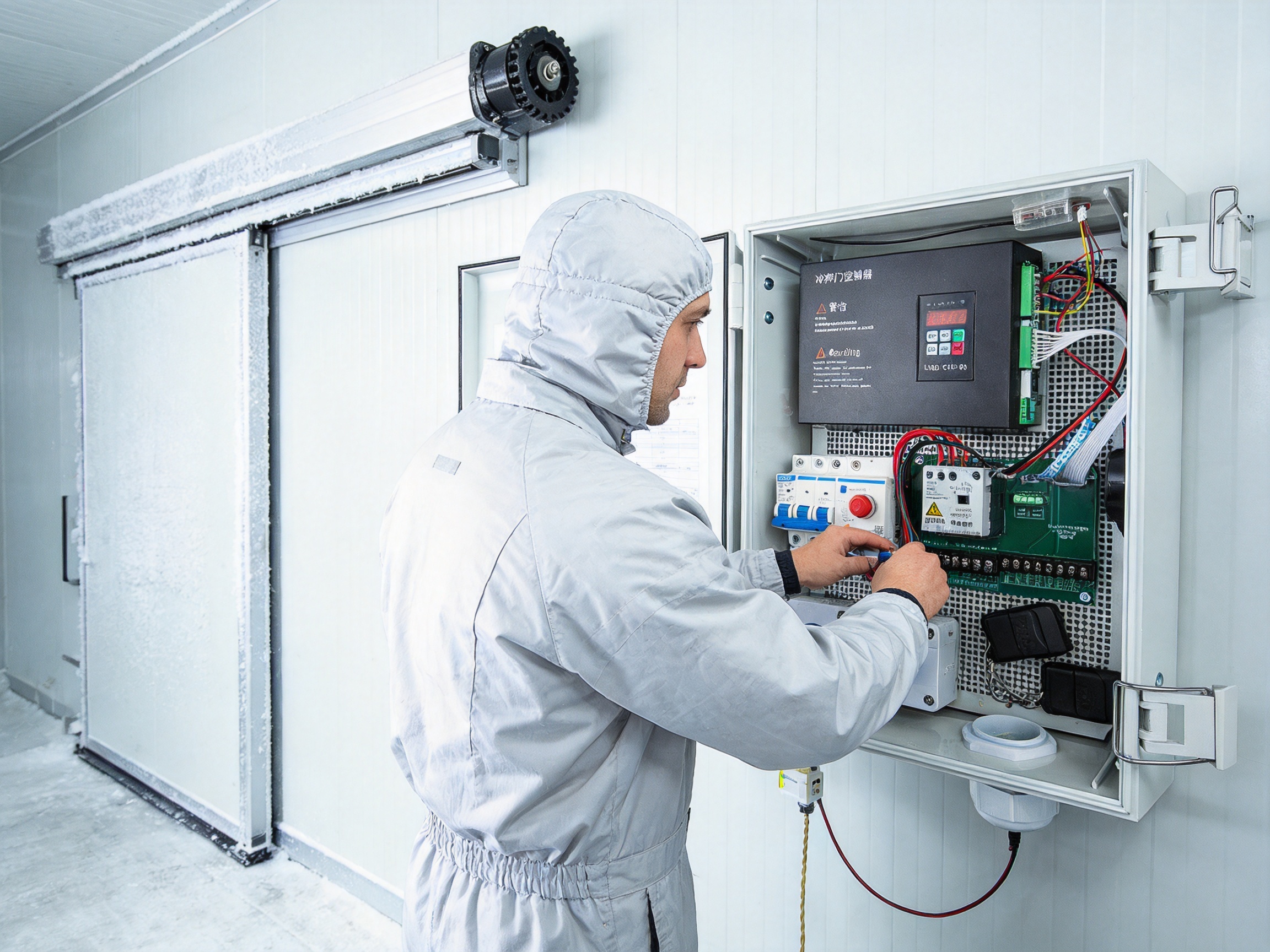
Manufacturing Strengths Behind the Product
The product is supported by the manufacturing and engineering capabilities of ASY Electronics (JiaXing) Co., Ltd., a high-tech enterprise focused on smart factory infrastructure, data sensing, intelligent connectivity, and industrial hardware solutions. The company’s broader product portfolio includes broadband power line carriers, wireless temperature monitoring systems, transmitters, flow meters, and automatic door controllers. This background gives the company a strong foundation in industrial electronics, sensor integration, communication technology, and control systems.
Advanced manufacturing strength is important for a product like a cold storage door controller because reliability depends on both design and production quality. Industrial controllers require stable circuit assembly, accurate component selection, thermal consideration, protective enclosure planning, consistent wiring interfaces, and functional testing. A strong manufacturing process helps ensure that each controller performs predictably in demanding environments.
The company’s focus on edge-layer hardware and industrial data integration is especially relevant. Modern facilities increasingly expect equipment to be connected, monitored, and adaptable. The RS485 interface in the controller aligns with this trend. It allows the door controller to become part of a larger industrial data system rather than remaining an isolated electromechanical device.
Manufacturing capability also influences product consistency. Controllers used in cold storage facilities may be installed across multiple doors in the same warehouse or across many facilities. Operators need consistent setup behavior, consistent terminal layout, and consistent response to inputs. Standardized production, inspection, and quality-control processes help deliver this repeatability.
Engineering Philosophy: Control, Connectivity, and Reliability
The controller reflects an engineering philosophy based on control, connectivity, and reliability. Control means that door movement is not left to crude power switching. Instead, users can adjust speed gears, starting current, and tightening torque. Connectivity means that external devices and network systems can communicate with the controller through physical input terminals, relay outputs, remote-control modules, and RS485. Reliability means that the product is designed for cold storage conditions and supports the accessories needed to keep the door functioning despite frost and humidity.
This philosophy is closely aligned with smart factory development. A smart facility does not only collect data from production machines; it also manages infrastructure equipment such as doors, environmental systems, energy equipment, and safety devices. Cold storage doors are part of this infrastructure. If they fail, energy performance, safety, and logistics efficiency can all suffer. A network-ready door controller therefore supports a more complete digital factory architecture.
By applying experience from industrial connectivity and sensing products, the manufacturer can design door controllers that are easier to integrate into broader systems. This is a meaningful distinction from suppliers that focus only on simple door automation without considering industrial data and energy management needs.
Advanced Production and Quality Considerations
For industrial control products, manufacturing quality must address electrical safety, signal stability, component durability, and assembly consistency. A controller for cold storage doors may need to operate through thousands of cycles while exposed to voltage variation, motor loads, inductive switching, humidity, and maintenance handling. Therefore, product reliability depends on careful production practices.
Advanced manufacturing processes for this category typically include controlled electronic assembly, inspection of soldering quality, verification of terminal layout, parameter testing, functional simulation, power-on testing, relay-output confirmation, communication-interface testing, and protection checks. For a controller with many I/O functions, each input and output must be verified to prevent field failures. A miswired or untested terminal can create major problems during installation.
Quality-oriented production also includes traceability and documentation. When products are deployed in industrial environments, operators and installers need reliable manuals, parameter instructions, and service procedures. Voice-guided commissioning further supports this quality strategy because it reduces dependency on subjective interpretation during installation.
The manufacturer’s broader experience with industrial IoT communication solutions and edge-layer hardware supports the development of reliable electronics. Products such as power line communication devices, wireless temperature monitoring sensors, industrial transmitters, thermal gas mass flow meters, and door controllers share a common need for stable signal processing and robust field operation. This cross-category expertise strengthens the company’s ability to produce dependable control systems.
Installation and Commissioning Workflow
A typical installation begins with mechanical preparation of the cold storage sliding door, including track alignment, door-panel movement verification, motor mounting, and connection of the gear motor. The controller is usually installed within the refrigerator door control box, where power supply, motor wiring, input devices, outputs, and communication lines can be organized. Proper grounding, cable routing, and protection against moisture are essential.
After wiring, commissioning can begin. The controller’s voice-guided debugging process assists the technician through self-testing and door-width measurement. During this process, the system learns the movement characteristics required to control the door accurately. The technician can then adjust speed gears, starting current, and tightening torque based on the door’s behavior. If the door is very heavy, a lower speed or adjusted starting current may be selected. If the door seal requires firm compression at closure, tightening torque can be tuned.
External devices are then tested. Pull-cords should command operation correctly. Radar devices should trigger opening as intended. Emergency stop should immediately stop movement. Anti-pinch sensors should respond reliably. Door lock signals should prevent unsafe operation. Air curtain and heating outputs should be verified according to the project design. If relays are programmed for alarms or position signals, their responses should be checked using the receiving devices.
Finally, remote controls can be paired if wireless operation is required. If the system is connected through RS485, communication settings and network response should be confirmed. A complete commissioning process should include repeated opening and closing cycles to verify smooth movement, correct stopping positions, accessory coordination, and safety input response.
Maintenance and Long-Term Operation
Long-term door performance depends on both controller reliability and mechanical maintenance. The controller provides the intelligence to manage motion, but the door track, seals, rollers, motor coupling, heating elements, and sensors must also remain in good condition. Regular inspection should include checking for ice buildup, verifying heating wire operation, confirming air curtain function, testing anti-pinch devices, and observing door movement for unusual vibration or noise.
Because the controller allows parameter adjustment, maintenance personnel can fine-tune operation if the door characteristics change over time. For example, if the door begins to move with more resistance due to mechanical wear or seal replacement, speed or starting parameters may be adjusted after mechanical issues are corrected. If end-position compression changes, tightening torque can be reviewed. This adaptability extends the practical service life of the system.
Networked monitoring through RS485 can further support maintenance. If integrated with a facility system, door status and abnormal events may be observed more easily. Operators can identify doors that are frequently open, doors that generate alarms, or doors that do not reach closed position reliably. Such information helps move maintenance from reactive repair toward planned intervention.
Application Scenarios
The primary application is cold storage facilities with heavy sliding doors. These include frozen food warehouses, refrigerated logistics hubs, meat-processing facilities, seafood storage rooms, dairy warehouses, pharmaceutical cold rooms, agricultural product storage, and industrial cold chain distribution centers. In each case, the door must preserve internal temperature while allowing frequent traffic.
The controller is also suitable for environments where humidity is high and temperature changes are frequent. Loading docks, pre-cooling rooms, blast-freezing areas, and intermediate refrigerated corridors often create difficult conditions for door systems. The heating wire and air curtain outputs are highly relevant in these zones because frost prevention and airflow management directly influence reliability and energy use.
Facilities with automation goals can benefit from RS485 communication and programmable relay outputs. For example, a central monitoring station may need to know whether a door is fully closed. A warehouse management system may coordinate door opening with vehicle movement. A safety system may require alarm indication if a door fails to close. The controller provides integration points for these requirements.
Economic Value for Facility Operators
The economic value of a cold storage door controller is measured not only by purchase price but by operational impact. A low-cost controller that causes door faults, poor sealing, difficult commissioning, or limited accessory integration may create higher lifetime costs. The AIG-750L-03 supports lower operational risk through reliable motion control, anti-freeze support, air curtain coordination, safety input compatibility, and network readiness.
Energy savings can be significant in cold storage operations. When doors close reliably and coordinate with air curtains, less warm air enters the refrigerated space. When heating wires prevent freezing, doors are less likely to remain partly open because of ice obstruction. When commissioning is accurate, the door reaches its intended positions without excessive impact or repeated cycles. These details contribute to stable thermal performance.
Reduced downtime is another economic benefit. Door failure can block logistics traffic and expose stored goods to temperature rise. A controller with strong diagnostics, flexible inputs, and guided commissioning can reduce troubleshooting time. Programmable relays can also signal alarms or status conditions to operators, allowing faster response to problems.
Comparison with Competitor Approaches
Many competing controllers fall into one of three categories. The first category includes basic relay-based controllers. These may be inexpensive, but they provide limited motion control, weak parameterization, and little support for advanced safety or energy accessories. The second category includes general automatic door controllers designed for commercial environments. These may offer smoother motion but may not be optimized for cold storage needs such as heating wire control, high-torque gear motor operation, and harsh environmental use. The third category includes complex automation systems that can be powerful but expensive and difficult to commission.
The AIG-750L-03 occupies a practical middle ground with industrial specialization. It provides the functions needed for cold storage doors without requiring unnecessary complexity. It supports high-torque gear motor control, heater and air curtain outputs, multiple safety and command inputs, programmable relays, remote control, voice-guided commissioning, and RS485 communication. This combination makes it more complete than basic controllers and more application-focused than generic automation platforms.
The product’s commissioning advantage is particularly important. In real projects, ease of setup can determine whether a technically capable product delivers good field results. Voice guidance helps reduce mistakes and supports repeatable commissioning. This is a differentiator that improves both installer experience and end-user satisfaction.
Role in Smart Cold Chain Infrastructure
Cold chain infrastructure is becoming increasingly digital. Temperature sensors, energy meters, compressors, fans, doors, security systems, and logistics equipment are being connected to improve visibility and efficiency. Door controllers are often overlooked, but they are important data points because door activity directly affects temperature stability and energy consumption.
A network-ready controller can provide valuable status information. Knowing whether doors are open or closed, whether alarms occur, and how door operation relates to temperature changes can help managers improve facility performance. RS485 communication provides a practical industrial communication channel for such integration.
The manufacturer’s experience in industrial IoT communication solutions, smart grid applications, power line carrier technology, sensing, and transmitters supports this broader vision. A door controller is not an isolated product; it can become one component in a smart factory or smart warehouse ecosystem. This perspective gives the product long-term relevance as facilities move toward data-driven operations.
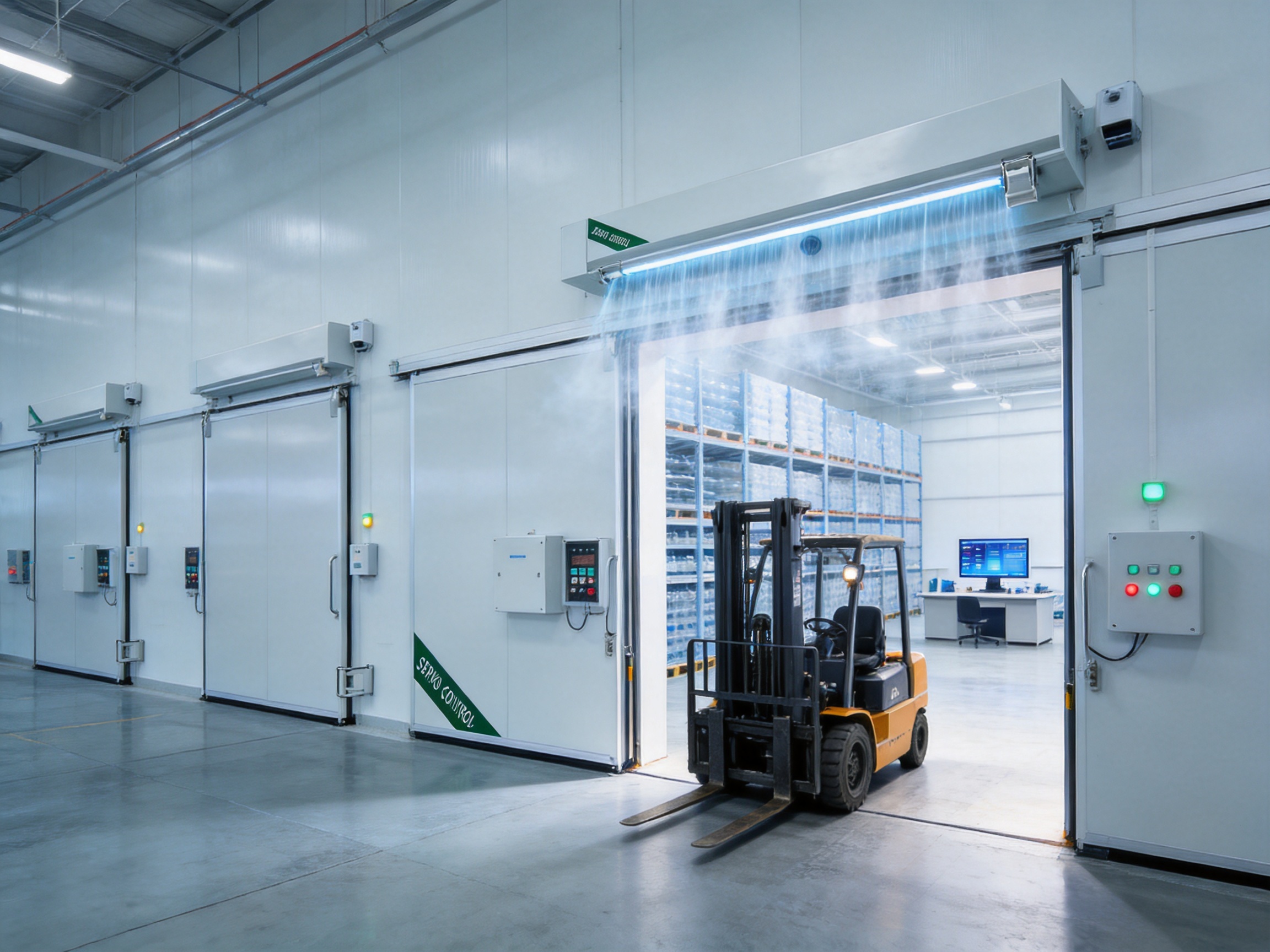
Practical Design Recommendations
To achieve the best performance from the controller, project designers should consider the door system as a whole. The motor torque must match door weight and resistance. The track and rollers must be properly aligned. The seals must be installed correctly. Heating wires should be placed where freezing risk is highest. Air curtains should be selected and positioned according to opening size and airflow conditions. Safety sensors should be installed where they can detect relevant hazards.
Electrical design should include suitable protection, grounding, cable management, and separation between power and signal wiring where appropriate. Because the controller supports many external devices, clear terminal labeling and documentation help prevent installation mistakes. If RS485 communication is used, network topology and communication parameters should be planned in advance.
During commissioning, technicians should not only complete the self-test but also observe actual door behavior under normal traffic conditions. A door may behave differently when pressure differences exist between rooms or when the environment is colder. Final parameter tuning should reflect real operating conditions.
Q&A Section
What is the main purpose of the AIG-750L-03 controller?
The main purpose is to control gear-motor-driven cold storage sliding doors with reliable torque, smooth movement, flexible safety integration, and support for heating wires and air curtains. It is designed for heavy insulated doors used in refrigerated and frozen environments.
What type of motor is compatible with the system?
The controller is compatible with the MT01-JS-45N, also known as DLG-56S-45. This is a three-phase permanent magnet gear motor with a rated torque of 45 N.m and a reduction ratio of 1:6.45, making it suitable for demanding sliding door applications.
Why is heating wire output important for cold storage doors?
Heating wire output helps prevent freezing around seals, tracks, and contact areas. In cold storage environments, frost or ice can stop the door from moving or sealing correctly. Integrated heating support improves reliability and helps maintain thermal performance.
How does the controller support energy efficiency?
It supports energy efficiency by enabling controlled door movement, reliable closing, air curtain coordination, and heating-wire management. These functions help reduce warm air infiltration, prevent incomplete closure, and maintain more stable cold-room temperatures.
What is the benefit of voice-guided commissioning?
Voice-guided commissioning provides prompts and countdowns during self-testing and door-width measurement. This helps technicians complete setup more accurately and efficiently, reducing the risk of incorrect adjustment and shortening installation time.
Can the controller be used in networked systems?
Yes. The controller includes an RS485 interface that enables networked control and monitoring. This makes it suitable for smart warehouses, digital cold chain facilities, and centralized maintenance systems.
What external inputs can the controller support?
It supports a wide range of input signals, including open, close, stop, anti-pinch, fire protection, door lock, radar, pull-cord, emergency stop, and related control signals. This flexibility helps adapt the controller to different project requirements.
How does it compare with basic automatic door controllers?
Basic controllers often provide limited movement control and few accessory outputs. The AIG-750L-03 offers cold-storage-specific functions such as heating wire output, air curtain support, high-torque gear motor control, voice-guided commissioning, programmable relays, and RS485 communication.
Is remote operation supported?
Yes. The system includes a remote control receiver module with simple code pairing and clearing procedures. This supports convenient wireless operation in warehouses where workers or forklift operators need flexible door control.
What environments is the system designed for?
It is designed for cold storage facilities and harsh industrial environments. The compatible motor is rated for ambient temperatures from -25°C to +50°C and relative humidity up to 95%, making it suitable for refrigerated and humid operating conditions.
Conclusion
The Gear Motor Controller for Cold Storage Sliding Doors is a specialized industrial control solution for facilities that require reliable door operation under low-temperature and high-humidity conditions. With 0.75 kW rated power, 220 V operation, support for high-voltage servo geared motor control, compatibility with a 45 N.m permanent magnet gear motor, heating wire output, air curtain output, broad I/O support, programmable relays, remote management, voice-guided commissioning, and RS485 communication, the AIG-750L-03 offers a complete platform for demanding cold storage door applications.
Its advantages over conventional controllers are clear. It is more application-specific, easier to commission, more flexible in parameter adjustment, better equipped for anti-freezing and thermal-management needs, and more suitable for smart facility integration. It supports not only movement but also safety, energy efficiency, maintenance, and operational convenience.
Behind the product is a company with strengths in industrial electronics, smart factory solutions, sensing, connectivity, and edge-layer hardware. This manufacturing and engineering foundation supports reliable production, practical integration, and long-term product relevance. For cold storage operators seeking dependable sliding door control, the AIG-750L-03 represents a strong balance of torque performance, intelligent control, environmental resilience, and system-level functionality.
References
1. Industrial Door Control Engineering Handbook, cold storage door motion control and safety integration chapters.
2. Refrigerated Warehouse Design Guide, thermal barrier management and door energy-loss analysis sections.
3. Electric Motor Applications in Industrial Automation, permanent magnet motor and gear reduction principles.
4. Cold Chain Facility Maintenance Manual, frost prevention, door seal inspection, and air curtain operation guidelines.
5. Industrial Communication Systems Reference, RS485 network design and field-device integration principles.
6. Automatic Door Safety and Commissioning Practices, input-device configuration and emergency-stop design recommendations.