

Industrial communication is no longer a supporting accessory in modern production sites; it is a core component of safety, coordination, and operational continuity. In workshops, tunnels, logistics corridors, power distribution rooms, mines, ports, chemical auxiliary areas, and heavy manufacturing facilities, personnel need a communication device that can be heard clearly, can remain stable in harsh environments, and can operate without complex network engineering. The CS618L-FS24 DC Waterproof Digital Telephone is designed for these demanding conditions. It combines multi-party intercom, broadcast, and alarm functions in one rugged industrial terminal, using wideband power line carrier communication over a two-core cable that carries both power and signal.
This article introduces the product’s technical value, competitive advantages, application scenarios, and the manufacturing strengths behind it. It also explains why a waterproof digital telephone based on power line communication can simplify industrial deployment while improving reliability, maintainability, and long-term cost efficiency.
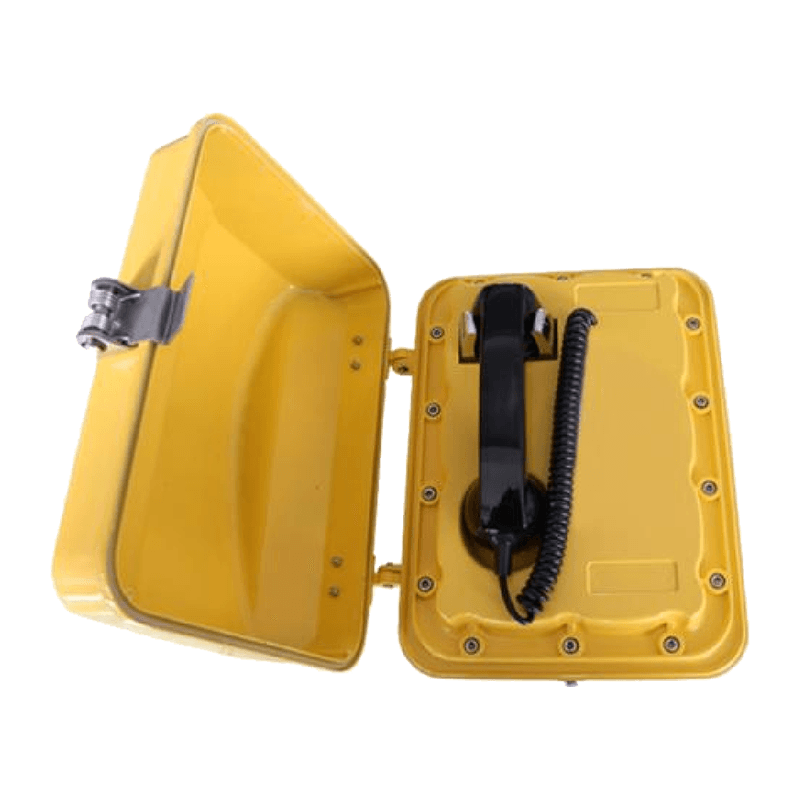
CS618L-FS24 DC Waterproof Digital Telephone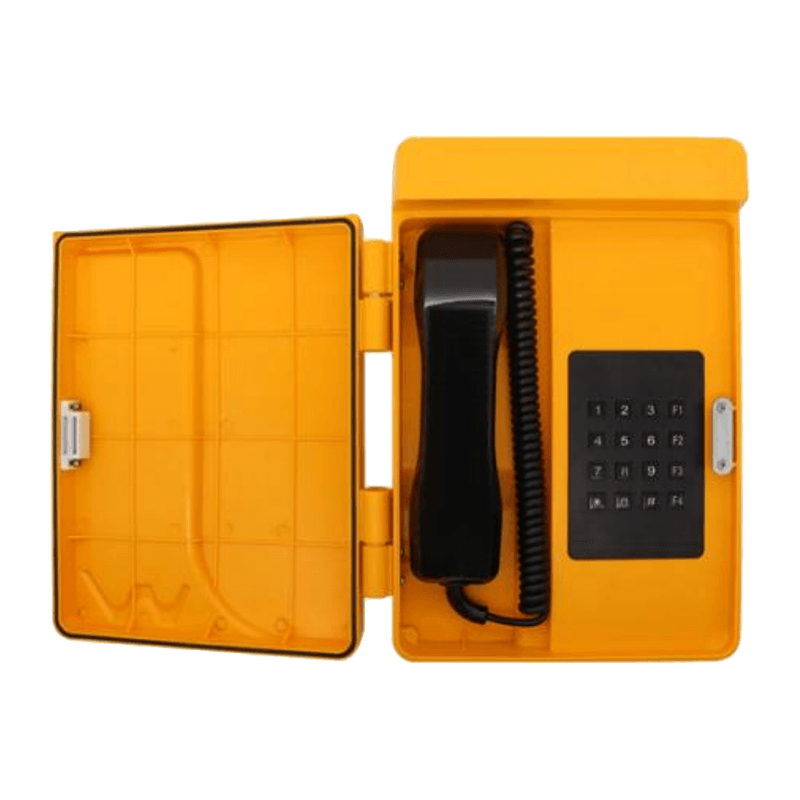
Product Overview
The CS618L-FS24 is a DC 24V waterproof digital telephone designed for industrial environments that are wet, dusty, or exposed to wide temperature variations, but that do not specifically require explosion-proof certification. It is housed in ABS engineering plastic, has an IP66 waterproof protection rating, and supports operation from -40°C to 85°C. These characteristics make it suitable for factories, utility corridors, outdoor equipment areas, energy stations, production lines, transportation facilities, and other demanding industrial locations.
The device integrates intercom, broadcast, and alarm functions. Instead of relying on a traditional network server or separate communication cable, it uses wideband power carrier communication, allowing power and signal to be transmitted through the same two-core cable. This design supports automatic IP allocation and self-organizing networking. In practical terms, this means the system can be installed and expanded more easily than conventional networked intercom solutions that require Ethernet infrastructure, switches, manual IP configuration, and extensive commissioning.
The telephone is designed to be plug and play. Once connected to the appropriate DC 24V line, it can join the system and communicate with other compatible units. The communication distance can reach up to 1000 meters under suitable conditions, providing coverage for long production lines, building-to-building corridors, industrial yards, and distributed process areas.
With standby power consumption of 5W and full-load power consumption of 25W, the device balances performance and energy efficiency. Its speaker output supports clear broadcast capability, and the wall-mounted form factor provides practical installation in industrial spaces where floor equipment may be unsuitable.
Key Product Positioning
The CS618L-FS24 is positioned as an industrial communication terminal for sites that need reliable voice communication, broadcast notification, and alarm linkage without complex wiring. Many industrial users face similar communication challenges: conventional telephones may not survive humid or dusty environments, wireless systems may suffer from interference or coverage blind spots, and Ethernet-based intercoms may require costly network infrastructure. This product addresses these pain points with a robust waterproof enclosure, integrated power and signal transmission, and self-organizing network capability.
Its category is PLC digital telephone, where PLC refers to power line communication. Unlike standard IP phones that need data cables and switches, a power line communication telephone can use the power line as the communication medium. This greatly reduces installation complexity in industrial environments where cable trays are crowded, cable routing is expensive, or network maintenance resources are limited.
The product is particularly valuable in industrial areas where communication terminals must be placed far apart. A talking distance of up to 1000 meters allows long-span communication over plant infrastructure. For example, it can connect multiple stations along a conveyor system, utility tunnel, warehouse zone, crane operation area, water treatment line, or energy management room.
Technical Specification Table
Parameter |
Specification |
Product model |
CS618L-FS24 |
Product type |
DC waterproof digital telephone |
Supply voltage |
DC 24V |
Signal line voltage |
DC 24V |
Communication method |
Wideband power carrier communication |
Networking mode |
Automatic IP assignment and self-organizing network |
Protection grade |
IP66 waterproof |
Enclosure material |
ABS engineering plastic |
Internal speaker |
8Ω 5W |
Broadcast speaker output |
8Ω 25W |
Power consumption |
Standby 5W; full load 25W |
Working temperature |
-40°C to 85°C |
Relative humidity |
10% to 95%, non-condensing |
Barometric pressure |
80 to 110 KPa |
Corrosion resistance grade |
WF1 |
Dimensions |
322 × 260 × 142 mm |
Weight |
6 kg |
Installation method |
Wall-mounted installation |
All-in-One Intercom, Broadcast, and Alarm Capability
One of the major advantages of the CS618L-FS24 is its all-in-one functional design. In many industrial facilities, communication, public address, and emergency alarm systems are separated into different products. A site may install telephones for point-to-point calls, speakers for broadcast announcements, and alarm buttons or sirens for emergency signaling. While this approach can work, it increases equipment count, wiring complexity, maintenance effort, and the risk of system incompatibility.
By combining multi-party intercom, broadcast, and alarm functions, the CS618L-FS24 helps industrial users build a more unified communication platform. Workers can use the device for routine coordination, supervisors can broadcast instructions, and emergency information can be distributed rapidly when abnormal conditions occur. This integration is especially important in noisy or distributed environments where mobile phones may be unreliable, handheld radios may not cover all areas, and visual signals may be insufficient.
Multi-party intercom capability supports collaborative communication among several stations. This is useful when maintenance teams, control rooms, and field operators need to coordinate in real time. Broadcast capability allows announcements to reach multiple locations simultaneously. Alarm capability supports fast notification in urgent situations, helping personnel respond quickly and reducing confusion during equipment failure, environmental incidents, or evacuation procedures.
Power and Signal on the Same Two-Core Cable
A defining feature of this waterproof digital telephone is the integrated power and signal design. The product uses a DC 24V system in which both power and communication signal are transmitted through the same two-core cable. This approach offers important advantages over conventional communication systems.
First, it reduces cable quantity. Traditional systems may require separate power wiring and signal wiring, or even multiple cables for Ethernet, power, speaker output, and control lines. In industrial sites, every additional cable increases material cost, labor cost, installation time, and failure points. By using the same two-core cable for power and signal, the CS618L-FS24 simplifies installation and makes the overall system cleaner and easier to maintain.
Second, it reduces dependence on network infrastructure. Ethernet-based intercom systems usually need switches, routers, IP configuration, network segmentation, and protection against electromagnetic interference. In contrast, the CS618L-FS24 can self-organize through power line carrier communication, reducing the need for specialized network commissioning. This is valuable for industrial users who need quick deployment, rapid expansion, or retrofitting in existing facilities.
Third, it supports flexible layout. Because the device communicates over the same cable used for DC power, communication terminals can be deployed in distributed industrial zones without redesigning the whole network. For long corridors, process lines, or outdoor utility areas, this feature can shorten project delivery cycles and reduce downtime during installation.
Automatic IP Assignment and Self-Organizing Networking
Industrial communication projects often become complicated during commissioning. Manual IP configuration, address conflicts, switch compatibility issues, and network troubleshooting can delay project completion. The CS618L-FS24 addresses these problems through automatic IP allocation and self-organizing network capability.
Automatic IP assignment means the terminal can obtain network identity without manual configuration for each device. Self-organizing networking means that compatible devices can discover and connect with each other according to the system architecture. These features make the product more convenient for installers and maintenance teams. In many cases, users can add or replace terminals with less technical intervention than would be required for traditional IP communication systems.
This plug-and-play behavior is an advantage over many competing products that require detailed network planning. It reduces the skill threshold for installation personnel and lowers the likelihood of configuration errors. For industrial operators, this translates into faster deployment, easier maintenance, and better continuity when equipment must be replaced.
Self-organizing networking is also useful for phased projects. A factory may first install several communication terminals in a critical area, then expand coverage to additional workshops, warehouses, or outdoor zones. A system that supports automatic organization makes expansion more practical and cost-effective.
Waterproof IP66 Protection for Harsh Industrial Environments
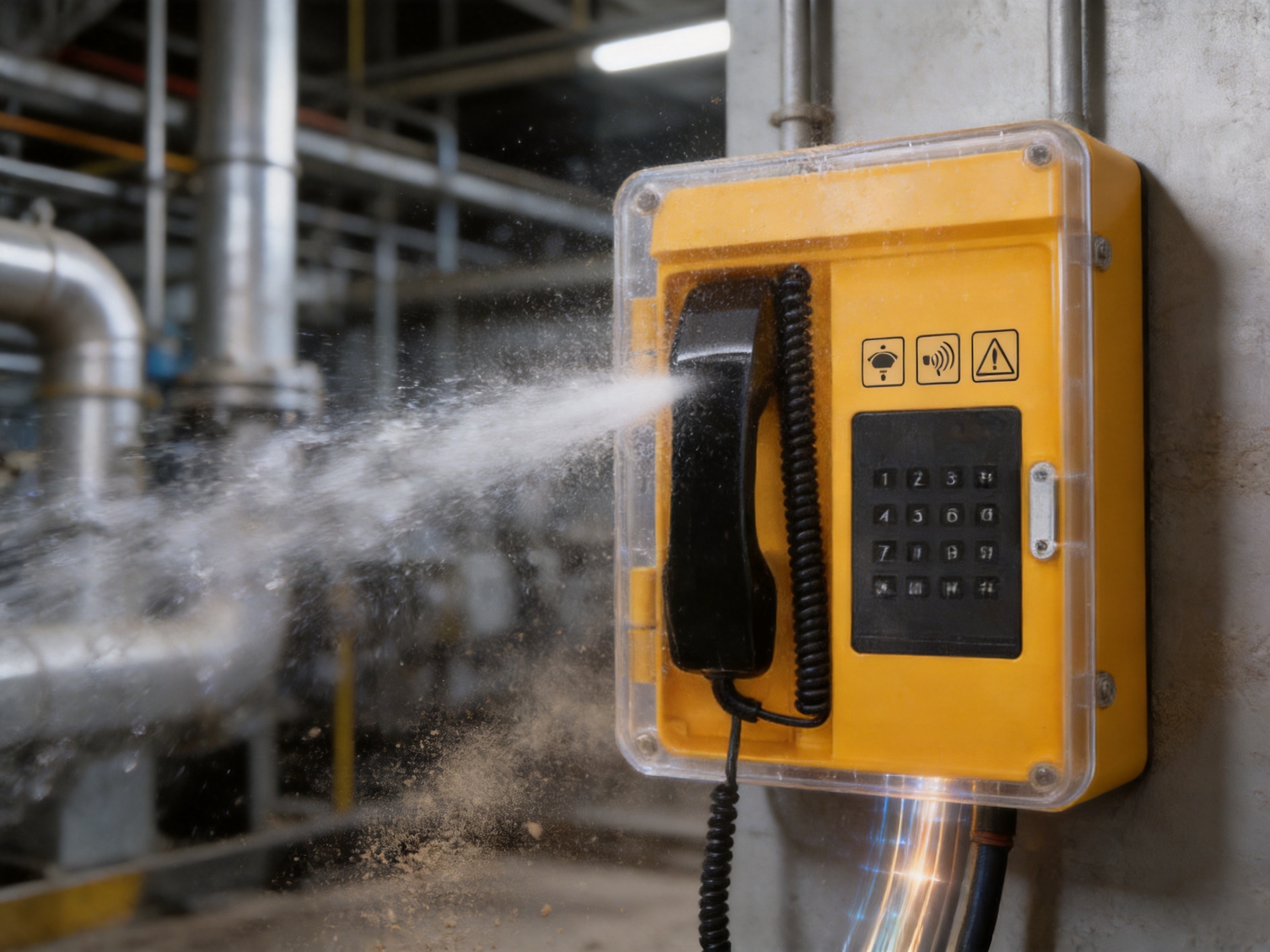
The CS618L-FS24 carries an IP66 waterproof protection rating. This is a significant feature for facilities where dust, water spray, humidity, and cleaning operations are common. Many commercial communication devices are not suitable for such environments because moisture can enter the enclosure, damage internal electronics, corrode contacts, or degrade audio performance.
IP66 protection indicates strong resistance against dust ingress and powerful water jets. In practical terms, the device can be installed in wet or dusty locations where ordinary telephones would be vulnerable. This includes food processing auxiliary areas, water treatment facilities, outdoor equipment platforms, tunnel sections, logistics loading areas, and production sites where washdown or airborne particles may occur.
The waterproof design supports long-term reliability. In industrial environments, device failure is not merely an inconvenience; it can interrupt safety communication and create operational risk. A communication terminal that remains functional under moisture and dust exposure helps maintain stable voice communication when it is most needed.
Compared with many competitor products using lighter-duty plastic housings or office-grade components, the CS618L-FS24 is specifically designed with industrial protection in mind. Its housing, sealing structure, and installation method are aligned with the needs of field deployment rather than clean office conditions.
ABS Engineering Plastic Housing
The enclosure is made from ABS engineering plastic. This material provides a practical balance of strength, insulation, weight control, corrosion resistance, and manufacturability. At approximately 6 kg, the device is lighter than many metal-housed industrial terminals while still providing a robust structure for wall mounting.
ABS engineering plastic is suitable for many industrial environments because it resists impact better than ordinary plastics, provides electrical insulation, and does not rust. In locations where corrosion is a concern but explosion-proof metal enclosures are not required, ABS can be an efficient and reliable choice. The WF1 corrosion resistance grade further supports use in environments with moderate corrosive exposure.
The lighter weight also benefits installation. A 6 kg wall-mounted terminal is easier to handle than a heavy cast-metal unit, reducing labor burden and simplifying mounting on walls, columns, equipment frames, or control stations. This can be particularly valuable when multiple communication points must be installed across a large facility.
Wide Temperature Range from -40°C to 85°C
The product is designed to operate from -40°C to 85°C, which reflects industrial-grade environmental tolerance. This wide temperature range allows the device to be used in cold outdoor facilities, unheated warehouses, high-temperature production areas, and equipment rooms subject to seasonal or process-related temperature changes.
Many standard communication devices are designed for commercial temperature ranges and may fail or become unstable outside controlled indoor environments. Low temperatures can affect LCDs, plastics, batteries, capacitors, and mechanical parts. High temperatures can accelerate aging of electronic components and cause system instability. By supporting a broad operating range, the CS618L-FS24 offers a stronger reliability margin.
This advantage is especially important for infrastructure projects and industrial users who require year-round operation. Communication equipment should not require special climate control in every installation location. A terminal that can tolerate extreme temperatures reduces the need for protective cabinets or heated enclosures, lowering project cost and simplifying maintenance.
Clear Voice and Strong Broadcast Output
Industrial communication must overcome noise. Machinery, fans, pumps, compressors, conveyors, vehicles, and ventilation systems can create high ambient sound levels. A communication terminal that is too quiet or unclear may fail in real emergencies. The CS618L-FS24 includes an internal 8Ω 5W speaker and supports 8Ω 25W broadcast output, enabling stronger audio performance for announcement and alert applications.
The broadcast function allows instructions or alarm messages to be delivered to personnel in surrounding areas. This is important in workshops where workers may not be standing directly beside the terminal. A stronger speaker output improves audibility and supports the product’s role as a combined intercom and public address unit.
Clear voice communication can also reduce operational mistakes. In industrial maintenance, a misheard instruction can lead to delays, incorrect operation, or safety risk. A reliable voice terminal supports accurate coordination between field personnel and control teams.
Plug-and-Play Deployment
The phrase plug and play is especially meaningful in industrial projects. Installation windows may be short, production downtime may be expensive, and site personnel may not have specialized network engineering skills. The CS618L-FS24 is designed to reduce commissioning requirements through automatic networking and integrated power-signal wiring.
Compared with systems that require separate data networks, manual addressing, central servers, and extensive debugging, this product provides a simpler path to deployment. The result is faster project completion and lower total installation cost. This can be a decisive advantage for factories that need to upgrade communication quickly without interrupting production.
Plug-and-play capability also benefits maintenance. If a terminal needs to be replaced, the process can be more straightforward. A replacement unit can be connected to the existing line and integrated into the system with minimal configuration. This reduces downtime and makes spare-part management easier.
Communication Distance up to 1000 Meters
The product supports a talking distance of up to 1000 meters under suitable conditions. This makes it well suited for long industrial spaces and distributed facilities. Many factories and infrastructure sites are not compact. Communication points may be separated by hundreds of meters along corridors, pipelines, conveyors, docks, or energy distribution routes.
Wireless systems may appear convenient, but they can be affected by metal structures, electromagnetic interference, walls, tunnels, and equipment movement. Ethernet systems may need repeaters, switches, or fiber conversion for longer distances. The CS618L-FS24 provides an alternative by using power line carrier communication over a two-core cable, enabling long-distance voice communication with simplified wiring.
This distance capability can reduce the need for intermediate network equipment. Fewer intermediate devices mean fewer points of failure and lower maintenance requirements. For industrial users, the value is not only the distance itself, but also the ability to maintain stable communication with a simpler architecture.
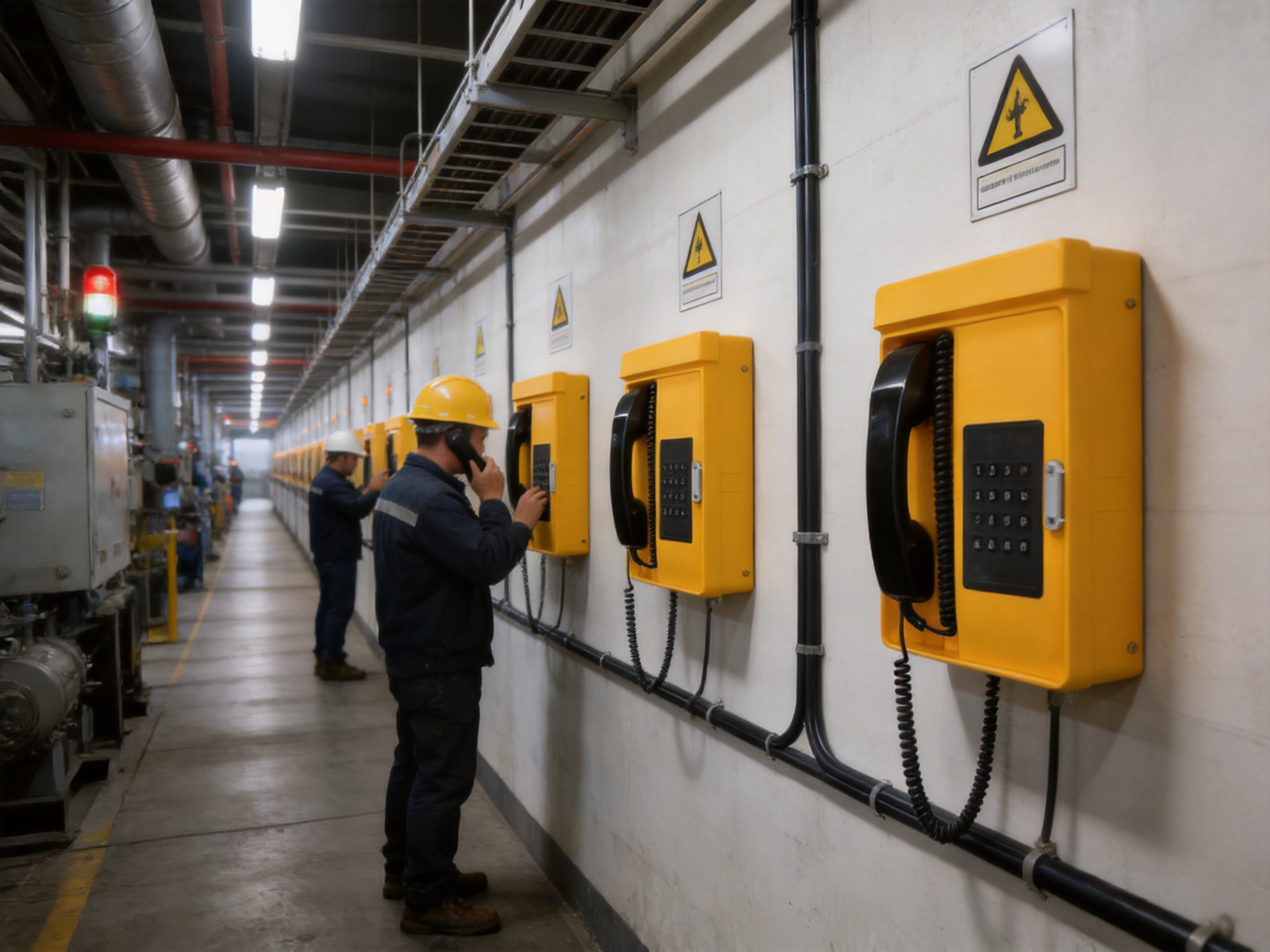
Advantages over Conventional Industrial Telephones
Conventional industrial telephones often depend on analog lines, Ethernet networks, or dedicated communication cables. Each method has limitations. Analog systems may have limited expandability and fewer integrated functions. Ethernet systems can provide flexibility but require network infrastructure and skilled configuration. Wireless systems reduce wiring but may face interference and coverage limitations.
The CS618L-FS24 offers a competitive combination of features: waterproof IP66 protection, DC 24V operation, two-core power-signal integration, automatic IP assignment, self-organizing networking, multi-party intercom, broadcast, alarm functionality, and long-distance communication. This combination reduces the need to choose between ruggedness, functionality, and installation convenience.
Compared with ordinary waterproof telephones, the product’s digital PLC-based networking improves deployment flexibility. Compared with server-based IP intercoms, it reduces dependence on centralized network equipment. Compared with wireless communication terminals, it offers a wired communication path that is less vulnerable to radio interference and signal shadowing. Compared with separate broadcast and alarm systems, it reduces device count and simplifies management.
The result is a practical industrial terminal designed around real site conditions rather than theoretical laboratory convenience.
Advantages over Wireless Communication Systems
Wireless communication is useful in many applications, but it is not always the best choice for industrial voice communication. Metal structures, reinforced concrete, high-voltage equipment, rotating machinery, and electromagnetic noise can all reduce wireless stability. In tunnels, basements, large workshops, and enclosed process areas, wireless signal coverage may be uneven. Wireless systems may also require frequency planning, repeaters, battery management, or radio licenses depending on the technology and region.
The CS618L-FS24 avoids many of these issues by using wired power line communication. Once the cable path is installed, the communication link is more predictable. There is no reliance on battery charging, radio signal propagation, or access point coverage. This is especially valuable for safety-related communication, where reliability is more important than mobility.
In addition, wired terminals provide fixed communication points. During emergencies, personnel know where to find them. Fixed stations are also easier to identify in operation procedures and safety plans. The CS618L-FS24 can become part of the facility’s communication map, supporting disciplined and repeatable emergency response.
Advantages over Standard IP Intercom Systems
Standard IP intercom systems are powerful but often require Ethernet cabling, switches, power supplies, network configuration, and sometimes servers. In new buildings with structured cabling, this may be acceptable. In existing industrial facilities, however, adding Ethernet to every communication point can be expensive and disruptive. Cable trays may be crowded, long distances may exceed standard Ethernet limits, and network security policies may complicate connection.
The CS618L-FS24 uses wideband power carrier communication and automatic network organization. It does not depend on a conventional Ethernet switch at every communication segment. This can reduce hardware cost, installation labor, and commissioning complexity. For retrofits, this is a strong advantage.
Another benefit is system independence. Industrial communication systems sometimes need to remain available even when office networks or production data networks are under maintenance. A dedicated PLC-based communication architecture can provide separation from general IT infrastructure, improving operational resilience.
Advantages over Separate Public Address and Telephone Systems
When telephone and broadcast systems are separate, operators must maintain two platforms. Fault diagnosis becomes more complex, spare parts are multiplied, and personnel training must cover different procedures. During emergencies, switching between systems may delay response.
The CS618L-FS24 integrates intercom, broadcast, and alarm functions. This integration simplifies communication workflows. A single terminal can support routine conversation, group announcement, and alarm notification. For facilities seeking leaner infrastructure and simpler operation, this is a major benefit.
Integration also improves consistency. Personnel become familiar with one interface and one communication procedure. Maintenance teams inspect and service fewer types of equipment. Project managers purchase and deploy a unified product family rather than coordinating multiple suppliers or technologies.
Application Scenarios
The CS618L-FS24 is suitable for many industrial environments. In manufacturing plants, it can be installed along production lines, maintenance zones, equipment rooms, and control stations. Operators can coordinate production adjustments, request technical support, or broadcast urgent notices.
In energy and utility facilities, it can support communication in power distribution rooms, pumping stations, water treatment plants, heating systems, and renewable energy auxiliary areas. The DC 24V architecture and power line communication method align well with industrial control environments.
In logistics and warehousing facilities, terminals can be installed in loading docks, conveyor zones, sorting areas, and security gates. Broadcast capability can support dispatching, safety reminders, and emergency announcements.
In transportation infrastructure, the product can support communication in tunnels, underground corridors, service areas, maintenance passages, and equipment rooms. The long communication distance and waterproof housing are useful where environmental conditions may be challenging.
In heavy industry, such as metallurgy, machinery manufacturing, shipyards, and large equipment assembly, the device can provide fixed communication points in noisy and dusty locations. Its rugged enclosure and strong broadcast output help maintain communication where ordinary devices may fail.
Value for Smart Factory Development
Smart factories rely on data sensing, intelligent connectivity, equipment monitoring, energy management, and production optimization. Voice communication remains an important part of this ecosystem. Even as industrial sites adopt sensors, edge computing, and automation platforms, human coordination is still required for maintenance, troubleshooting, safety response, and process decisions.
The CS618L-FS24 contributes to smart factory development by providing reliable field communication through an industrial connectivity method. Its self-organizing network reduces the burden of manual configuration. Its digital communication architecture can align with broader industrial communication strategies. Its broadcast and alarm functions support safer and more coordinated operations.
ASY Electronics develops products for industrial data sensing and intelligent connectivity, including broadband power line carriers, wireless temperature monitoring systems, transmitters, flow meters, and automatic door controllers. The CS618L-FS24 fits this broader technical direction by applying power line carrier technology to practical industrial voice communication.
Manufacturing Strength and Engineering Capability
A reliable industrial communication product depends not only on design specifications but also on manufacturing discipline. ASY Electronics operates as a high-tech enterprise focused on smart factory technologies and industrial connectivity. Its product portfolio demonstrates experience in communication, sensing, measurement, and control. This cross-disciplinary foundation is valuable because industrial products must satisfy electrical, mechanical, environmental, and usability requirements simultaneously.
The company’s strengths include self-developed edge-layer hardware, industrial data integration solutions, and practical experience serving manufacturing enterprises. This means the product is not designed in isolation. It is part of a larger understanding of how industrial equipment is installed, connected, monitored, and maintained.
Advanced manufacturing for a product such as the CS618L-FS24 involves multiple stages. Mechanical design must ensure sealing, strength, wall-mounting reliability, and component accessibility. Electronic design must support stable DC 24V power, signal modulation and communication, audio processing, and low power consumption. Production processes must control assembly consistency, wiring quality, enclosure fit, and final functional testing.
Quality management is especially important for waterproof industrial terminals. If sealing quality varies, the IP66 rating may be compromised. If electronic assembly quality is inconsistent, communication stability may suffer. If speaker or audio components are not properly tested, broadcast performance may be unreliable. A capable manufacturer must combine design verification, incoming material inspection, process control, and finished-product testing.
Material Selection and Structural Design
The use of ABS engineering plastic reflects a design decision based on application needs. For non-explosion-proof wet and dusty industrial environments, ABS offers corrosion resistance, electrical insulation, and manageable weight. The enclosure must protect internal electronics while remaining practical for wall installation.
Structural design must account for sealing surfaces, cable entry points, fasteners, internal layout, speaker placement, and serviceability. The product dimensions of 322 × 260 × 142 mm provide sufficient space for industrial-grade components while maintaining a compact footprint. A compact device is easier to install in narrow corridors, equipment rooms, and production areas where wall space may be limited.
Wall-mounted installation is another practical feature. Wall mounting keeps the terminal visible, accessible, and protected from ground-level damage. It also supports standardized installation height and consistent operation procedures.
Electrical and Communication Engineering
The product’s electrical architecture is based on DC 24V supply and signal line voltage. DC 24V is widely used in industrial control systems because it is safer than higher voltages, compatible with many control cabinets, and practical for distributed devices. By using the same voltage for power and signal line operation, the product simplifies integration.
Wideband power carrier communication requires careful engineering. The system must transmit communication signals over a power line while maintaining power delivery and resisting industrial noise. This involves signal coupling, filtering, modulation, interference suppression, and protocol control. Achieving reliable communication in real industrial environments is more challenging than laboratory communication because industrial power lines may contain noise, load changes, and electromagnetic disturbances.
The self-organizing network feature reflects both hardware and software engineering capability. Devices must identify, address, and communicate with each other automatically. This requires embedded system design, communication protocol development, and robust error handling.
Environmental Reliability
The product is designed for temperature, humidity, pressure, and corrosion conditions typical of industrial sites. Its rated relative humidity range of 10% to 95% non-condensing supports use in variable climates. Its barometric pressure range of 80 to 110 KPa covers common installation environments. Its WF1 corrosion resistance grade supports durability in moderate corrosive conditions.
Environmental reliability is not a single feature; it is the result of coordinated design. Enclosure materials, seals, circuit boards, connectors, speakers, and fastening elements must all withstand the expected environment. When a product is exposed to moisture, dust, heat, cold, and vibration over time, weak design points become failure points. A strong industrial manufacturer must evaluate these risks during development and production.
Lower Total Cost of Ownership
The purchase price of industrial communication equipment is only one part of cost. Total cost of ownership includes cables, installation labor, commissioning, network equipment, maintenance, spare parts, downtime, and future expansion. The CS618L-FS24 can reduce total cost of ownership in several ways.
Integrated power and signal transmission reduces cabling requirements. Automatic IP assignment and self-organizing networking reduce commissioning labor. The IP66 enclosure reduces failure risk in harsh environments. The all-in-one intercom, broadcast, and alarm design reduces the need for separate systems. Long communication distance reduces intermediate equipment requirements. Plug-and-play operation simplifies replacement and expansion.
These advantages can be more important than the initial unit cost. For an industrial user, a product that installs quickly, operates reliably, and requires less maintenance can deliver stronger lifecycle value than a cheaper product that needs more supporting infrastructure.
Operational Safety Benefits
Communication is a safety tool. In industrial operations, fast and accurate communication can prevent accidents, reduce response time, and coordinate emergency actions. The CS618L-FS24 supports safety in several ways.
First, fixed communication points ensure workers have known locations for requesting help or receiving instructions. Second, broadcast capability allows urgent messages to reach multiple areas. Third, alarm functionality supports rapid notification of abnormal events. Fourth, the waterproof and temperature-resistant design improves availability in harsh locations where safety communication is still required.
For example, if equipment fails on a long production line, operators can communicate with maintenance personnel without leaving the area. If a hazardous condition is detected, supervisors can broadcast instructions. If an emergency response is required, multiple terminals can help coordinate actions across the site.

Why This Product Is Different
The CS618L-FS24 is different because it combines practical industrial design with intelligent communication architecture. Many products offer one or two strong features, but fewer combine waterproof protection, PLC digital communication, automatic networking, multi-party intercom, broadcast, alarm, long-distance operation, and wide temperature tolerance in a single device.
Its competitor advantage is strongest in environments where wiring simplicity and ruggedness are both required. A standard IP intercom may offer digital communication but requires Ethernet infrastructure. A traditional industrial telephone may be rugged but less flexible. A wireless device may be easy to place but less predictable in harsh electromagnetic environments. A separate public address system may broadcast well but cannot provide the same integrated intercom workflow.
The CS618L-FS24 occupies a valuable middle ground: it is rugged enough for wet and dusty sites, digital enough for self-organizing communication, simple enough for plug-and-play installation, and functional enough to replace multiple separate communication devices.
Installation Considerations
For best results, installation should follow industrial wiring and mounting practices. The unit should be mounted on a stable wall or structural surface where personnel can access it easily. Cable routing should protect the two-core line from mechanical damage, excessive heat, and severe electromagnetic interference where possible. Although the product is designed for industrial environments, proper installation improves reliability and service life.
Installers should verify the DC 24V supply, line continuity, and cable quality. Because communication and power share the same two-core cable, cable selection and connection quality are important. Terminals should be positioned according to communication needs, ambient noise levels, and safety procedures.
After installation, functional checks should include intercom operation, broadcast output, alarm function, network connection, and audio clarity. Periodic inspection should verify enclosure integrity, cable entry sealing, mounting stability, and speaker performance.
Maintenance and Lifecycle Management
The product’s design reduces maintenance complexity, but regular inspection remains important. Industrial environments can expose devices to dust buildup, moisture, vibration, chemical vapors, and accidental impact. Maintenance teams should inspect the enclosure, clean the exterior when necessary, verify cable connections, and test communication performance at scheduled intervals.
Because the product supports plug-and-play behavior and self-organizing networking, replacement can be simplified. A spare unit can be installed with less configuration effort than many conventional IP devices. This supports better lifecycle management, especially in facilities where communication downtime must be minimized.
Documenting terminal locations and communication groups is also recommended. A clear communication map helps operators, maintenance teams, and safety personnel use the system effectively.
Role in Industrial Digital Transformation
Industrial digital transformation is often associated with sensors, automation platforms, cloud systems, and artificial intelligence. However, successful transformation also depends on reliable field-level connectivity. The CS618L-FS24 contributes at the edge of the industrial environment, where people, machines, and infrastructure interact.
By using power line carrier technology, the product demonstrates how existing or simplified wiring can support intelligent communication. This aligns with the broader trend of reducing installation barriers for smart factory upgrades. Facilities can modernize communication without rebuilding their entire network infrastructure.
ASY Electronics’ broader focus on smart factories, efficient energy management, equipment condition monitoring, and industrial data integration supports the product’s value. A manufacturer with experience in industrial connectivity can better understand the needs of real deployment: stable communication, environmental durability, simplified integration, and scalable architecture.
Procurement Value for Industrial Buyers
Industrial buyers evaluate communication products based on reliability, environmental suitability, installation cost, supplier capability, and long-term service. The CS618L-FS24 provides clear procurement value because it addresses multiple practical requirements in one product.
For project engineers, the two-core integrated power-signal design simplifies system planning. For maintenance managers, plug-and-play networking reduces troubleshooting burden. For safety managers, broadcast and alarm functions improve emergency communication. For procurement teams, the all-in-one design can reduce the need to source multiple separate systems. For plant managers, long-term reliability supports operational continuity.
The product is also well suited for custom industrial communication projects. Because ASY Electronics has capabilities in power line carrier solutions and industrial IoT communication, it can support broader system design needs beyond a single device. This is important for buyers who require not only products but also practical communication solutions.
Q&A Section
What is the CS618L-FS24 designed for?
It is designed for industrial voice communication in wet, dusty, and harsh environments that do not require explosion-proof certification. It supports intercom, broadcast, and alarm functions in one waterproof terminal.
How does the device communicate?
It uses wideband power line carrier communication. Power and signal are transmitted through the same two-core DC 24V cable, reducing wiring complexity and supporting simplified installation.
Does it require a network server?
No. The device supports automatic IP assignment and self-organizing networking, which reduces the need for a dedicated network server and extensive manual debugging.
What is the protection grade?
The product has an IP66 waterproof rating, making it suitable for wet and dusty industrial environments.
What is the working temperature range?
The working temperature range is -40°C to 85°C, allowing use in cold, hot, indoor, and outdoor industrial locations.
How far can communication reach?
The talking distance can reach up to 1000 meters under suitable conditions, making the product suitable for long production lines, tunnels, corridors, and distributed facilities.
What are the main advantages over ordinary industrial telephones?
The main advantages include integrated power and signal transmission, automatic networking, IP66 waterproof protection, multi-party intercom, broadcast and alarm integration, long communication distance, and wide temperature tolerance.
Why is power line communication useful in factories?
Power line communication reduces the need for separate communication cabling and network switches. It is especially useful in existing facilities where adding Ethernet or separate signal cables would be expensive or disruptive.
Is the enclosure metal?
No. The enclosure is made of ABS engineering plastic, which provides impact resistance, electrical insulation, corrosion resistance, and lower weight compared with many metal enclosures.
What type of installation does it support?
The product supports wall-mounted installation, making it practical for production lines, equipment rooms, corridors, and fixed industrial communication points.
Conclusion
The CS618L-FS24 DC Waterproof Digital Telephone is a practical and advanced industrial communication terminal built for environments where reliability, simplicity, and durability matter. Its IP66 waterproof ABS enclosure, DC 24V operation, wide temperature range, and WF1 corrosion resistance support stable use in wet, dusty, and demanding industrial conditions.
Its greatest competitive advantage lies in the combination of wideband power line carrier communication and integrated power-signal transmission over a two-core cable. This design reduces wiring, eliminates much of the complexity associated with conventional network infrastructure, and enables automatic IP assignment with self-organizing networking. The result is a plug-and-play industrial communication system that can be deployed quickly and maintained efficiently.
By integrating multi-party intercom, broadcast, and alarm functions, the product reduces equipment count and improves operational coordination. Its communication distance of up to 1000 meters makes it suitable for large, distributed, and long-span industrial facilities. Its strong broadcast output supports audible announcements in noisy environments.
Behind the product is the engineering and manufacturing capability of ASY Electronics, a high-tech enterprise focused on industrial connectivity, smart factory solutions, and edge-layer hardware development. The company’s experience in broadband power line carriers, wireless temperature monitoring, transmitters, flow meters, and industrial control products supports a strong foundation for reliable industrial communication equipment.
For industrial users seeking a rugged, easy-to-install, and multifunctional communication terminal, the CS618L-FS24 offers a strong balance of performance, simplicity, and lifecycle value. It is not merely a telephone; it is a field-ready communication node for safer, smarter, and more efficient industrial operations.
References
International Electrotechnical Commission. Degrees of Protection Provided by Enclosures, IEC 60529.
International Electrotechnical Commission. Industrial Communication Networks and System Reliability Guidelines.
Institute of Electrical and Electronics Engineers. Power Line Communication Principles and Industrial Applications.
Industrial Automation and Control Systems Engineering Handbook. Field Communication and Safety Communication Practices.
Materials Engineering Reference Manual. ABS Engineering Plastics: Properties and Industrial Applications.
Smart Manufacturing Systems Guide. Edge Connectivity, Industrial IoT, and Factory Digitalization.