

Modern machine tools require more than a motor that can move a door from one position to another. A machine door must open and close smoothly, respond predictably to commands, protect operators from pinch hazards, withstand repeated cycling, and communicate reliably with the wider production system. In many factories, the door is part of the machine’s safety chain and directly influences loading efficiency, operator convenience, equipment protection, and overall production availability.
The AIG-150S-02 is a compact DC brushless controller developed specifically for automated machine tool doors and specially customized industrial doors. It uses full closed-loop space vector PWM control to coordinate motor movement, positioning, acceleration, deceleration, and protection functions. The controller supports a 24 V DC brushless motor or servo motor, with a maximum output current of 7.5 A and maximum output power of 150 W.
Unlike a basic motor driver that simply applies power according to an external command, this controller combines motor control, door travel learning, configurable operating curves, digital adjustment, safety inputs, relay outputs, fault memory, and RS-485 communication in one integrated platform. This architecture helps reduce the need for separate control devices and gives machine builders a practical solution for improving the performance and maintainability of automated doors.
Developed by ASY Electronics (JiaXing) Co., Ltd., the AIG-150S-02 reflects the company’s wider focus on industrial sensing, intelligent connectivity, edge-layer hardware, and equipment automation. Its design is especially suitable for manufacturers seeking a compact, configurable, and serviceable door-control solution rather than a fixed-function actuator controller.
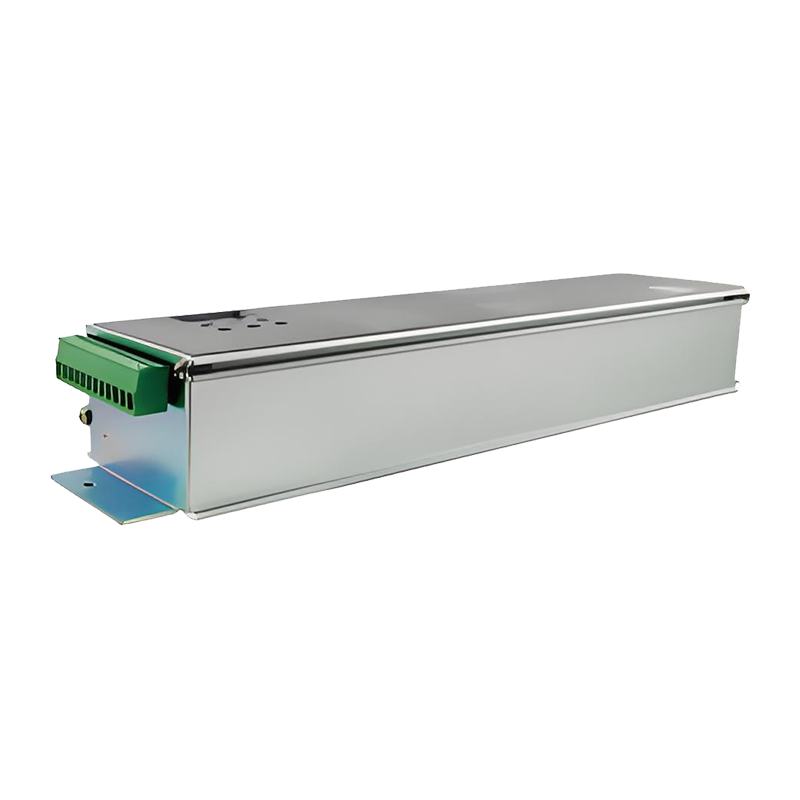
DC Brushless Controller for Machine Tool Doors
Why Machine Tool Door Control Requires a Dedicated Architecture
Machine tool doors operate in a demanding environment. They may be exposed to vibration, metal chips, cutting fluids, dust, rapid temperature changes, electromagnetic interference, and frequent start-stop cycles. At the same time, the door must remain coordinated with the machine’s operating state. It may need to open only after a machining cycle is complete, remain locked during hazardous movement, stop when an obstruction is detected, or report its position to a supervisory controller.
A simple open-loop control system may be acceptable for a low-cost door with limited movement requirements, but it has important limitations in industrial use. Without encoder feedback, the controller cannot continuously verify the actual motor position. Mechanical resistance, belt tension changes, load variation, or a partially obstructed track can cause the door to stop short, overshoot, or move unevenly. Over time, these errors can lead to poor positioning, mechanical stress, operator complaints, and unplanned maintenance.
The AIG-150S-02 addresses these requirements through closed-loop motor control. Encoder feedback allows the controller to monitor the movement of the motor and door system while the movement is taking place. Instead of relying only on a preset voltage or timing value, the controller can adjust motor operation according to actual position and operating conditions.
This is particularly valuable for machine tool doors because door travel may vary from one machine design to another. The controller must accommodate different door weights, guide mechanisms, transmission systems, and movement distances. A dedicated controller with self-learning and adjustable operating curves can be adapted during commissioning without requiring a complete redesign of the electrical system.
Core Product Architecture
The AIG-150S-02 is built around a DC brushless motor-control architecture with full closed-loop space vector PWM. Space vector PWM is a sophisticated switching method that enables efficient and coordinated control of the motor phases. In practical terms, it helps the controller produce smoother torque, more controlled acceleration, and more stable movement than a simple switching or basic voltage-control approach.
Closed-loop operation adds a further level of control. The encoder supplies feedback related to the motor’s position and movement. The controller uses this information to regulate operation and identify abnormal conditions such as encoder failure, motor stalling, reverse rotation, or unexpected movement.
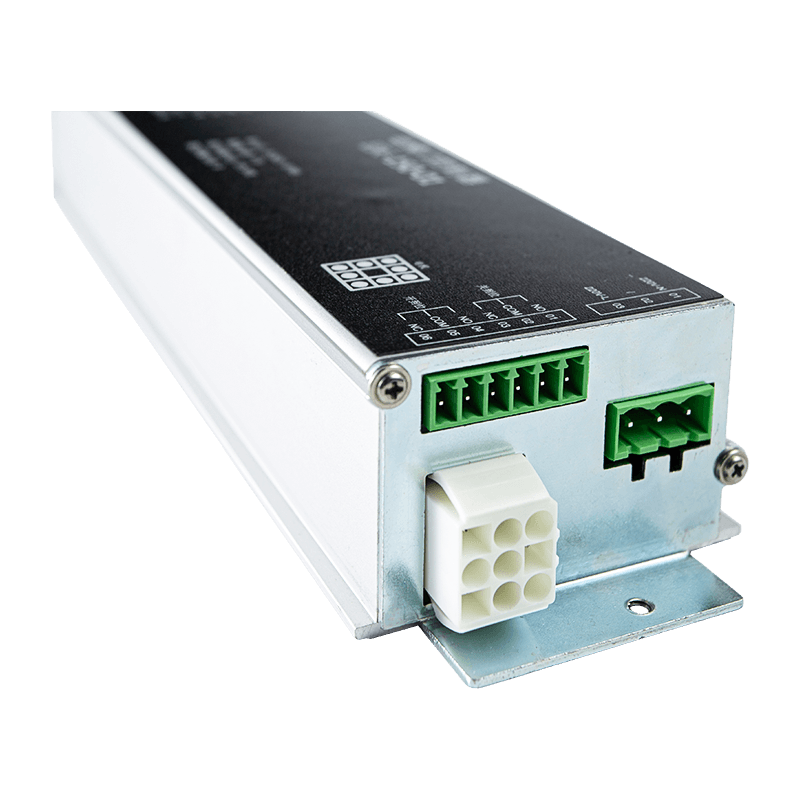
The product accepts an input voltage of 176–264 VAC at 50/60 Hz. It includes a 24 V power switch and is designed to control a 24 V DC brushless motor or servo motor. Its maximum output current is 7.5 A, while its maximum output power is 150 W. This rating makes it appropriate for a broad range of compact and medium-duty automated machine doors.
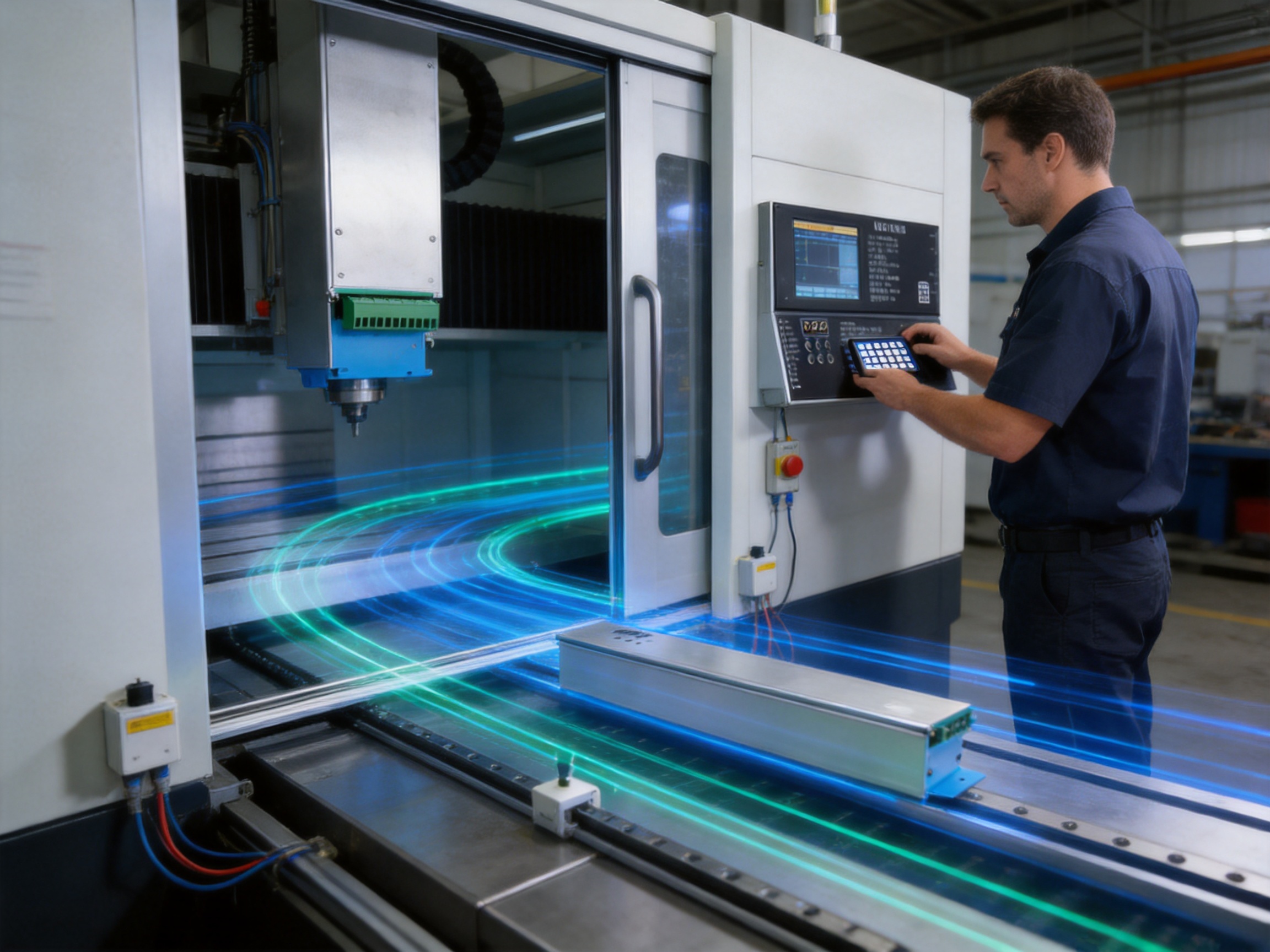
The controller has a compact profile of 261 x 64 x 41 mm. The elongated, narrow form factor can simplify installation inside machine cabinets, side compartments, electrical panels, or door-control enclosures where available space is limited. A compact controller can also help machine builders reduce cabinet volume and maintain a cleaner wiring layout.
RS-485 communication networking is integrated into the controller. This provides a practical foundation for connecting the door controller to other industrial devices, a machine control system, or a local communication network. Depending on the control architecture, RS-485 can be used for parameter management, status monitoring, commissioning support, and the exchange of operating information.
One-Key Debugging and Faster Commissioning
Commissioning an automated machine door can be time-consuming if every movement limit, motor angle, and speed profile must be entered manually. The AIG-150S-02 includes an “A-c” self-learning function intended to simplify this process. With one-key debugging, the controller can automatically measure the door travel and identify the initial angle of the motor.
This feature offers several advantages to machine builders and maintenance teams. First, it reduces the amount of manual measurement required during installation. Second, it helps accommodate differences between individual machines or door assemblies. Third, it reduces the possibility of errors caused by incorrect travel parameters or motor-angle settings.
Self-learning does not eliminate the need for proper mechanical installation and safety verification. The door tracks, transmission components, encoder wiring, and safety circuits must still be installed correctly. However, automatic learning can make the electrical commissioning process more efficient and repeatable.
For equipment manufacturers producing multiple machine models, a self-learning procedure can also support standardized commissioning instructions. Technicians can use a consistent process even when door travel distances or motor installation conditions vary. This may reduce training requirements and shorten the time from mechanical assembly to final machine testing.
Compared with controllers that depend primarily on fixed factory settings, the AIG-150S-02 provides a more adaptable commissioning approach. It is not limited to one predetermined door size or a single mechanical arrangement. The controller can be configured to suit the actual door system installed on the machine.
Digital Keypad for Practical Industrial Adjustment
The controller includes a digital keypad that allows users to switch operating modes, monitor real-time information, and modify functional parameters. This local interface is important in industrial environments because technicians often need to adjust or diagnose a door directly at the machine.
During setup, the keypad can be used to review operating data such as speed and current. These values can help technicians understand whether the door is moving within the expected range and whether the motor is experiencing excessive load. Parameter adjustment can be carried out without relying exclusively on an external computer or a separate programming device.
A local keypad is also useful during service. If a door begins to move more slowly, produces abnormal resistance, or fails to reach its programmed position, maintenance personnel can examine relevant parameters and fault information at the controller. This can reduce troubleshooting time and help distinguish between electrical, mechanical, encoder, and control-related problems.
The keypad-based interface supports a more transparent control process than a sealed motor driver with no local display. Operators and service engineers can obtain meaningful information from the controller instead of treating it as an inaccessible black box. This is especially useful for machine builders that want to provide clear commissioning and maintenance procedures to end users.
Multi-Level Opening and Closing Curves
Machine doors do not necessarily need to move at one constant speed from the beginning to the end of travel. A rapid movement may be desirable across the main part of the travel, while a slower movement is preferable near the fully open or fully closed position. The AIG-150S-02 supports four distinct speed levels, identified as Lv1 through Lv4, for both opening and closing groups.
Each level can be customized through parameters related to acceleration, deceleration, jerk, and cushion distance. This enables the machine builder to create a movement profile suited to the door’s structure and the production process.
Acceleration determines how quickly the door reaches its operating speed. Controlled acceleration can reduce sudden mechanical loading and help prevent the door from shaking at startup. Deceleration determines how the door slows before reaching its target position. Appropriate deceleration can reduce impact, noise, and stress on the guide and transmission system.
Jerk settings influence the smoothness of the transition between acceleration, constant-speed movement, and deceleration. Excessive changes in acceleration can create vibration or an uncomfortable movement sensation. By adjusting the relevant curve parameters, the designer can achieve a more controlled and refined door motion.
Cushion distance defines the area in which the door approaches its final position more gently. This is useful for reducing impact at the end of travel and improving positioning consistency. It can also help protect mechanical components such as stops, belts, gears, rollers, and guide rails.
The ability to configure multiple opening and closing levels is a notable advantage over basic controllers that use only one fixed speed profile. Opening and closing often have different mechanical and operational requirements. For example, the door may open quickly to improve access to the machining area but close more cautiously to improve safety and reduce noise. Separate configurable groups allow these requirements to be addressed independently.
Configurable Input and Output Functions
Industrial door control depends on more than motor commands. The controller must receive signals from the machine and communicate important conditions back to the machine control system. The AIG-150S-02 provides configurable input and relay-output functions for this purpose.
The input signals include open, close, anti-pinch or fire, arrival, and motor overheat protection functions. These inputs allow external equipment to influence door operation and provide information about the machine’s condition.
An open command can initiate the door-opening sequence, while a close command can initiate closing. Arrival or limit-related signals can help coordinate the door with the machine’s position or operating sequence. Anti-pinch and fire-related inputs can be connected to safety or emergency logic according to the application design.
Motor overheat protection can be connected through the available protection input. The product information identifies DI6 or DI5 as possible inputs for motor thermal protection. This makes it possible to integrate a thermal switch or equivalent motor-protection signal into the controller’s operating logic.
Three relay outputs are available. They can be programmed for 15 different functions, including open-position indication, close-position indication, and controller-error indication. These relay outputs allow the door controller to report its state to a PLC, machine controller, indicator circuit, safety relay, or other industrial equipment.
Position feedback is important for process coordination. A machine may need confirmation that the door is fully open before loading begins or confirmation that it is fully closed before spindle operation is permitted. Error feedback is equally important because it allows the machine system to respond appropriately if the door controller detects an abnormal condition.
Because the relay outputs are programmable, machine builders have more flexibility than they would with fixed-purpose contacts. The same controller can be adapted to different machine-control sequences without requiring a different hardware model for every application.
Safety-Oriented Motor and Door Protection
Automated doors must be designed with safety as a primary consideration. The controller cannot replace a complete machine safety system, physical guarding, risk assessment, or applicable safety devices. However, it can provide important protective functions that support a safer and more reliable door assembly.
The AIG-150S-02 includes programmable anti-pinch logic with dead zones and stall detection times. A dead zone can help define a region or condition in which the controller should interpret movement behavior differently, while stall detection identifies a situation in which the motor is energized but the expected movement does not occur.
These functions can help reduce the risk of continued motor force when the door encounters an obstruction. They can also assist in identifying mechanical problems such as a blocked guide rail, excessive friction, a damaged transmission component, or a door that has moved outside its expected operating condition.
Stall detection must be configured in accordance with the door’s mechanical characteristics. If the detection time is too short, normal acceleration or temporary resistance could be interpreted as a fault. If it is too long, the system may continue applying force for longer than desired. The controller’s adjustable parameters allow the machine builder to set a suitable response during commissioning.
The controller also provides protection against overvoltage, undervoltage, motor stalling, and reverse rotation. These protections help safeguard the motor and control electronics while supporting more dependable operation under abnormal conditions.
Induced lightning surge protection is included as part of the electrical guarding functions. Industrial installations can experience transient disturbances caused by switching equipment, long cable runs, or external electrical events. Surge protection helps improve the controller’s resilience, although the final installation should still use suitable grounding, shielding, circuit protection, and cabinet design.
Motor thermal protection can be integrated through the designated digital input. This is important because repeated door cycles, excessive mechanical load, poor ventilation, or an unsuitable motor can produce overheating. Connecting the motor’s thermal protection device to the controller gives the system a means of responding to an overtemperature condition.
Encoder Feedback and Prevention of Uncontrolled Movement
One of the most important distinctions between the AIG-150S-02 and a simple open-loop driver is its use of encoder feedback. The controller is designed to work with shielded encoder cables, helping protect feedback signals from electrical interference generated by motors, switching devices, and industrial machinery.
Accurate feedback supports reliable door positioning. It also helps the controller recognize whether the motor is moving as commanded. If the expected position change does not occur, the system can identify a potential encoder fault, stall, or mechanical problem rather than continuing blindly.
Closed-loop control can also help prevent runaway motor behavior. In an open-loop system, the controller may continue to issue a movement command even if the motor has lost synchronization with the door mechanism. With feedback, the controller has more information with which to detect an abnormal relationship between commanded movement and actual movement.
Encoder wiring should be installed according to good industrial practice. Shielding, separation from high-power cables, appropriate grounding, and secure connectors are important for reliable signal transmission. The controller’s closed-loop architecture provides the control capability, while the quality of the installation determines how effectively that capability is realized in the field.
Compared with controllers that rely only on timing or limit switches, encoder-based control offers more detailed operational information. This can improve positioning, support diagnostic functions, and help maintenance teams identify developing faults before they become major failures.
Real-Time Monitoring and Fault Diagnostics
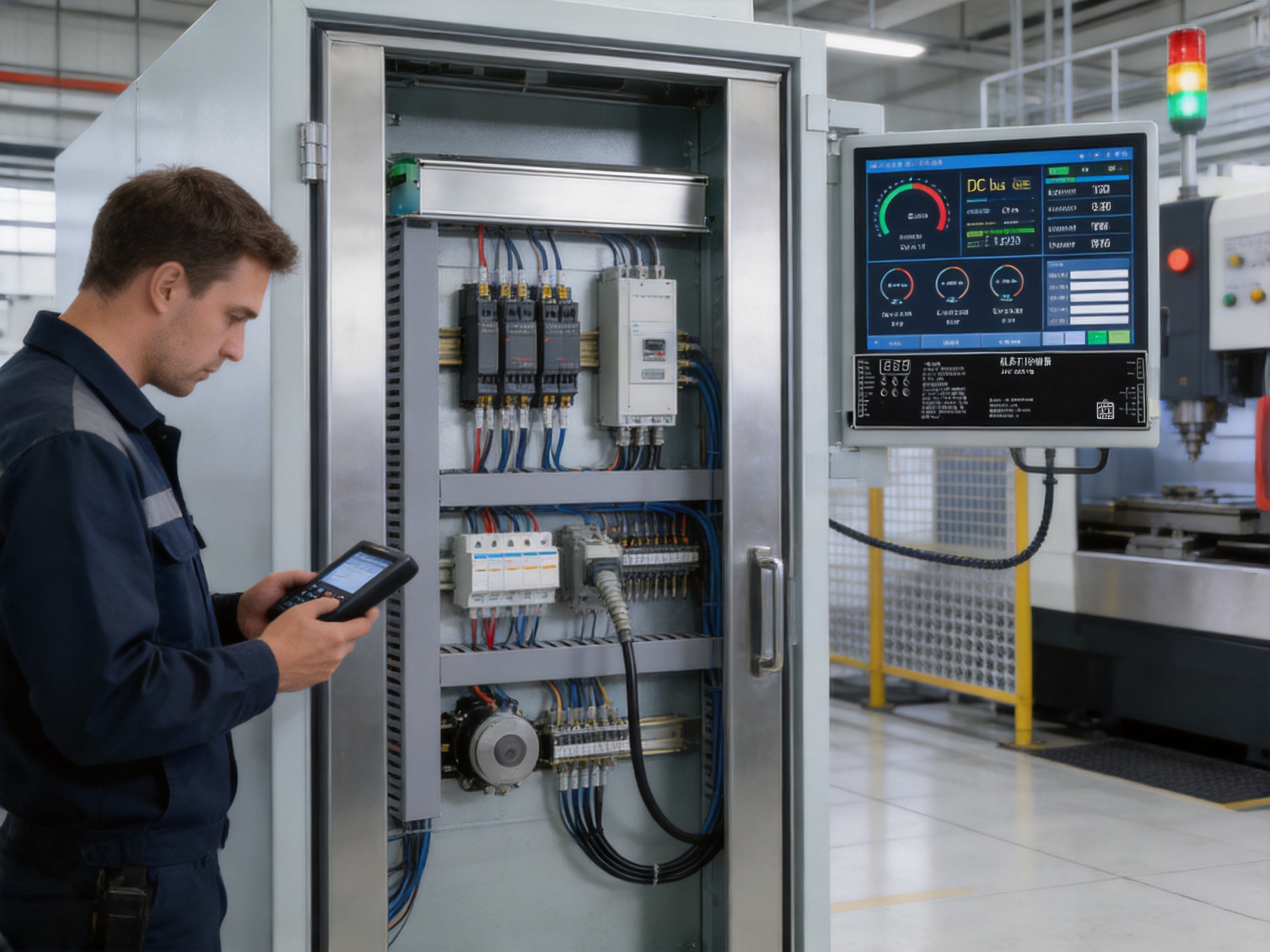
The AIG-150S-02 monitors a range of technical data through its parameter system. The available N parameters include DC bus voltage, current encoder position, total run time, and door cycle counts. Cycle counting can extend to millions of operations, providing a useful indication of equipment utilization and service history.
DC bus voltage monitoring can help technicians assess whether the controller is receiving an appropriate electrical supply and whether abnormal voltage conditions may be contributing to a fault. Current encoder position provides information about where the motor or door is located within its travel. Total run time and cycle counts can support preventive maintenance planning.
Cycle data is especially useful in production environments where doors operate continuously. A maintenance team may establish inspection intervals based on the number of cycles rather than relying only on calendar time. For example, guide rails, belts, rollers, and fasteners can be checked after a defined operating count.
The controller stores the latest four faults to support troubleshooting. Examples include E-01 for overcurrent and E-02 for encoder failure. Retaining recent fault information is valuable because an intermittent problem may not be present when a technician arrives at the machine.
Fault history can help determine whether a problem is isolated or recurring. Repeated overcurrent faults may suggest increased mechanical friction, an overloaded door, incorrect acceleration settings, or a motor issue. Repeated encoder faults may point toward damaged cable shielding, loose connections, electrical interference, or a feedback-device problem.
Diagnostic information can reduce mean time to repair because maintenance personnel have a starting point for investigation. Rather than replacing components through trial and error, they can examine the stored fault code, review the operating conditions, and test the most likely causes.
Compared with basic door controllers that provide only a general alarm output, the AIG-150S-02 offers more useful operational visibility. The combination of live parameters, stored faults, position data, voltage monitoring, and cycle counting makes it more suitable for data-oriented industrial maintenance.
Advantages Over Basic and Less Flexible Controllers
The AIG-150S-02 has several technical advantages over conventional fixed-function motor controllers. These advantages are most apparent when the product is evaluated as a complete door-control platform rather than as a standalone power stage.
First, full closed-loop space vector PWM provides more precise control than simple open-loop switching. This supports smoother movement, improved positioning, and better response to changes in load or mechanical resistance.
Second, the self-learning function reduces commissioning effort. A controller that can measure door travel and identify the motor’s initial angle can be adapted more easily to different machine designs than one that depends entirely on manual parameter entry.
Third, four configurable speed levels for both opening and closing provide greater control over the door’s movement profile. This allows machine builders to balance speed, smoothness, noise, safety, and mechanical durability.
Fourth, the digital keypad provides local access to data and parameters. This can reduce dependence on external programming tools and make service work more practical at the machine.
Fifth, configurable relay outputs and multiple input functions allow the controller to integrate with different machine-control architectures. This flexibility can reduce the need for additional interface modules.
Sixth, real-time monitoring and four-fault memory provide more useful diagnostic information than a simple fault lamp or unclassified alarm. Maintenance teams can use the available data to support faster troubleshooting and planned service.
Seventh, the compact 261 x 64 x 41 mm housing helps machine designers save panel space. Space efficiency is increasingly important as modern machines integrate more sensors, drives, communications equipment, and safety components.
Finally, the product combines motor control, positioning support, safety-related input logic, diagnostics, and communication in one controller. This integrated design can simplify system architecture and reduce the number of separate components that must be selected, wired, and maintained.
Manufacturing and Product Development Strengths
The product is supplied by ASY Electronics (JiaXing) Co., Ltd., a high-tech enterprise focused on smart-factory technologies, data sensing, intelligent connectivity, and industrial equipment integration. The company’s product portfolio includes broadband power line carriers, wireless temperature monitoring systems, transmitters, thermal gas mass flow meters, and automatic door controllers.
This portfolio provides a relevant industrial context for the AIG-150S-02. The controller is not an isolated consumer product; it belongs to a broader range of industrial hardware designed to connect physical equipment with monitoring, control, and production-management systems.
The company’s stated focus on self-developed edge-layer hardware is important for machine builders. Edge-layer products operate close to industrial equipment, where stable signal acquisition, deterministic control, electrical robustness, and practical installation are essential. A door controller is a typical edge device because it directly connects a motor, encoder, safety signals, machine commands, and status outputs.
Advanced manufacturing for this type of product begins with translating application requirements into a controlled hardware and firmware architecture. The controller must support the specified voltage range, motor output, feedback signals, protection logic, communication interface, keypad functions, and relay outputs within a compact enclosure. Each of these functions must work together without creating unacceptable electrical interference or thermal stress.
A disciplined product-development process should include electrical design review, motor-control verification, interface testing, parameter validation, and protection-function testing. For a machine-door controller, testing should cover normal opening and closing, repeated cycling, acceleration and deceleration transitions, encoder feedback, limit behavior, obstruction response, overcurrent response, voltage abnormalities, and fault reporting.
The product’s combination of closed-loop control, self-learning, diagnostics, and configurable interfaces indicates an emphasis on application-oriented engineering. Instead of designing only for a nominal motor output, the controller is organized around the complete door-control task, including commissioning and maintenance.
Compact industrial electronics also require attention to assembly consistency. Electrical connections, terminal quality, keypad operation, relay switching, encoder interfaces, and enclosure dimensions must remain consistent across production units. Consistency is particularly important when a machine manufacturer installs the same controller across many machines and expects the commissioning procedure to be repeatable.
Another manufacturing strength is the ability to support customization at the functional level. The controller already provides multiple configurable inputs, relay functions, speed profiles, and parameters. This makes it possible to adapt the product to specialized machine doors without necessarily creating a completely new hardware platform for every application.
Because ASY Electronics also develops communication and industrial monitoring products, it can approach door control as part of a larger equipment-data environment. The RS-485 interface and monitoring parameters can support integration with broader industrial systems, while the local controller continues to perform the immediate motor-control task.
For international machine builders, supplier capability is not determined only by the circuit design. It also includes product documentation, technical support, configuration assistance, application understanding, and the ability to respond to customized requirements. ASY Electronics is positioned as an industrial technology provider rather than only a component reseller, which can be valuable when the controller must be adapted to a particular machine platform.
Application Suitability
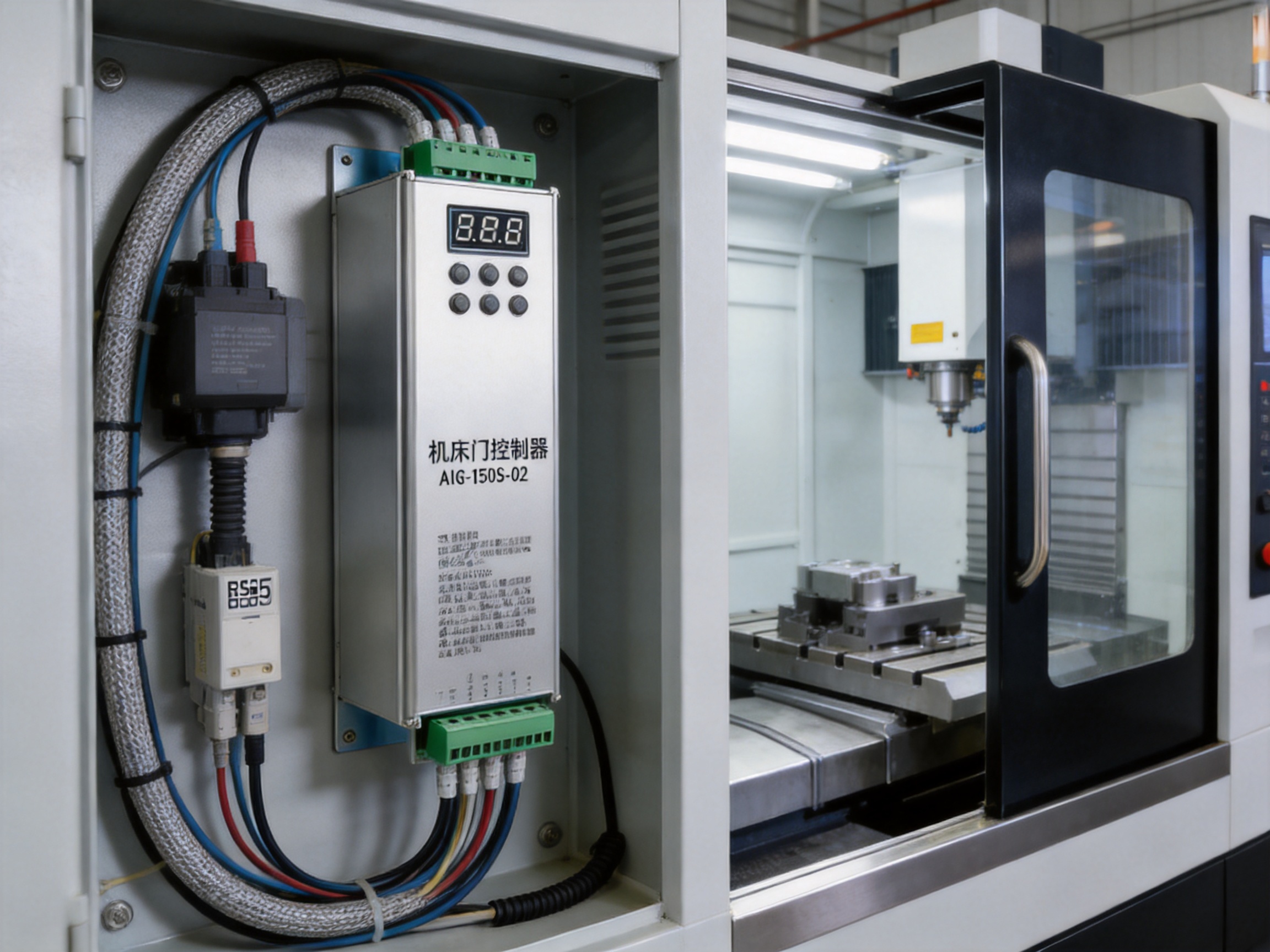
The primary application for the AIG-150S-02 is the automated door of a machine tool. This includes doors used on machining centers, production machines, enclosed processing equipment, and other industrial systems where controlled access is required.
The controller is also suitable for specially customized functional doors. These may include doors with nonstandard travel distances, unique opening and closing sequences, customized safety interlocks, or special communication requirements. The available speed curves, inputs, outputs, and parameters provide a foundation for adapting the controller to such systems.
In a machining center, the controller can coordinate door opening and closing with the loading, unloading, and machining sequence. A fully open signal can be used to confirm that the operator or loading device has access to the work area. A fully closed signal can be used as a permissive condition before the machine begins a hazardous operation.
In a production line, door-cycle information can contribute to equipment utilization data. Cycle counts may help identify how frequently a station is being accessed and whether door movement is affecting takt time. Fault history can also help maintenance teams identify stations with abnormal mechanical wear.
For customized industrial enclosures, the controller’s programmable acceleration, deceleration, and cushion distance can help address different door weights and transmission mechanisms. The correct configuration must always be determined through application testing and a formal safety evaluation.
Recommended Integration Approach
Successful implementation begins with defining the door’s mechanical and electrical requirements. The machine builder should identify the motor type, rated voltage, maximum current, encoder characteristics, door travel distance, maximum load, desired cycle time, and expected operating frequency.
The mechanical assembly should be inspected before electrical commissioning. Guide rails must be aligned, transmission components must move freely, and door stops must be positioned correctly. A closed-loop controller can regulate the motor accurately, but it cannot compensate indefinitely for a misaligned or damaged mechanical system.
Encoder cables should be shielded and routed separately from high-current motor conductors where practical. The cabinet should include suitable grounding and protection arrangements. Input and output wiring should be labeled clearly so that open, close, anti-pinch, fire, arrival, thermal protection, and relay signals can be verified individually.
After installation, technicians can use the one-key self-learning procedure to measure travel and identify the motor’s initial angle. The door should then be tested at low-risk settings before the final speed, acceleration, deceleration, jerk, and cushion parameters are selected.
Opening and closing profiles should be evaluated separately. The appropriate settings depend on door weight, transmission design, required access time, noise limits, and safety requirements. The anti-pinch dead zone and stall detection time should be configured based on actual mechanical behavior and validated through controlled testing.
All protection functions should be tested during commissioning. This includes overcurrent response, encoder failure detection, stall detection, reverse rotation protection, overvoltage and undervoltage behavior, motor thermal input response, and relay fault indication. Testing should be performed by qualified personnel using procedures appropriate to the complete machine.
Finally, the machine builder should document the final parameter set, wiring diagram, motor information, fault codes, maintenance intervals, and safety verification results. This documentation will help future service personnel maintain consistent operation and identify changes from the original commissioning condition.
Technical Specification Summary
Product model |
AIG-150S-02 |
Application |
Automated machine tool doors and specially customized functional doors |
Controller type |
DC brushless controller with full closed-loop space vector PWM control |
Input voltage |
176–264 VAC, 50/60 Hz |
Compatible motor |
24 V DC brushless motor or servo motor |
Maximum output current |
7.5 A |
Maximum output power |
150 W |
Communication |
RS-485 communication networking function |
Dimensions |
261 x 64 x 41 mm |
Input functions |
Open, close, anti-pinch/fire, arrival, and motor overheat protection |
Relay outputs |
Open position, close position, error, and other programmable functions |
Relay function capacity |
Three relays with up to 15 programmable functions |
Operating profiles |
Four speed levels for opening and four speed levels for closing |
Monitoring data |
DC bus voltage, encoder position, total run time, and door cycle count |
Fault memory |
Latest four faults |
Maintenance and Lifecycle Benefits
A machine-door controller should be evaluated over its entire service life, not only by its initial purchase price. Maintenance time, replacement complexity, commissioning effort, and the consequences of unexpected stoppages can have a significant effect on the total cost of ownership.
The AIG-150S-02 supports lifecycle management through cycle counting and total run-time monitoring. These parameters can help maintenance teams move from reactive repair toward preventive inspection. When cycle counts approach a planned service threshold, the door mechanism can be inspected before a failure affects production.
Stored faults can also reduce diagnostic labor. A technician can examine recent overcurrent, encoder, or other fault conditions and compare them with the door’s mechanical state. This approach is more efficient than repeatedly resetting the system without identifying the underlying cause.
The adjustable profiles can contribute to longer mechanical life when correctly configured. Smooth acceleration and deceleration reduce sudden force changes, while suitable cushion distances can reduce impact at the end of travel. These benefits depend on correct setup, but the controller provides the necessary adjustment range.
Integrated functions may also reduce the number of external components. When the controller includes motor control, local parameter access, relay outputs, monitoring, fault storage, and RS-485 communication, the machine builder may need fewer separate interface devices. Fewer components can mean less wiring, fewer potential connection points, and a simpler service inventory.
Selection Considerations for Machine Builders
Before selecting the AIG-150S-02, the machine builder should confirm that the motor and door load remain within the controller’s 24 V, 7.5 A, and 150 W limits. The motor’s continuous and peak operating requirements should be reviewed, especially if the door is heavy or operates at a high cycle frequency.
The encoder arrangement should also be verified. Closed-loop control depends on compatible feedback signals and correctly installed encoder wiring. If the motor or encoder has unusual electrical characteristics, technical confirmation should be obtained before final integration.
The machine builder should define the required input and output sequence. The controller supports open, close, anti-pinch/fire, arrival, and motor-overheat-related inputs, as well as three programmable relay outputs. The intended use of each signal should be documented in the machine’s electrical drawings and control logic.
RS-485 integration requirements should be considered early. The system designer should identify whether the network will be used for status monitoring, parameter management, production coordination, or another function. Proper communication addressing, cable routing, grounding, and protocol configuration should be established during system design.
Finally, the complete door assembly must undergo a risk assessment. The controller’s anti-pinch and stall functions are valuable protective features, but they should be combined with suitable physical safeguards, emergency-stop arrangements, safety interlocks, and other measures required by the application and applicable regulations.
Frequently Asked Questions
What type of motor does the AIG-150S-02 control?
The controller is designed for a 24 V DC brushless motor or servo motor. Its maximum output current is 7.5 A, and its maximum output power is 150 W. Motor compatibility should be confirmed against the complete motor and encoder specifications before installation.
What is the main benefit of closed-loop control for a machine tool door?
Closed-loop control uses encoder feedback to monitor actual motor movement and position. This supports more accurate positioning, smoother control, and improved detection of conditions such as encoder failure, stalling, reverse rotation, and unexpected movement.
How does the one-key self-learning function work?
The “A-c” self-learning function automatically measures door travel and identifies the motor’s initial angle. It is intended to simplify commissioning and reduce manual parameter entry. Mechanical alignment, wiring verification, and safety testing are still required.
Can opening and closing use different speed settings?
Yes. The controller supports four speed levels for opening and four speed levels for closing. Acceleration, deceleration, jerk, and cushion-distance parameters can be customized for the relevant operating group.
What information can be monitored through the controller?
Available monitoring information includes DC bus voltage, current encoder position, total run time, and door cycle counts. These values can assist commissioning, maintenance planning, and operating analysis.
How many faults can the controller store?
The controller stores the latest four faults. Examples provided for the product include E-01 for overcurrent and E-02 for encoder failure. Fault history can help technicians investigate intermittent or recurring problems.
Does the controller support communication with other industrial equipment?
Yes. The AIG-150S-02 includes an RS-485 communication networking function. The exact communication arrangement should be defined during system integration according to the machine’s control and monitoring requirements.
What input signals are available?
The listed input signals include open, close, anti-pinch/fire, arrival, and motor overheat protection. These inputs allow the controller to interact with machine commands, safety-related conditions, position information, and motor thermal protection.
What relay outputs are available?
The controller includes three programmable relays. They can provide open-position, close-position, error, and other functions selected from a range of up to 15 programmable functions.
Is the controller suitable for doors other than machine tool doors?
Its stated application range includes machine tool doors and specially customized functional doors. Other applications may be possible when the motor rating, mechanical requirements, safety functions, and control sequence are compatible, but each alternative application should be evaluated separately.
Why is shielded encoder wiring important?
Shielded encoder cables help protect feedback signals from electrical interference generated by motors, switching circuits, and industrial equipment. Correct cable routing, grounding, and installation practices are also important for reliable closed-loop operation.
Can the controller replace a complete machine safety system?
No. The controller provides anti-pinch logic, stall detection, fault protection, and related control functions, but it does not replace a complete machine risk assessment, physical guarding, emergency-stop system, safety interlocks, or other measures required for the specific machine.
Conclusion
The AIG-150S-02 is a purpose-built controller for machine tool doors that combines precision motor control with practical industrial integration features. Its full closed-loop space vector PWM architecture provides a stronger technical foundation than basic open-loop door drivers, while encoder feedback supports positioning, fault detection, and controlled movement.
The controller’s one-key self-learning function can simplify commissioning, and its digital keypad provides direct access to operating modes, real-time values, and functional parameters. Four configurable speed levels for opening and closing allow machine builders to create profiles that balance production speed, smoothness, noise, safety, and mechanical durability.
Its configurable inputs and relay outputs make it easier to coordinate the door with a machine control system. RS-485 communication supports connection to broader industrial equipment, while monitoring functions such as DC bus voltage, encoder position, total run time, and cycle count improve equipment visibility.
Safety-oriented functions include anti-pinch logic, stall detection, overvoltage and undervoltage protection, motor thermal protection, reverse-rotation protection, induced lightning surge protection, and fault memory. These functions do not replace a complete safety design, but they provide useful layers of protection and diagnostic support within the door-control system.
The compact dimensions, 24 V motor compatibility, 7.5 A maximum output current, and 150 W maximum output power make the controller suitable for a broad range of automated machine doors. Supported by ASY Electronics’ wider experience in industrial connectivity, sensing, transmitters, flow measurement, and automatic equipment control, the AIG-150S-02 offers machine builders an integrated platform for reliable, configurable, and maintainable door automation.
References
1. AIG-150S-02 Product Description and Performance Specification, ASY Electronics (JiaXing) Co., Ltd.
2. Industrial Motor Control Engineering Principles: Closed-Loop Feedback, Encoder Applications, and PWM-Based Drive Systems.
3. Machine Tool Automation Design Practices: Door Interlocking, Motion Profiles, Commissioning, and Preventive Maintenance.
4. Industrial Electrical Installation Guidelines: Shielded Signal Cables, Grounding, Surge Protection, and Control Cabinet Design.
5. General Principles of Industrial Functional Safety: Risk Assessment, Guarding, Emergency Stop Design, and Safety Interlock Integration.